Dental Tooth Preparation Essentials
Tooth Anatomy
The Layers of a Tooth
At a glance, a tooth seems like a simple, solid structure. But it's actually composed of several distinct layers, each with a specific job. Think of it like a piece of fruit: there’s a hard outer skin, a softer fleshy part, and a core. A tooth is organized in a similar way, with two main parts: the crown (the part you see) and the root (the part anchored in your jawbone).
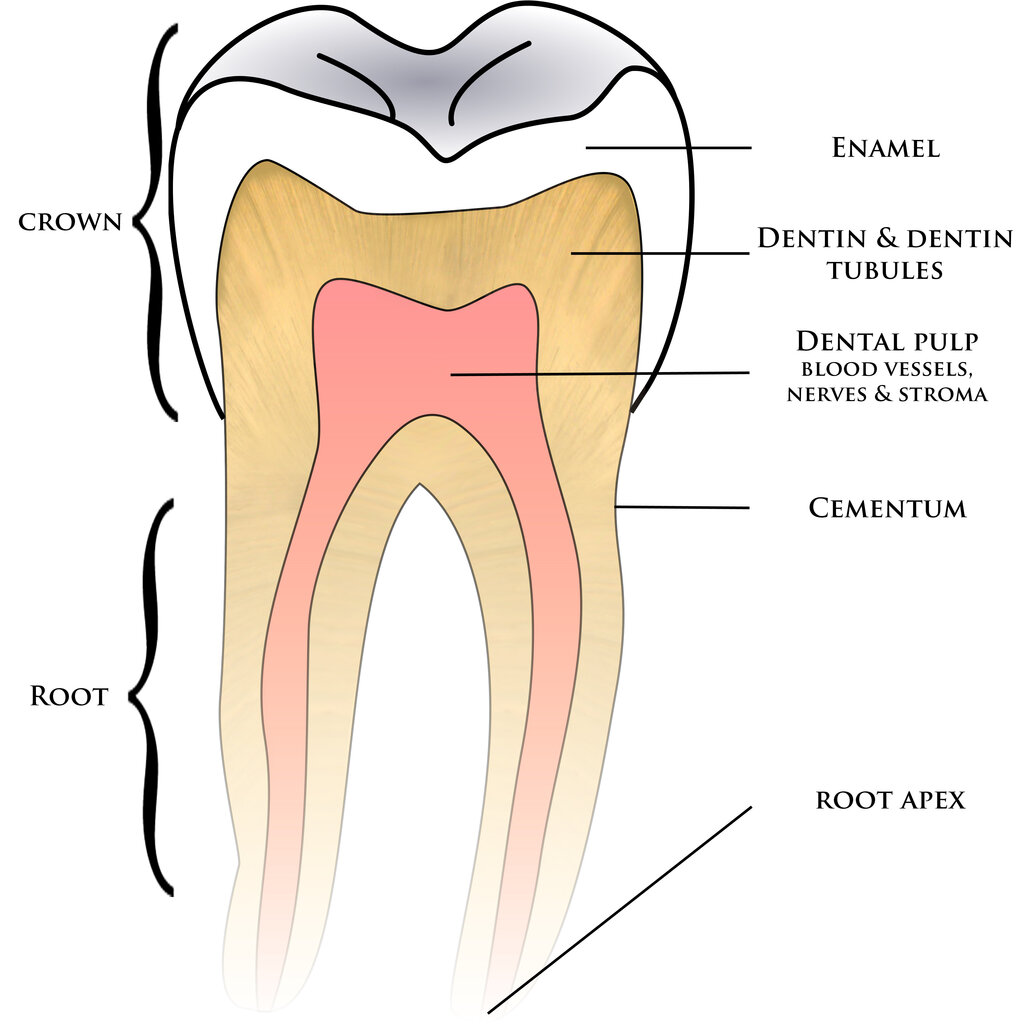
Let’s break down the four main tissues that make up a tooth, starting from the outside and working our way in.
Enamel
noun
The hard, protective outer layer of the tooth crown.
Enamel is the white, visible part of the tooth. It’s the hardest substance in the human body, even tougher than bone. Its main purpose is to protect the sensitive inner layers from the wear and tear of chewing, as well as from temperature changes and acids from food and drink.
Dentin
noun
The hard, dense, bony tissue forming the bulk of a tooth, beneath the enamel.
Directly beneath the enamel is the dentin. It’s a yellowish, bone-like material that makes up most of the tooth's structure. While it's quite hard, it's softer than enamel. Dentin is filled with microscopic tubules that lead directly to the tooth's core. This is why if your enamel is damaged, you might feel sensitivity or pain—the pathways to the nerve are exposed.
Pulp
noun
The soft inner part of a tooth, containing nerves and blood vessels.
At the very center of the tooth is the pulp. This is the tooth’s living core. It’s a soft tissue made up of nerves, blood vessels, and connective tissue. The pulp is responsible for forming dentin, and it's what provides sensation to the tooth, signaling pain when something is wrong, like decay reaching the tooth's center.
Cementum
noun
A layer of bone-like tissue covering the root of a tooth.
The final layer is cementum, which covers the root of the tooth. It's not as hard as enamel but is crucial for anchoring the tooth in the jaw. It works with the periodontal ligament, a system of connective tissue fibers, to hold the tooth firmly in its socket.
The Four Types of Teeth
Your mouth isn't filled with 32 identical teeth. Instead, you have four different types, each shaped to perform a specific task in the process of eating. This specialization makes your mouth an incredibly efficient food-processing machine.
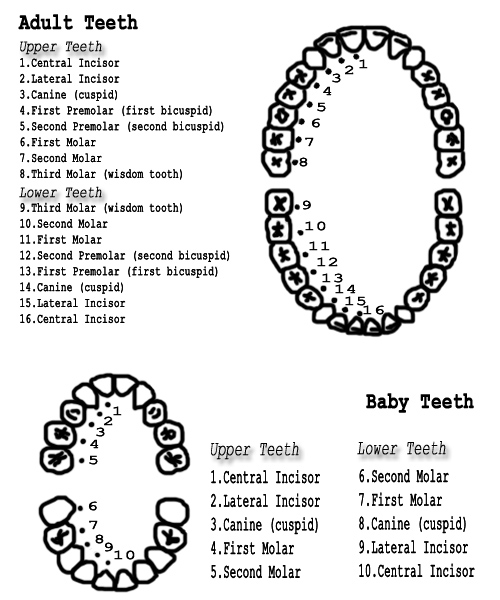
Each type of tooth plays a role, from the initial bite to the final grind.
| Tooth Type | Number (in adults) | Primary Function |
|---|---|---|
| Incisors | 8 | Biting and cutting |
| Canines | 4 | Tearing and gripping |
| Premolars | 8 | Crushing and grinding |
| Molars | 12 | Grinding and chewing |
Incisors are the eight teeth at the very front of your mouth, four on top and four on the bottom. Their sharp, chisel-like edges are perfect for biting into food. They are also the most visible teeth, playing a key role in your smile.
Canines are the four pointed teeth located next to the incisors. Sometimes called cuspids or eyeteeth, their sharp tips are designed for gripping and tearing tough foods, like meat.
Premolars, or bicuspids, are found just behind your canines. You have eight of them in total. With their flat chewing surfaces, premolars are responsible for crushing and grinding food into smaller pieces.
Molars are your largest and strongest teeth, located in the back of your mouth. Adults typically have twelve, including four wisdom teeth. Their broad, ridged surfaces are ideal for the heavy-duty work of chewing and grinding food before it’s swallowed.
Together, these different teeth work in sequence. The incisors and canines start the process by cutting and tearing, and the premolars and molars take over to complete the job. This teamwork ensures food is properly broken down for digestion, and it all starts with understanding the unique role of each tooth.
Ready to check your understanding?