Demystifying Scientific Papers
Scientific Paper Structure
The Blueprint of a Paper
Scientific papers can feel intimidating. They're dense with information, specialized vocabulary, and complex ideas. But once you understand their underlying structure, they become much easier to navigate. Most research articles aren't written as a free-flowing story; they follow a specific, logical formula.
Most academic research papers follow a standard framework, often summarized as IMRaD: Introduction, Methods, Results, and Discussion.
This structure, IMRAD, acts like a road map. It helps you know exactly where to look for specific information. Before we break down the IMRAD sections, it's important to mention two other parts you'll always see: the title and the abstract.
Abstract
noun
A short, self-contained summary of the most important points of a paper. It briefly touches on the background, methods, results, and conclusions.
The abstract gives you a high-level overview in about 250 words. After reading it, you'll know the main story of the research. Then, you dive into the core of the paper.
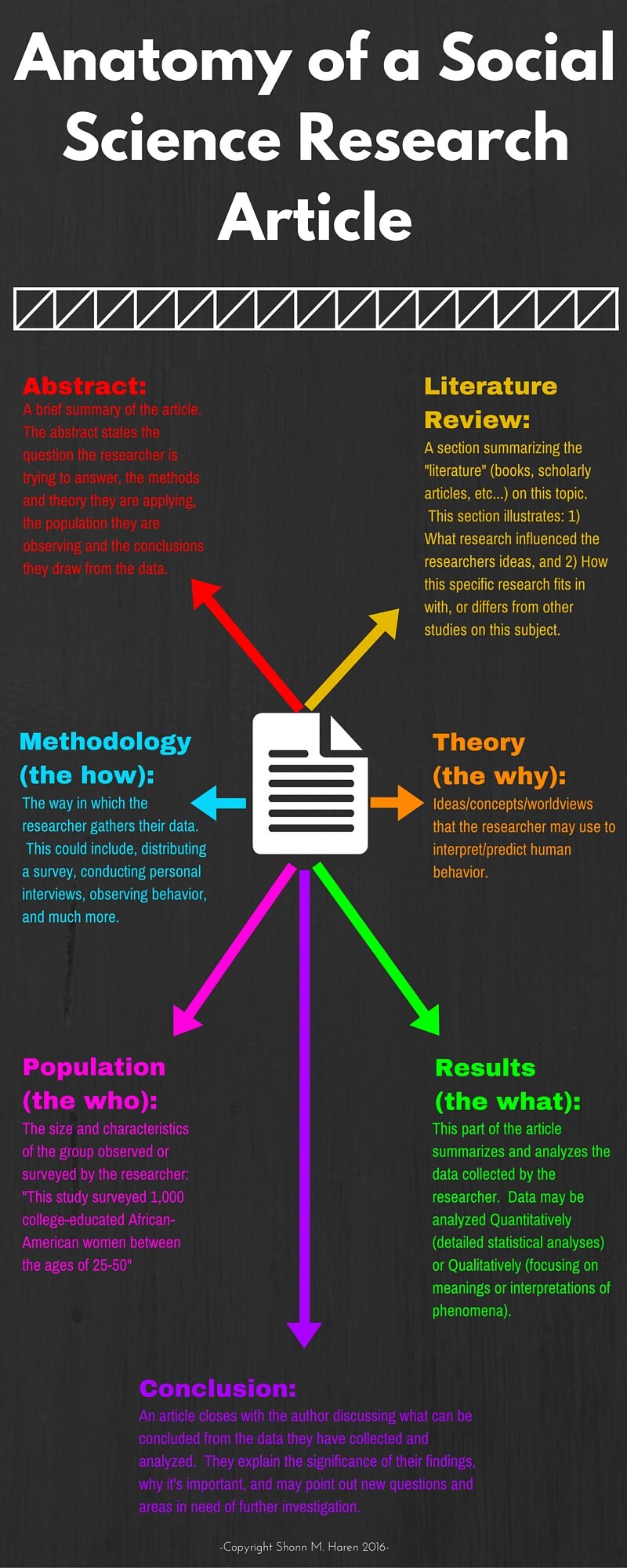
The IMRAD Sections
Each part of the IMRAD structure answers a different question, guiding you through the research process step by step.
Introduction: This section sets the stage. It explains the background of the research topic, highlighting what is already known and pointing out a gap in that knowledge. It ends by stating the research question, the study's purpose, and often the specific hypothesis the authors are testing.
Think of the introduction as the "why." Why did the researchers do this study? Why is it important?
Methods: This is the technical part of the paper. It provides a detailed description of how the study was performed. The goal is to give enough information so that another scientist could, in theory, replicate the experiment. It covers the materials used, the subjects or participants, the procedures followed, and the statistical tests used to analyze the data.
Results: Here, the authors present their findings without any interpretation. This section is all about the data. It's often filled with tables, graphs, and figures that display the outcomes of the experiments. The text in this section simply describes these findings in a direct, factual way. For example, it might say, "Group A showed a 20% increase, while Group B showed a 5% decrease."
The Results section is the "what." What did the data show?
Discussion: This is where the authors interpret the results. They explain what their findings mean in the broader context of the field. They will connect their results back to the original question from the introduction, explain how their findings support or contradict previous research, and discuss the limitations of their study. This section often ends with suggestions for future research.
Using the Structure
Understanding the IMRAD format allows you to read more efficiently. You don't have to read a paper from start to finish.
For example, if you just want to know what the researchers discovered, you can jump straight to the Results section. If you're curious about how they conducted their experiment, the Methods section is the place to go. And if you want to understand the significance of the work, the Introduction and Discussion are your best bets.
This structure turns a daunting document into a navigable resource, empowering you to find the information you need quickly.
What does the acronym IMRAD stand for in the context of a scientific paper?
If you want to understand exactly how a study was conducted, with enough detail to potentially replicate it, which section should you read?