Demystifying Scientific Literature
Scientific Method
A Framework for Asking Questions
Science isn't just a collection of facts; it's a way of thinking. At the heart of this thinking is the scientific method, a structured process for exploring the world and answering questions. It’s a systematic way to move from a casual observation to a supported conclusion. Think of it as a recipe for discovery, one that helps ensure the results are as reliable and unbiased as possible.
At its essence, the scientific method is a systematic procedure that researchers use to explore observations, answer questions, and test hypotheses.
This method isn't just for scientists in lab coats. We use a simplified version of it in everyday life, like when we try to figure out why a cake didn't rise or why our internet is slow. By understanding its formal steps, we can become better critical thinkers and more informed consumers of information.
The Steps of the Method
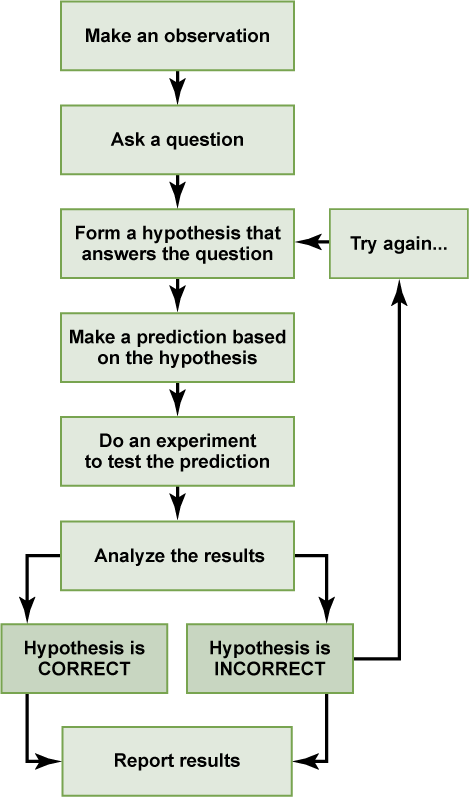
The scientific method can be broken down into a series of logical steps. While it's often presented as a neat, linear list, in practice it's a dynamic and often messy process. Scientists may loop back and repeat steps as they learn more.
1. Make an Observation and Ask a Question
It all starts with noticing something. You see a phenomenon and wonder what's causing it. For example, you might observe that the plants on one side of your yard seem to grow taller than the plants on the other side. This leads to a question: Why is there a difference in plant height?
This initial step is all about curiosity. Good questions are specific enough to be investigated.
2. Form a Hypothesis
A hypothesis is a proposed explanation for your observation. It’s not just a random guess; it's an educated, testable statement. A key feature of a good hypothesis is that it must be falsifiable, meaning you can design an experiment that could prove it wrong.
Hypothesis
noun
A tentative explanation for a phenomenon, used as a basis for further investigation.
For our plant example, a hypothesis might be: "The plants on one side of the yard grow taller because they receive more sunlight."
3. Conduct an Experiment
This is where you test your hypothesis. An experiment is designed to isolate and test a single factor, or variable. To get reliable results, scientists often use a control group and an experimental group.
For our plants, you could design an experiment: Plant the same type of seeds in identical pots with the same soil. Place one group of pots (the experimental group) in a very sunny spot and the other group (the control group) in a shady spot. Give both groups the same amount of water.
4. Collect and Analyze Data
As the experiment runs, you must carefully observe and record what happens. This is data collection. The data can be quantitative (numbers, like plant height in centimeters) or qualitative (descriptions, like leaf color).
After a few weeks, you would measure the height of all the plants and record the measurements. You would then analyze this data, perhaps by calculating the average height for each group, to see if there's a clear difference.
5. Draw a Conclusion
Finally, you look at your analyzed data and decide whether it supports or refutes your hypothesis. If the plants in the sunny spot grew significantly taller, your conclusion would be that the data supports the hypothesis that more sunlight leads to taller growth.
If there was no difference, or if the shady plants grew taller, you would conclude that the hypothesis is not supported. This is not a failure! A rejected hypothesis is just as valuable as a supported one because it eliminates one possibility and guides you toward a new hypothesis to test. Perhaps the difference is due to soil quality or water drainage.
A Cycle of Inquiry
The scientific method is the engine of scientific discovery. It provides a shared framework that allows researchers to build on each other's work with confidence. Each conclusion, whether it supports or rejects a hypothesis, becomes an observation that can fuel the next cycle of questions.
Understanding these steps helps demystify science. It shows that scientific knowledge isn't arbitrary but is built through a rigorous process of questioning, testing, and refining. It’s a powerful tool for anyone who wants to understand the world more deeply.
What is the primary purpose of the scientific method?
A student observes that plants on one side of their yard grow taller than plants on the other. What is the best example of a testable hypothesis they could form?
This structured approach ensures that scientific findings are based on evidence and can be scrutinized and replicated by others.