Demystifying Scientific Literature
Scientific Inquiry Basics
A Framework for Asking Questions
Science isn't just a collection of facts; it's a way of thinking. It’s a process for asking questions about the natural world and finding reliable answers. This process is called the scientific method. It provides a structured way to move from a casual observation to a well-tested explanation.
The goal is to generate knowledge that is objective and dependable. By following a clear set of steps, scientists can minimize bias and build on each other's work. This systematic approach allows us to understand everything from the smallest atoms to the largest galaxies.
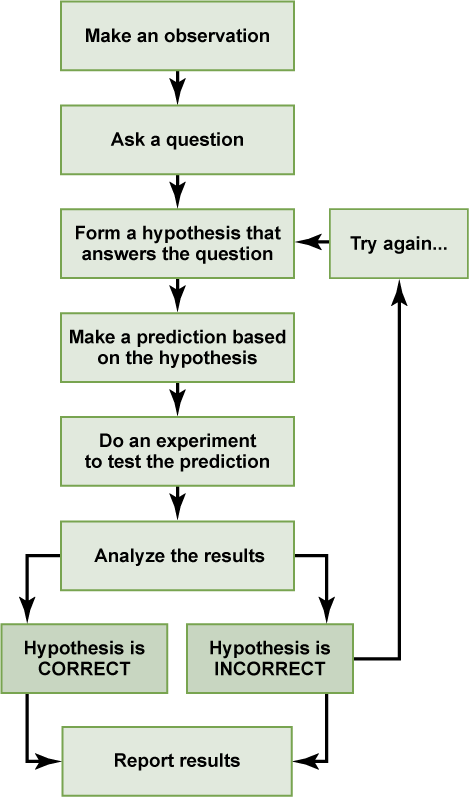
The Core Steps
While the scientific method can be flexible, it generally follows a few key stages. It all starts with curiosity.
Observation: This is the spark. It could be noticing that your houseplant grows faster in one window than another, or seeing a strange pattern in the stars. It's about paying attention to the world and asking, "Why is that happening?"
Once you have a question, the next step is to propose a potential answer. This isn't just a wild guess; it's an educated and testable explanation.
Hypothesis
noun
A proposed explanation for an observation that can be tested through experimentation.
A crucial feature of a good hypothesis is that it must be falsifiable. This means there has to be a way to prove it wrong. For example, the hypothesis "All swans are white" is falsifiable because finding just one black swan would disprove it. An untestable statement, like "This plant is beautiful," isn't a scientific hypothesis because it's an opinion.
Next comes the test itself.
Experimentation: This is where you design a controlled test to see if your hypothesis holds up. If your hypothesis is about sunlight and plant growth, you might set up an experiment with two identical plants, giving one more light than the other while keeping everything else (like water and soil) the same. The goal is to collect data.
After the experiment, you analyze the data you've collected. Did the plant with more sunlight actually grow faster? This analysis leads to the final step.
Conclusion: Based on your analysis, you decide whether the evidence supports or refutes your hypothesis. If it's supported, great! If not, that's also valuable information. An incorrect hypothesis is not a failure; it’s a chance to refine your question and try again. This is why the process is often shown as a loop.
Science Is a Team Sport
A single study is just one piece of a much larger puzzle. To be truly accepted, scientific findings must stand up to scrutiny from the broader community. Two key principles ensure this happens: reproducibility and peer review.
Reproducibility
noun
The ability of an independent researcher to duplicate an experiment and obtain comparable results.
If other scientists can follow the same steps and get the same results, it builds confidence that the findings are not just a fluke. This is why scientists publish their methods in great detail.
Before a study is even published, it usually goes through a rigorous quality-control process.

Peer review is a system where a scientist's research paper is sent to other experts in the same field for evaluation. These anonymous reviewers check the study's design, methods, and conclusions for flaws. They might suggest revisions or even recommend that the paper be rejected if the work isn't up to standard. This process acts as a filter, helping to ensure that published science is valid and reliable.
Now, let's test your understanding of these core principles.
What is the primary purpose of the scientific method?
An essential characteristic of a scientific hypothesis is that it must be:
Understanding this process is the first step in being able to critically evaluate scientific claims and appreciate the robust, self-correcting nature of science.