Demystifying Science A Guide to Understanding Research
Scientific Method
A Method for Discovery
Science is a way of asking and answering questions about the natural world. It’s not just a collection of facts, but a process for understanding how things work. At the heart of this process is the scientific method, a systematic approach that helps guide inquiry and ensure that findings are reliable.
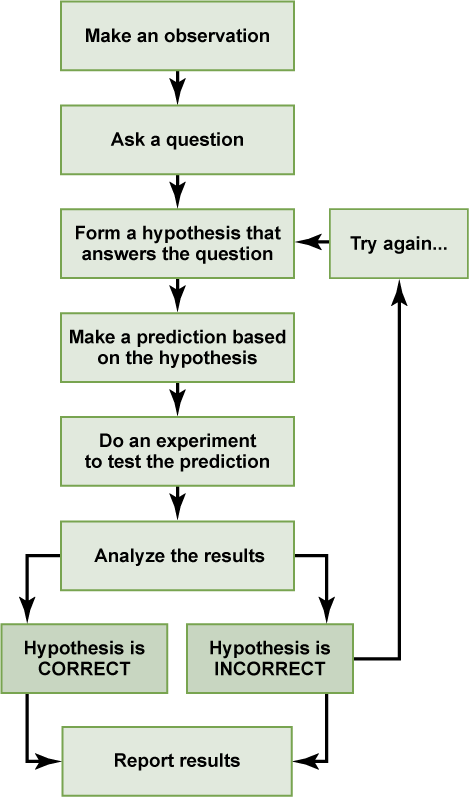
While often shown as a rigid, step-by-step list, it's more of a flexible cycle. Scientists move back and forth between steps, and new discoveries often lead to new questions, starting the process all over again. The goal is to build knowledge based on evidence.
Start with a Question
Every scientific investigation begins with an observation that sparks curiosity. You notice something and wonder why it happens. Maybe you see that the grass is always greener on your neighbor's side of the fence, or you notice that your phone battery seems to drain faster on cold days.
From that observation, you form a question. It needs to be specific enough to be answered. Instead of asking “Why is my neighbor’s grass better?” you might ask, “Does my neighbor’s brand of fertilizer make grass greener than mine?”
Observation: My phone battery dies quickly in the cold.
Question: Does cold temperature cause phone batteries to lose charge faster?
Form a Hypothesis
Once you have a question, the next step is to propose a possible answer. This proposed answer is called a hypothesis. It's not just a random guess; it's an educated, testable statement based on your initial observations and any background knowledge you have.
Hypothesis
noun
A proposed explanation for a phenomenon that can be tested through experimentation.
A good hypothesis has two key features. First, it must be testable. You need to be able to design an experiment that can check if the hypothesis is supported by evidence. Second, it must be falsifiable. This means there must be a way to prove it wrong. If you can’t possibly disprove a statement, it isn’t a scientific hypothesis.
For our phone battery question, a hypothesis might be: “Cold temperatures cause a chemical reaction in phone batteries that reduces their ability to hold a charge.” This is testable and can be proven false.
Test It Out
This is the experiment stage. Here, you design and conduct a procedure to test your hypothesis. A crucial part of this is controlling variables. You want to change only one thing at a time—the independent variable—to see how it affects the outcome, or the dependent variable. Everything else must be kept the same; these are the control variables.
| Variable Type | Phone Battery Example |
|---|---|
| Independent Variable | The temperature the phone is exposed to. |
| Dependent Variable | How quickly the battery drains. |
| Control Variables | Same phone model, same battery age, same apps running, etc. |
To test our hypothesis, you could take two identical phones, fully charge them, and run the same video on both. You’d place one in a cold environment (like a refrigerator) and leave the other at room temperature. Then, you would measure how long it takes for each battery to drain.
During the experiment, you collect data. This could be numbers, measurements, or direct observations. The key is to be meticulous and record everything accurately. This commitment to careful data collection is what ensures that your results are reliable.
Analyze and Conclude
After the experiment is over, you analyze the data. Does it support your hypothesis? In our example, you’d compare the battery life of the phone in the cold to the one at room temperature. If the cold phone's battery drained significantly faster, then the data supports the hypothesis.
Based on your analysis, you draw a conclusion. The conclusion summarizes your findings and states whether your hypothesis was supported or rejected. It's important to note that a single experiment never
An experiment doesn't prove a hypothesis true. It can only provide evidence that supports it or fails to support it.
The final step is to communicate your results. This is how scientific knowledge grows. Scientists publish their methods and findings so that others can review their work, ask new questions, and conduct their own experiments. This leads to reproducibility—the ability for other researchers to perform the same experiment and get the same results. Reproducibility is a cornerstone of good science, as it helps confirm that findings are valid and not just a fluke.
If your hypothesis was rejected, it’s not a failure. It's an opportunity to learn. You can now revise your hypothesis or form a new one and begin the process again, moving science forward one question at a time.
What are the two essential features of a scientific hypothesis?
A student wants to test if tomato plants grow taller when given more sunlight. She places one plant in a sunny window and an identical plant in a dim corner. She gives both plants the same amount of water and the same type of soil. In this experiment, what is the independent variable?