Demystifying Artificial Intelligence
Defining Artificial Intelligence
What is Artificial Intelligence?
Artificial intelligence, or AI, is the science of making machines that can think and learn like humans. It's about creating systems that can perform tasks that usually require our intelligence, like solving problems, recognizing patterns, and making decisions.
Artificial Intelligence (AI) refers to the simulation of human intelligence in machines that are programmed to think and learn like humans.
Think about your coffee maker. A standard one follows simple instructions: you press a button, and it starts brewing. An AI-powered coffee maker might learn your daily routine. It could notice you wake up at 7:00 AM on weekdays and start brewing automatically, so your coffee is ready when you get to the kitchen. It doesn't just follow a command; it learns a pattern and acts on it.
AI vs. Traditional Programs
Traditional software operates on a clear set of rules written by a programmer. A calculator is a perfect example. It knows that 2 + 2 will always equal 4 because a human gave it that exact instruction.
AI is different. Instead of being given rigid, step-by-step instructions, an AI system is often given a goal and a lot of data. It then learns the best way to achieve that goal on its own. A spam filter in your email doesn't have a rule for every single possible spam message. Instead, it has learned from millions of emails what spam tends to look like. It identifies patterns, like unusual links or urgent requests for money, to make an educated guess.
| Feature | Rule-Based System (Traditional) | Learning-Based System (AI) |
|---|---|---|
| Logic | Follows explicit if-then rules. | Discovers patterns in data. |
| Flexibility | Rigid. Can't handle new situations. | Adapts and improves over time. |
| Example | A traffic light on a simple timer. | A smart traffic system that adjusts based on real-time traffic flow. |
The AI Family Tree
AI isn't a single thing. It's a broad field with many branches. The most important terms to know are Artificial Intelligence (AI), Machine Learning (ML), and Deep Learning. Think of them as nested categories, where each one is a more specific part of the one before it.
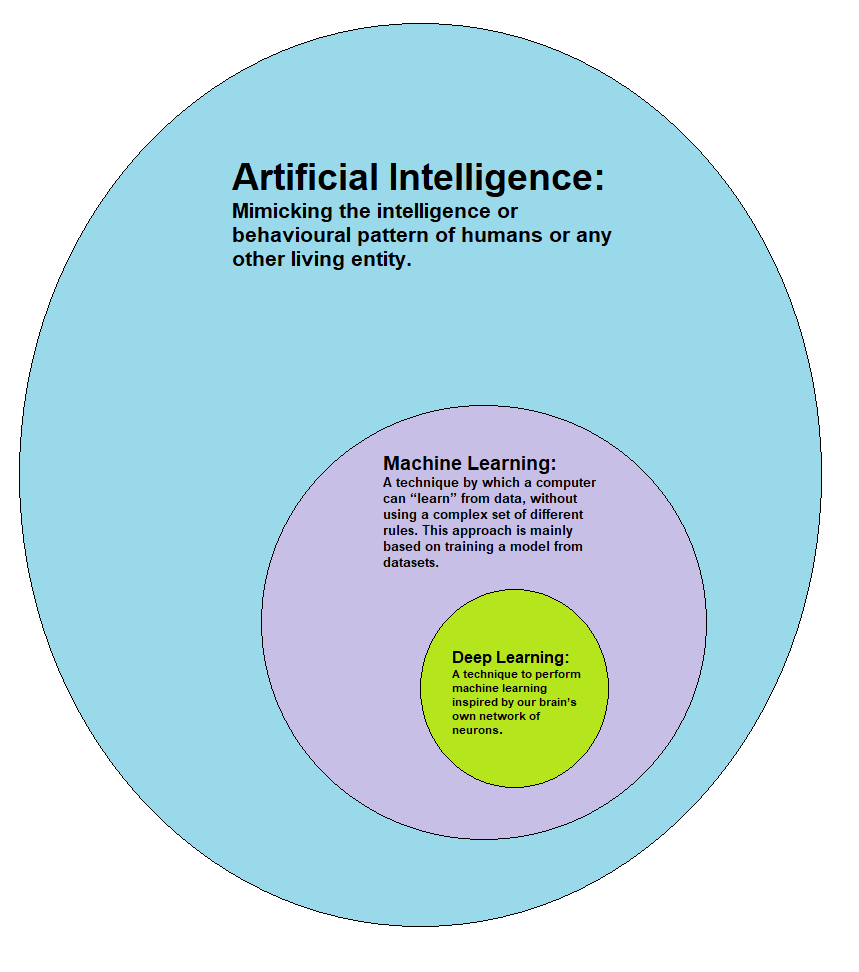
Let's break them down.
Artificial Intelligence
noun
The overall concept of creating machines capable of tasks that typically require human intelligence.
This is the big umbrella that covers everything. It’s the goal.
Machine Learning
noun
A subset of AI where systems learn from data to find patterns and make decisions without being explicitly programmed for every task.
This is the how. Instead of writing rules, developers feed the machine vast amounts of data, and the machine learns the rules itself. The spam filter is a classic example of machine learning.
Deep Learning
noun
A specialized type of machine learning that uses structures inspired by the human brain, called neural networks, to learn from large amounts of data.
This is a very powerful technique within machine learning. Deep learning is behind many of the most advanced AI applications today, like voice assistants that understand your speech and systems that can generate realistic images from a text description.
Cognitive Tasks for Machines
The ultimate goal of AI is to replicate human cognitive functions in machines. These are the mental processes that allow us to perceive, think, and learn. For an AI, this includes:
- Learning: Acquiring knowledge from data and improving performance over time.
- Problem-solving: Analyzing a situation and finding an effective solution.
- Pattern Recognition: Identifying trends or regularities in data, like recognizing a face in a photo.
- Language Understanding: Processing and interpreting human language, both written and spoken.
AI is best suited for complex, messy problems where the rules aren't clear and the data is constantly changing. It's a powerful tool for navigating the kind of uncertainty we deal with in the real world every day.
Time to review what you've learned.
Now, let's check your understanding.
What is the primary difference between an AI system and traditional software, based on the provided text?
According to the text, which statement correctly describes the relationship between Artificial Intelligence (AI), Machine Learning (ML), and Deep Learning?
Understanding these core ideas is the first step. You now have a framework for thinking about what AI is, how it differs from older software, and how its key branches fit together.