Demystifying Artificial Intelligence
Defining Artificial Intelligence
What Is Artificial Intelligence?
Artificial Intelligence (AI) is about creating computer systems that can perform tasks that usually require human intelligence. This includes things like learning from experience, solving problems, understanding language, and making decisions. It’s not just about crunching numbers; it's about mimicking how we think.
Artificial Intelligence
noun
The capability of a computer system or machine to imitate intelligent human behavior, such as reasoning, learning, and problem-solving.
Learning vs. Following Rules
What makes AI different from a normal computer program? It comes down to rules versus experience.
A traditional program, like a calculator, follows a strict set of rules. You type in 2 + 2, and it follows a pre-written instruction to always output 4. It can't learn or adapt. It will give you the same answer today, tomorrow, and a decade from now.
An AI system, on the other hand, learns. Think about your music streaming app. It doesn't have a fixed rule for what song you want to hear next. Instead, it analyzes your listening history, what you skip, and what other people with similar tastes enjoy. It uses this data to make an educated guess, and it gets better at predicting your preferences over time. This ability to improve through experience is the key difference.
Traditional software is programmed with explicit, step-by-step instructions. AI systems are often trained using powerful and massive amounts of data. The system learns the patterns itself, rather than having a programmer spell out every possible scenario. This allows AI to tackle complex problems where the rules aren't easily defined, like recognizing a face in a crowd or translating between languages.
Two Flavors of AI
When people talk about AI, they are almost always talking about one specific type: Narrow AI. This is also known as Weak AI. These are systems designed and trained for one particular task.
A facial recognition system is a great example. It's incredibly good at identifying people in photos, but it can't drive a car, write a poem, or diagnose a disease. Your voice assistant, a spam filter for your email, and the AI that beat the world champion at chess are all forms of Narrow AI—they are specialists with a very limited scope.
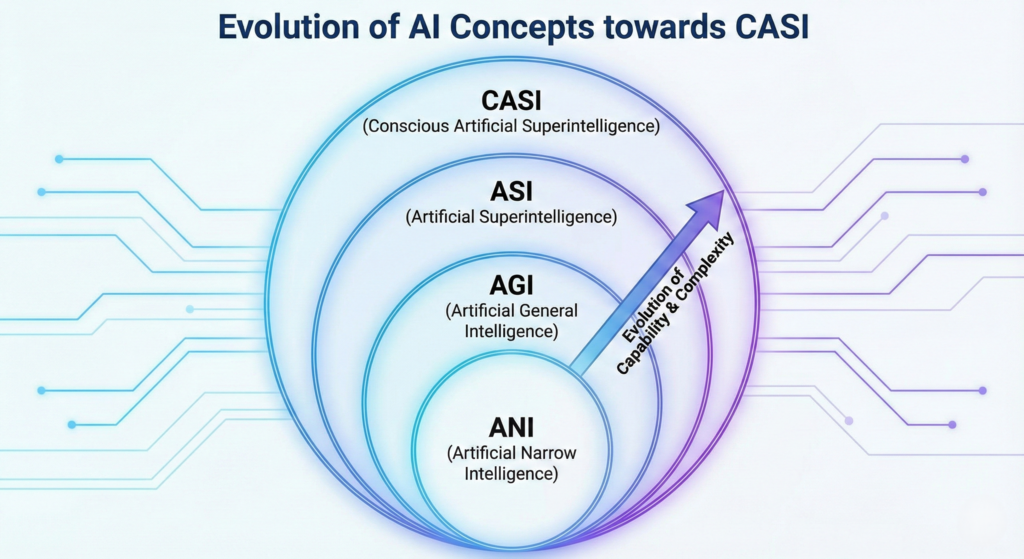
The other type is Artificial General Intelligence, or AGI. This is the stuff of science fiction: a machine with the ability to understand, learn, and apply its intelligence to solve any problem, just like a human being. An AGI could switch from composing a symphony to performing scientific research to having a deep conversation, all with the same level of competence as a person.
It’s important to understand that AGI does not exist today. Creating a system with true, human-like consciousness and adaptability across countless domains is a challenge that is still far beyond our current capabilities.
| Feature | Narrow AI (ANI) | General AI (AGI) |
|---|---|---|
| Scope | Performs a single, specific task. | Can perform any intellectual task a human can. |
| Capability | Can exceed human ability in its one task. | Possesses human-like consciousness and problem-solving. |
| Example | A chess-playing computer, a spam filter. | A self-aware robot from a movie. |
| Status | Exists today and is widely used. | Theoretical; does not yet exist. |
What is the primary characteristic that distinguishes an AI system from a traditional computer program like a calculator?
A spam filter that analyzes your emails and gets better at identifying junk mail over time is an example of Narrow AI.
Understanding these basic distinctions is the first step. AI isn't a single, magical technology. It's a broad field of computer science focused on creating systems that can learn and adapt, with different types designed for very different purposes.