Demystifying Artificial Intelligence
Introduction to Artificial Intelligence
What Is Artificial Intelligence?
Artificial Intelligence, or AI, is a branch of computer science focused on building smart machines capable of performing tasks that typically require human intelligence. Think of it as teaching a computer to learn, reason, and solve problems on its own.
At its core, AI is about creating systems that can perceive their environment, think about their actions, and make decisions to achieve specific goals. This can be as simple as a spam filter learning to identify junk email or as complex as a car navigating city streets by itself.
The central goal of AI is to simulate human intelligence in machines, enabling them to learn from experience, adapt to new inputs, and perform human-like tasks.
A Brief History of AI
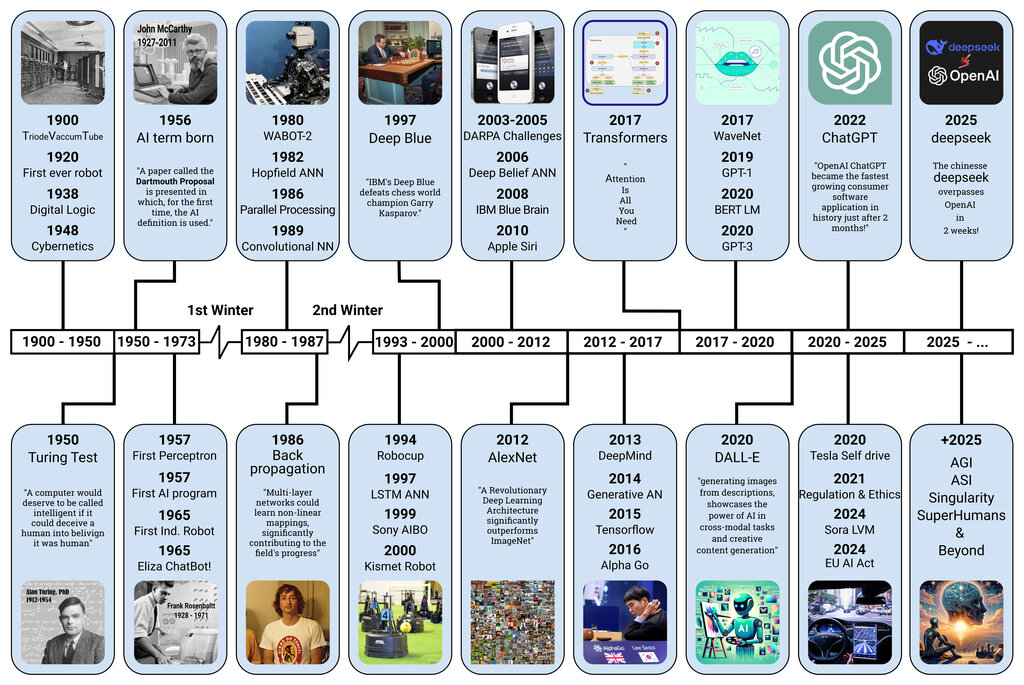
While AI feels like a recent buzzword, its roots go back decades. The dream of creating intelligent machines is ancient, but the scientific pursuit began in the mid-20th century. One of the earliest pioneers was Alan Turing, a British mathematician who proposed a test in 1950, now known as the Turing Test, to see if a machine could exhibit intelligent behavior indistinguishable from that of a human.
The field officially got its name in the summer of 1956. A group of researchers, including John McCarthy, Marvin Minsky, and Claude Shannon, organized a workshop at Dartmouth College. It was here that McCarthy coined the term "Artificial Intelligence," kicking off decades of research.
1956: Dartmouth Conference: Official birth of AI as a field of study, coining the term “Artificial Intelligence.”
The journey wasn't always smooth. The field experienced several "AI winters," periods when progress stalled, and funding dried up due to overly optimistic promises. However, breakthroughs continued. In 1997, IBM's Deep Blue chess computer defeated world champion Garry Kasparov, a major milestone. The rise of the internet, massive datasets, and powerful computing hardware in the 2000s fueled a resurgence, leading to the AI boom we see today.
The Branches of AI
AI is not a single technology but a broad field with many specialized subfields. Each branch focuses on a different aspect of intelligence.
Machine Learning
noun
The most common type of AI. Instead of being explicitly programmed, machine learning systems use data to learn and improve over time. They identify patterns and make decisions with minimal human intervention.
Natural Language Processing (NLP) is another key area. This branch gives machines the ability to read, understand, and generate human language. It's the technology behind voice assistants like Siri and Alexa, as well as language translation apps.
Computer Vision aims to give computers the ability to "see" and interpret the visual world. This includes recognizing objects in photos and videos, which is crucial for things like self-driving cars and medical imaging analysis.
Finally, Robotics focuses on designing and building robots. When robotics is combined with AI, robots can perform tasks intelligently and autonomously in the physical world, from manufacturing cars to exploring other planets.
| Subfield | Primary Goal |
|---|---|
| Machine Learning | Learn from data to make predictions or decisions. |
| Natural Language Processing | Understand and generate human language. |
| Computer Vision | Interpret and understand information from images. |
| Robotics | Create machines that can move and act in the world. |
These fields often overlap, and many of today's most advanced AI systems combine elements from each to achieve their goals. Understanding these branches helps clarify what AI is and what it can do.
What is the primary goal of Artificial Intelligence as a field of computer science?
The term 'Artificial Intelligence' was coined at a workshop held in 1956 at which institution?
This introduction lays the groundwork for understanding AI. From its philosophical beginnings to its modern applications, the field is a testament to the quest to understand and replicate intelligence.