Demystifying Artificial Intelligence
Introduction to AI
What Is Artificial Intelligence?
At its core, artificial intelligence is the science of making machines smart. The goal is to create computer systems that can perform tasks that typically require human intelligence. Think about how you learn new things. You observe, you figure out patterns, and you adjust your approach based on what works. AI tries to replicate this process in machines.
AI systems are designed to learn from experience, reason through problems, and correct their own mistakes over time.
Artificial Intelligence
noun
A field of computer science dedicated to creating systems capable of performing tasks that normally require human intelligence, such as visual perception, speech recognition, decision-making, and translation between languages.
Instead of being explicitly programmed for a specific task, an AI is designed to be flexible. It's like the difference between a simple calculator, which can only do what its buttons say, and a person who can learn to play chess, write a poem, or identify a bird from its song. The calculator is programmed; the person learns. AI aims for the latter.
A Quick Trip Through Time
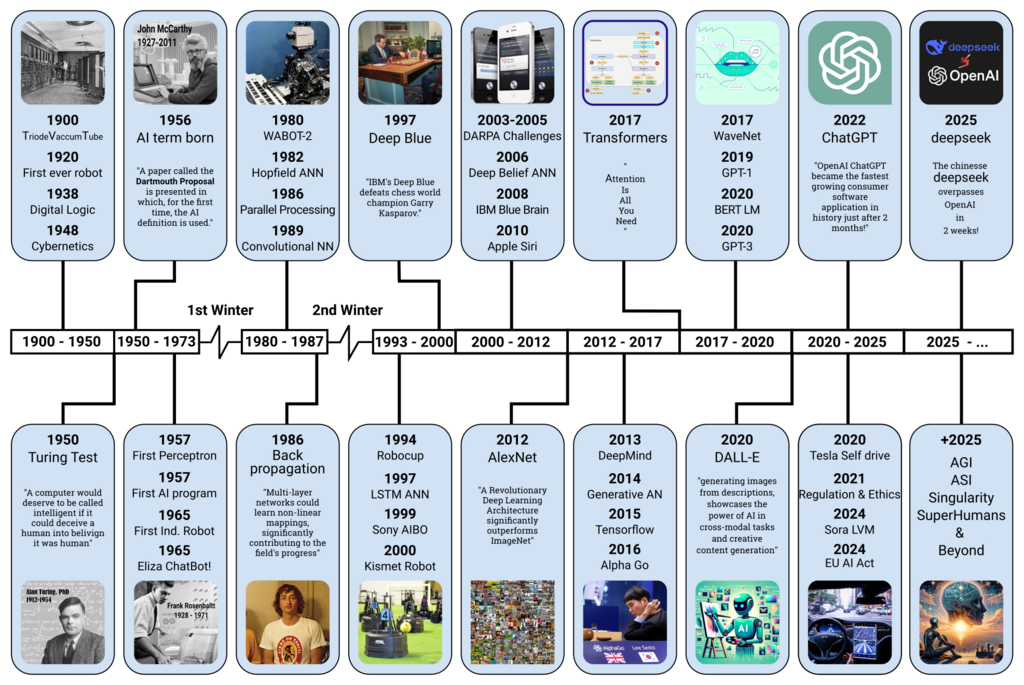
The dream of intelligent machines is ancient, but the actual field of AI took root in the 1950s. Early researchers were incredibly optimistic, believing that a machine with human-like intelligence was just a few decades away. Progress, however, turned out to be much harder than expected.
The journey of AI has had its ups and downs. Periods of intense research and funding were sometimes followed by "AI winters," when progress stalled and interest waned. But breakthroughs in the last couple of decades have changed everything. The explosion of available data and massive increases in computing power have fueled a renaissance, turning many of AI's early promises into reality.
The Branches of AI
Artificial intelligence isn't a single thing; it's a broad field with many specialized branches. Just as medicine has cardiologists and dermatologists, AI has its own areas of focus. Here are a few of the most important ones.
Machine Learning (ML) is perhaps the most well-known subfield. Instead of writing step-by-step instructions, developers use ML to train a computer by showing it vast amounts of data. The system learns to recognize patterns on its own. For example, to teach an AI to identify cats, you don't describe what a cat is. You just show it thousands of cat pictures, and it figures out the common features.
Natural Language Processing (NLP) focuses on enabling computers to understand, interpret, and generate human language. Every time you use a translation app, talk to a voice assistant like Siri or Alexa, or see your email program suggest a reply, you're interacting with NLP.
Computer Vision aims to give machines the ability to "see." It involves processing and analyzing images and videos to identify objects, people, and activities. This is the technology behind facial recognition on your phone, quality control on an assembly line, and the ability of a self-driving car to spot a pedestrian.
Robotics is where AI gets a physical body. This field combines AI with engineering to build robots that can move and interact with the physical world. A robot on a factory floor might use computer vision to find a part and machine learning to determine the best way to pick it up.
Why AI Matters Now
So, what's the big deal? AI is rapidly moving from research labs into our daily lives. It’s changing how we work, communicate, and solve problems. In healthcare, AI helps doctors diagnose diseases earlier and more accurately. In finance, it detects fraudulent transactions in real time. In entertainment, it powers the recommendation engines that suggest what you should watch or listen to next.
The impact of AI is broad and deep. It’s a powerful tool that is helping to automate routine tasks, uncover new scientific insights, and create entirely new products and services. Understanding its basic principles is becoming essential in our increasingly digital world.
What is the fundamental goal of Artificial Intelligence?
The subfield of AI focused on enabling machines to 'see' and interpret images and videos is called ________.
That's a quick tour of what AI is and the major fields within it. By understanding these core concepts, you're ready to explore how these technologies are built and applied.