Demystifying Artificial Intelligence
Introduction to Artificial Intelligence
What Is Artificial Intelligence?
Artificial intelligence, or AI, is the science of making computers do things that normally require human intelligence. This includes tasks like learning from experience, understanding language, recognizing objects, solving problems, and making decisions.
Think of it like teaching a computer to think. Instead of just following a strict set of pre-programmed instructions, an AI system can analyze vast amounts of information, identify patterns, and adapt its behavior. This ability to learn and reason is what makes AI so powerful and transformative.
At its core, AI is about creating systems that can perceive their environment, think about what they perceive, and act on their conclusions.
The significance of AI is enormous. It has the potential to solve some of the world's most complex challenges, from discovering new medicines to creating more efficient energy systems. It’s not just a futuristic concept; it's already a part of our daily lives, powering everything from search engines and navigation apps to recommendation systems on streaming services.
The Three Levels of AI
Not all AI is created equal. Scientists and researchers generally categorize AI into three distinct types based on its capabilities. Understanding these levels helps clarify what AI can do today versus what it might do in the future.
Artificial Narrow Intelligence
noun
Often called Weak AI, this type of artificial intelligence is designed and trained for one specific task.
This is the only level of AI humanity has achieved so far. Your smartphone's voice assistant, the AI that suggests what to watch next, and even self-driving cars are all examples of Narrow AI. They can be incredibly good at their specific jobs, sometimes even better than humans, but they can't operate outside of their pre-defined functions. A chess-playing AI can't write a poem or diagnose a disease.
Artificial General Intelligence
noun
Known as Strong AI, this is a theoretical form of AI that would possess the ability to understand, learn, and apply its intelligence to solve any problem, much like a human being.
An AGI could switch between writing an essay, composing music, and conducting scientific research with the same ease as a person. This is the type of AI often depicted in science fiction, like the android Data from Star Trek. It remains a goal for researchers, but a true AGI does not yet exist.
Artificial Superintelligence
noun
A hypothetical AI that possesses intelligence far surpassing that of the brightest human minds in practically every field, including scientific creativity, general wisdom, and social skills.
This type of AI would be so advanced that it could solve problems beyond our current comprehension. ASI is purely speculative and the subject of much debate among scientists and futurists.
A Brief History of AI
The idea of intelligent machines has been around for centuries, but the modern field of AI officially began in the summer of 1956. A group of scientists gathered for a workshop at Dartmouth College to explore the possibility of creating machines that could think. It was here that the term "artificial intelligence" was coined.
The early years were filled with excitement and bold predictions. While progress was made, the immense difficulty of creating true intelligence led to periods of reduced funding and interest, known as "AI winters." However, breakthroughs in the 1990s, like IBM's Deep Blue computer defeating world chess champion Garry Kasparov, reignited public fascination.
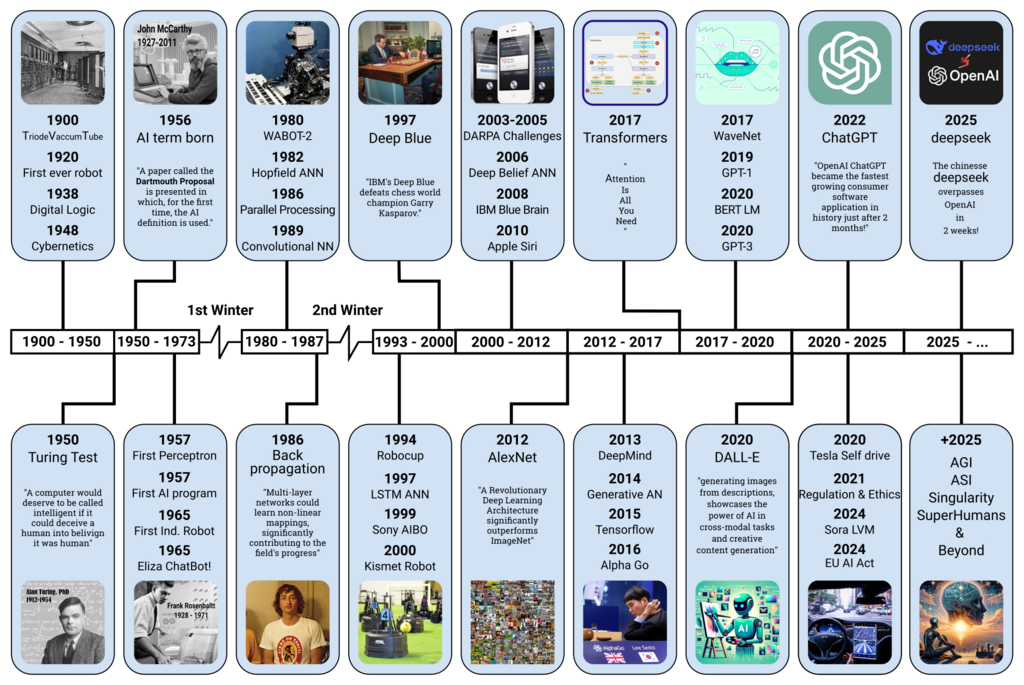
In the 21st century, two factors have caused an explosion in AI development: the availability of massive amounts of data and the development of powerful computers that can process it quickly. This has fueled the rapid advancements we see today.
Core Concepts of Modern AI
Modern AI isn't one single technology; it's an umbrella term for a range of methods and subfields. Here are four of the most important concepts that form the building blocks of today's AI systems.
Machine Learning (ML) is a subset of AI where systems learn directly from data without being explicitly programmed. Instead of writing rules, developers feed an algorithm huge amounts of data and let it discover patterns and make predictions on its own. The more data it processes, the more accurate it becomes.
Deep Learning is a specialized type of machine learning that uses structures inspired by the human brain, called neural networks. These networks have many layers, allowing them to learn complex patterns from data. Deep learning is the engine behind many of today's most advanced AI applications, like image recognition and natural language translation.
Natural Language Processing (NLP) focuses on enabling computers to understand, interpret, and generate human language. It's what allows you to talk to your voice assistant, translate text from one language to another, and see spam emails automatically filtered out of your inbox.
Computer Vision is the field of AI that trains computers to see and interpret the visual world. Using digital images and videos, computer vision systems can identify and classify objects, and then react to what they "see." This technology is crucial for everything from facial recognition on your phone to enabling self-driving cars to navigate roads.
Ready to test your knowledge? Let's see what you've learned about the fundamentals of AI.
What is the primary goal of artificial intelligence?
The AI that powers your smartphone's voice assistant and streaming service recommendations is an example of which type of AI?
These foundational ideas provide the framework for understanding the exciting and rapidly evolving world of artificial intelligence.