Demystifying AI Agents
Agent Foundations
What Is an AI Agent?
You've probably used AI before, maybe by asking a chatbot a question. You give it a prompt, and it gives you a response. It's a simple, one-time exchange. An AI agent is different. It's not just designed to respond; it's designed to achieve a goal.
Think of it like the difference between a calculator and an accountant. You can ask a calculator to add two numbers, and it will give you the answer. But you can give an accountant a goal, like "minimize my taxes," and they will perform a series of actions—gathering documents, finding deductions, and filing forms—to achieve it.
An AI agent works similarly. Instead of just answering a single question, it can pursue a multi-step goal on its own. This ability to act independently is what makes agents so powerful.
A standard AI model responds to a prompt. An AI agent acts to achieve a goal.
At its core, every agent operates on a simple, continuous loop: perceive, reason, and act.
- Perceive: The agent gathers information about its environment. This could mean reading new emails, checking stock prices online, or analyzing data from a sensor.
- Reason: Based on the information it perceives and the goal it's been given, the agent makes a plan. It decides what to do next.
- Act: The agent executes its plan by taking an action. This might involve sending an email, buying a stock, or adjusting the temperature on a thermostat.
This loop repeats, allowing the agent to react to new information and work steadily towards its objective without needing you to guide every single step.
From Tool to Collaborator
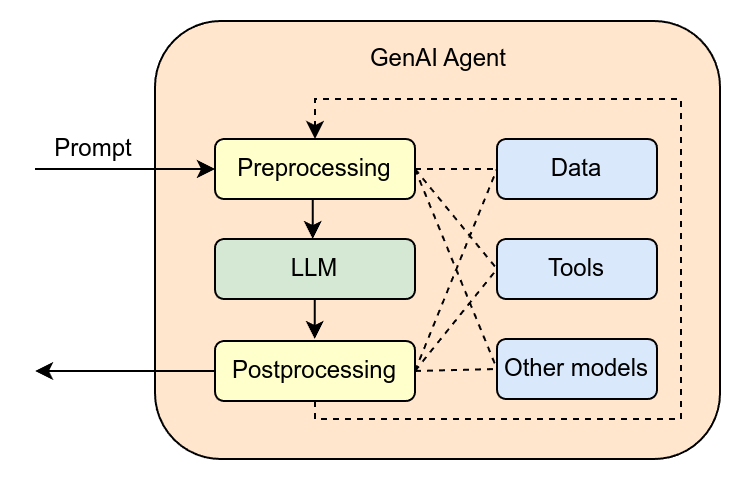
The "brain" of most modern AI agents is a Large Language Model (LLM). This is the same technology behind chatbots that can write poetry or summarize articles. But an agent is more than just an LLM. While the LLM provides the reasoning power, the agent framework provides the ability to perceive and act.
This combination is what enables autonomy—the ability for the system to make its own decisions to reach a goal. A simple AI tool needs a human to tell it exactly what to do. An autonomous agent only needs to know the final destination. It can figure out the route itself.
This shift moves AI from being a passive tool to an active collaborator. Instead of using AI to complete a small piece of a task, you can delegate the entire task to an agent.
Let's look at some examples to make this clear. The world is already full of simple automation.
A smart thermostat is a basic agent. Its goal is to maintain a specific temperature. It perceives the room's current temperature (perception), decides if it's too hot or cold (reasoning), and turns the heat or AC on or off (action).
A more advanced example is a customer service agent that handles returns. Its goal is to process a customer's return request. It perceives the request via email, reasons by checking the order history and return policy, and acts by generating a shipping label and issuing a refund. It works independently to solve the customer's problem from start to finish.
Now that you know what makes an agent different from a typical AI model, let's test your knowledge.
What is the primary characteristic that distinguishes an AI agent from a standard AI chatbot?
Which sequence correctly describes the continuous operational loop of an AI agent?
Understanding this foundation is key. Agents aren't just about conversation; they're about action. In the next sections, we'll explore the different types of agents and what they can do.