Deepening Buddhist Philosophy
Madhyamaka and Emptiness Logic
The Middle Way of Nagarjuna
In Mahayana Buddhism, the concept of emptiness, or śūnyatā, is central. It’s not about nothingness, but about how things exist. The philosopher who most powerfully articulated this was , an Indian thinker from around the 2nd century CE. His masterpiece, the Mūlamadhyamakakārikā (Fundamental Verses on the Middle Way), laid the groundwork for the Madhyamaka, or "Middle Way," school of thought.
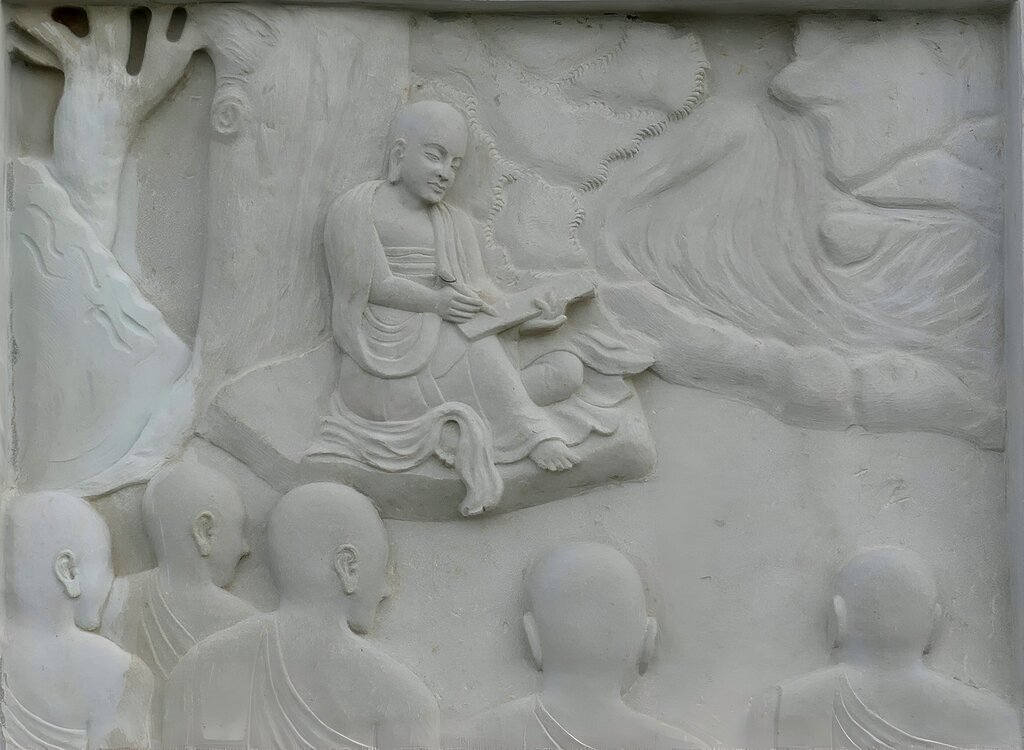
Nagarjuna’s primary target was the idea of svabhāva.
Svabhāva
noun
A term meaning "own-being," "self-nature," or "inherent existence." It refers to the idea that things possess a fixed, independent, and unchanging essence that makes them what they are.
Think of a chair. Does it have an essential "chair-ness" that exists on its own? Nagarjuna would say no. A chair is a collection of parts: legs, a seat, a back. It’s made of wood, which came from a tree. It was assembled by a carpenter. It only functions as a chair because we label it and use it that way. It has no independent, inherent existence. Its reality is constructed from causes and conditions.
Nagarjuna famously articulated this idea through his concept of “dependent origination” (pratityasamutpada), which states that everything arises due to causes and conditions, and nothing exists independently.
This is the crucial link: because all things are dependently originated, they are empty of svabhāva. Emptiness is not an abyss; it is the very nature of a reality where everything is interconnected and constantly changing. Nothing stands alone.
The Logic of Emptiness
To demonstrate this, Nagarjuna employed a powerful logical tool called the catuṣkoṭi (Sanskrit for "four corners"), or tetralemma. It's a way of examining any proposition from four perspectives to show that no absolute, inherent truth can be found.
| Position | Statement (applied to any phenomenon 'X') |
|---|---|
| 1. Affirmation | X exists (inherently). |
| 2. Negation | X does not exist (inherently). |
| 3. Both | X both exists and does not exist (inherently). |
| 4. Neither | X neither exists nor does not exist (inherently). |
Nagarjuna systematically refutes all four possibilities for anything having its own intrinsic nature. By showing that none of these positions hold up under scrutiny, he clears the ground of fixed views. He doesn’t replace them with a new fixed view. Instead, he points to a "middle way" that avoids the extremes of believing things are absolutely real (eternalism) or that they don't exist at all (nihilism).
Phenomena are not non-existent, because they function. They are not existent, because they lack an independent self. This is the Middle Way.
Two Ways to Argue
Over time, followers of Madhyamaka developed different approaches for demonstrating emptiness. Two major sub-schools emerged based on their logical methodology.
The first is the Prāsaṅgika school. Its proponents argue exclusively by revealing the absurd consequences (prasaṅga) within an opponent's own position. They don't put forward their own positive arguments. They simply show how any claim of inherent existence logically contradicts itself. The goal is to dismantle the opponent's view from the inside out, without asserting an alternative thesis.
The second is the Svātantrika school. These thinkers believe it is sometimes necessary and useful to construct their own autonomous (svatantra) arguments or syllogisms. While they agree that ultimate reality is empty, they argue that one can use conventional logic and positive assertions to lead people toward that understanding. They might, for example, build a logical proof to demonstrate that a table is dependently originated.
Both paths aim for the same goal: the realization of emptiness. They simply differ on the most effective logical strategy to get there.
Ready to test your understanding of this subtle logic?
What does the concept of emptiness, or śūnyatā, primarily signify in Nagarjuna's philosophy?
The philosopher Nagarjuna is most closely associated with which school of Buddhist thought?
Understanding Madhyamaka logic is less about winning a debate and more about changing one's perception. By seeing the dependent nature of all things, the mind can release its grip on fixed ideas, leading to wisdom and compassion.