Deep Visual Interpretation and Iconography
Semiotic Systems and Coding
Reading Between the Pixels
An image is never just an image. It’s a message, carefully constructed to tell a story or evoke a feeling. When you look at an advert, a news photograph, or even a painting, you're not just seeing objects; you're interpreting a complex system of signs. This is the core idea of semiotics, the study of how signs and symbols create meaning.
One of the most famous explorations of this idea came from the French theorist Roland Barthes, who analysed a simple pasta advert. On the surface, he saw pasta, tomatoes, and peppers in a string bag. But he also saw much more. He saw a message of freshness, Italian culture, and the idea of a complete, wholesome meal. The image wasn't just showing food; it was selling an entire lifestyle.
At the heart of this analysis is the concept of the sign. A sign isn't just one thing; it's a combination of two parts working together:
- The Signifier: The physical form of the sign. It's the image, word, or sound itself. In Barthes' example, the signifier is the picture of the tomatoes and peppers.
- The Signified: The concept or idea that the signifier represents. For Barthes, the signified was 'Italianicity'—the whole set of ideas we associate with Italy, like authenticity and fresh ingredients.
Literal vs. Loaded Meanings
Every image communicates on at least two levels. Barthes identified these as denotation and connotation. Understanding the difference is key to decoding visual messages.
Denotation
noun
The literal, face-value meaning of a sign. It’s what you can objectively describe in the image, free from interpretation.
Connotation
noun
The secondary, cultural meaning of a sign. It includes the emotions, ideas, and values that the sign evokes based on shared cultural knowledge.
Think of an advert featuring a golden retriever puppy. The denotative meaning is 'a young dog of a specific breed'. The connotative meaning, however, is much richer. It suggests family, loyalty, comfort, and wholesome fun. Advertisers rely on us to understand these connotations instantly and transfer those positive feelings to their product.
A Family of Signs
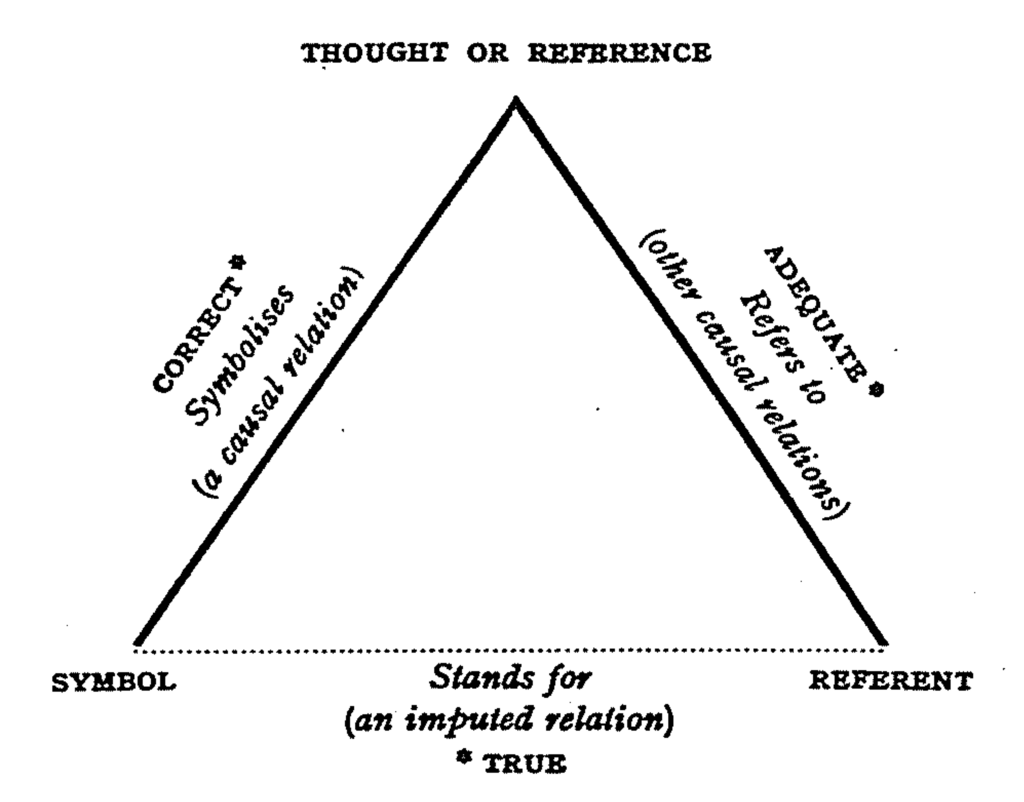
While Barthes focused on the two levels of meaning, the philosopher Charles Sanders Peirce categorized signs into three types based on the relationship between the signifier and the signified. This gives us another useful toolkit for analysing images.
| Type | Relationship | Example |
|---|---|---|
| Iconic | Resemblance | A portrait painting looks like the person it depicts. |
| Indexical | Causal Link | Smoke is an index of fire; it is caused by it. |
| Symbolic | Arbitrary Convention | A national flag represents a country by learned agreement. |
An iconic sign physically resembles what it stands for. The little house icon on a website that takes you to the homepage is an iconic sign. An indexical sign has a direct connection to its meaning. A footprint in the sand is an indexical sign that someone walked there. Smoke is an index of fire.
Symbolic signs are the most abstract. Their meaning is not natural but must be learned. The letters of the alphabet, traffic lights, and brand logos are all symbolic signs. Their meaning is purely a matter of cultural agreement.
The Choices That Build Meaning
When a photographer or designer creates an image, they make a series of choices. These choices fall into two categories: paradigmatic and syntagmatic. These sound complex, but the idea is simple.
Paradigmatic choices are about substitution. From all the possible options, which one did the creator choose? Why a rose and not a lily? Why a red coat and not a blue one? Why a smiling face and not a frowning one?
Each choice from a set of alternatives (a paradigm) carries specific connotations. Choosing a luxury watch over a cheap plastic one for a character in a film immediately tells you something about their wealth and status.
Syntagmatic choices are about combination. How are the chosen elements arranged in the final image? The order and placement create a specific narrative or relationship.
The arrangement of elements forms the image's syntax. Is the luxury watch on a man's wrist as he signs a business contract, or is it lying discarded on a bedside table next to an empty glass? The combination of signs creates a story. The luxury watch + the business contract suggests success and power. The luxury watch + the empty glass suggests regret or loss.
By analysing both the elements chosen (paradigmatic) and how they are combined (syntagmatic), we can deconstruct the 'grammar' of an image and understand the precise message it aims to convey. It’s how images move from simply showing things to telling us stories and shaping our view of the world.
Now, let's test your understanding of how images communicate meaning.
What is semiotics?
In a print advert, a picture of a luxury car is shown driving on a winding, open road. According to Roland Barthes, the idea of freedom and success that the image evokes is the...
By seeing images as coded systems, we move from being passive viewers to active readers, capable of understanding not just what we see, but what we are being told.