Deep RL for Wind Farm Optimization
Introduction to Reinforcement Learning
Learning from Experience
Imagine teaching a dog a new trick. You don't give it a textbook on how to "sit." Instead, you say the word, and when the dog accidentally sits, you give it a treat. Through trial and error, the dog learns that the action of sitting leads to a reward. This is the core idea behind Reinforcement Learning (RL).
Reinforcement Learning (RL) is a type of machine learning where an agent learns to make decisions by interacting with an environment, aiming to maximize a cumulative reward over time.
Unlike other types of machine learning that learn from static data, RL is about learning through action. An algorithm, called an agent, learns to achieve a goal in a complex, uncertain environment. It learns what to do—how to map situations to actions—to maximize a numerical reward signal. The agent isn't told which actions to take, but instead must discover which actions yield the most reward by trying them.
The Core Components
Every reinforcement learning problem has a few key ingredients. Let's break them down.
Agent
noun
The learner or decision-maker. It's the algorithm you're training.
Environment
noun
The world the agent interacts with. It's everything outside of the agent.
The agent and environment are constantly in a loop. The agent performs an action, which is a move or decision it makes. This action causes a change in the environment, leading to a new state, which is a snapshot of the environment at a particular moment. After each action, the environment gives the agent a reward, which is a piece of feedback—positive for good actions, negative for bad ones. The agent's goal is to collect the highest possible total reward over time.
How RL Is Different
Machine learning has two other major paradigms: supervised and unsupervised learning. Reinforcement learning is a different beast altogether.
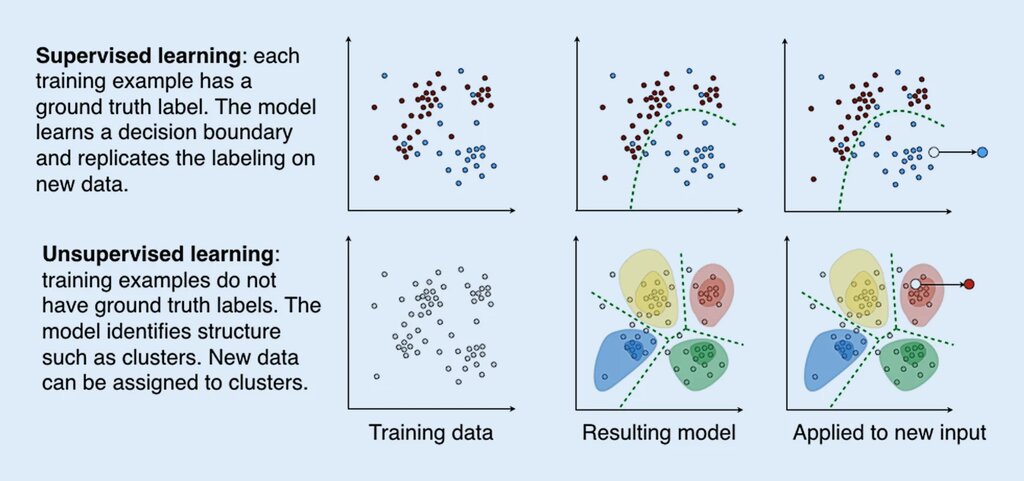
In supervised learning, the algorithm learns from a dataset that has been labeled with the correct answers. It's like a student learning with an answer key. The goal is to predict the correct label for new, unseen data.
In unsupervised learning, the algorithm gets a dataset with no labels. Its job is to find hidden patterns or structures on its own, like grouping similar customers based on their purchasing habits.
Reinforcement learning is different because there is no answer key. The agent learns from the consequences of its actions, not from being told what the correct action is. It's about sequential decision-making to achieve a long-term goal.
| Feature | Supervised Learning | Unsupervised Learning | Reinforcement Learning |
|---|---|---|---|
| Goal | Predict outcomes from labeled data | Find hidden structure in unlabeled data | Learn a series of actions to maximize reward |
| Input Data | Labeled data (input-output pairs) | Unlabeled data | No predefined dataset; agent generates data via interaction |
| Feedback | Direct feedback via correct labels | No direct feedback | Indirect feedback via rewards/penalties |
RL in the Wild
Reinforcement learning isn't just a theoretical concept; it's behind some of the most impressive advances in AI.
Game Playing: Programs like AlphaGo defeated world champions in the game of Go by learning strategies through self-play. The agent played millions of games against itself, learning which moves led to winning (a positive reward).
Robotics: Robots can learn to walk, run, and manipulate objects. An agent controlling a robotic arm can learn to pick up an item through trial and error, getting a positive reward when it succeeds.
Recommendation Systems: Online platforms use RL to personalize the content you see. When you click on a recommended video, it acts as a positive reward, teaching the system to show you similar content in the future.
These examples show the power of learning from interaction. By defining an agent, an environment, and a reward system, we can teach machines to master incredibly complex tasks.
What is the primary way a Reinforcement Learning agent learns?
In the Reinforcement Learning framework, what term describes a snapshot of the environment at a specific moment?