Deep Reinforcement Learning for Wind Farm Optimization
Introduction to Reinforcement Learning
Learning from Experience
Imagine teaching a dog to fetch. You don't give it a textbook on the physics of a thrown ball. Instead, you throw a stick. If the dog brings it back, you give it a treat. If it wanders off, it gets nothing. Through trial and error, guided by treats, the dog learns the desired behavior.
Reinforcement Learning (RL) works in a similar way. It's a type of machine learning where a computer program, called an agent, learns to make decisions by interacting with an environment. The goal is to take actions that maximize a cumulative reward.
Reinforcement learning (RL) differs from supervised and unsupervised learning in that it involves an agent interacting with an environment to maximize a reward.
This learning process involves a few key components that form a continuous loop.
Here’s a breakdown of the players in this loop:
- Agent: The learner. This could be a robot learning to walk, or an AI learning to play a game.
- Environment: The world the agent operates in. For a robot, it's the physical room; for a game AI, it's the game itself.
- State (): A snapshot of the environment at a specific moment. It’s all the relevant information the agent needs, like the position of pieces on a chessboard.
- Action (): A move the agent can make. The agent chooses an action from a set of possibilities based on the current state.
- Reward (): The feedback from the environment. A reward is a numerical value that tells the agent how good or bad its last action was. A positive reward is like a treat; a negative reward is a penalty.
How RL Is Different
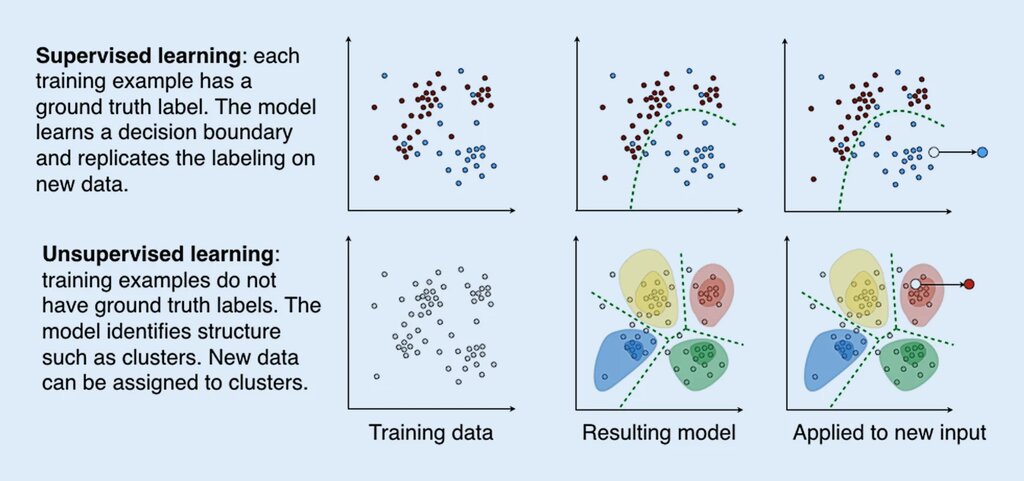
Machine learning has two other major paradigms: supervised and unsupervised learning. Reinforcement learning is fundamentally different from both.
Supervised learning uses labeled data to make predictions. You give the model a question and the correct answer, and it learns the relationship between them. Think of it like studying with flashcards that already have the answers on the back.
Unsupervised learning finds hidden patterns in unlabeled data. You give the model a dataset and it tries to find clusters or structures on its own, without any answer key.
This diagram shows the basic idea behind those two approaches.
Reinforcement learning, however, doesn't start with a dataset. The agent generates its own data by exploring the environment. It learns from the consequences of its actions, guided only by the rewards it receives. There is no instructor telling the agent what the right move is in any given situation. It has to figure that out for itself.
The Power of the Reward
The reward signal is the most important part of reinforcement learning. It is the sole indicator of success for the agent. The agent’s only goal is to choose actions that will give it the highest possible total reward over time. Everything it learns is in service of this goal.
This is a simple but powerful idea. By carefully designing a reward system, we can guide an agent to learn complex behaviors. For example, in a chess game:
- +1 for capturing an opponent's piece.
- -1 for losing one of your own pieces.
- +100 for winning the game.
- -100 for losing the game.
Given these simple rules, the agent will learn not just to capture pieces, but to develop sophisticated strategies to checkmate the opponent, because that action leads to the biggest prize.
The reward signal defines the goal. If the reward doesn't align with the desired outcome, the agent might learn an unintended or even harmful behavior.
This principle of learning through feedback is what allows RL to tackle dynamic problems where the optimal path isn't known ahead of time. The agent discovers the best strategies on its own, one action and one reward at a time.
What is the primary goal of an agent in Reinforcement Learning?
In the analogy of teaching a dog to fetch, what does the 'treat' represent in the Reinforcement Learning framework?