Deep Learning Fundamentals
Introduction to Neural Networks
What Is a Neural Network?
A neural network is a type of computing system inspired by the human brain. Instead of following a rigid set of pre-programmed rules, it learns from examples. Its main job is to recognize patterns in data, whether that's identifying a cat in a photo, understanding spoken words, or spotting unusual activity in a financial transaction.
Think of it like teaching a toddler. You don't give a child a rulebook for what a dog is. You show them pictures of dogs—big ones, small ones, fluffy ones—and say "dog." Over time, the child's brain wires itself to recognize the key features of a dog. Neural networks learn in a similar way, by processing many examples and adjusting their internal structure to find the underlying patterns.
Inspired by the Brain
The core idea for neural networks comes from biology. Our brains are made of billions of cells called neurons, which are connected to each other, forming a massive network. When we learn, the strength of the connections between these neurons changes.
neuron
noun
A specialized cell in the nervous system that transmits information to other nerve cells, muscle, or gland cells.
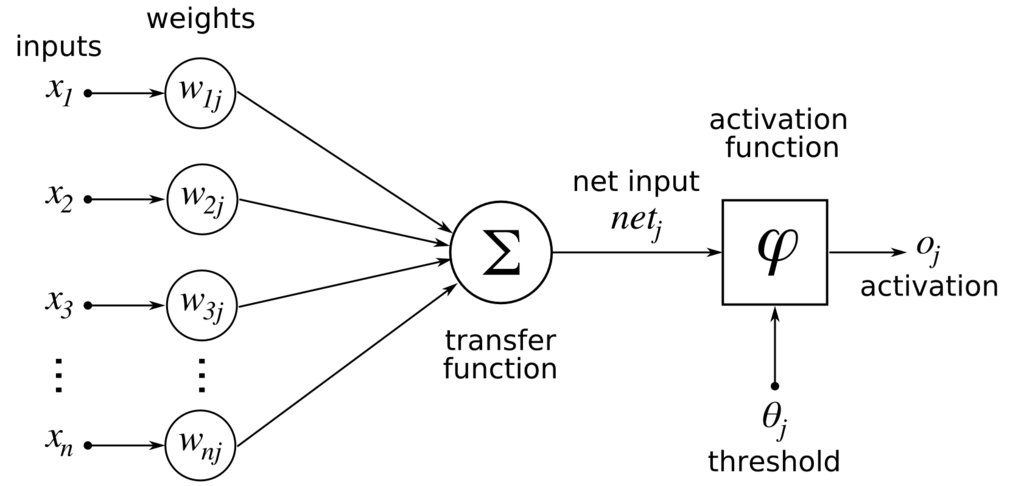
Artificial neural networks are a simplified model of this. They are built from a few basic components:
- Neurons (or Nodes): These are the fundamental units, like a single biological neuron. Each one holds a number and performs a simple calculation.
- Connections: These link neurons together, acting like the synapses in our brains. They pass information from one neuron to the next.
- Weights: Every connection has a weight, which is a number that determines the strength and importance of the connection. A connection with a larger weight has more influence on the next neuron.
- Biases: Each neuron has a bias, which is like a thumb on the scale. It's a number that makes it easier or harder for the neuron to activate, regardless of its inputs.
By adjusting these weights and biases, the network learns. A positive weight means one neuron activating makes the next one more likely to activate, while a negative weight makes it less likely.
The Basic Structure
Individual neurons aren't very powerful on their own. Their strength comes from being organized into layers. A simple neural network has at least three layers.
-
Input Layer: This is the network's front door. It receives the initial data. For an image, each neuron might correspond to a single pixel's brightness. For a loan application, neurons might represent age, income, and credit score.
-
Hidden Layer(s): These layers are sandwiched between the input and output. They are where the real work happens. The network combines the inputs in many different ways, identifying features and patterns that aren't immediately obvious. A network can have one or many hidden layers. The more hidden layers, the more complex the patterns it can learn.
-
Output Layer: This is the final layer. It produces the network's result. If the network is classifying images, the output layer might have one neuron for each category (e.g., "cat," "dog"). The neuron with the highest value is the network's prediction.
How Information Flows
Data travels through the network in one direction, from input to output. This process is called forward propagation.
It starts when you feed data into the input layer. Each input neuron passes its value to the neurons in the first hidden layer. Each neuron in the hidden layer calculates a weighted sum of all its inputs, adds its bias, and then uses that result to generate its own output. This output is then passed to the next layer.
This cascade continues, layer by layer, until the output layer is reached and a final result is produced.
Imagine a very simple calculation at a single neuron. It receives inputs from two other neurons, with values and . The connections have weights and , and the neuron has a bias . The neuron calculates:
This weighted sum is then used to determine the neuron's final output. The network performs millions of these simple calculations to arrive at a complex decision.
But how does the network know what the weights and biases should be? It learns them. Initially, the weights are set to random values. The network makes a guess, compares its guess to the correct answer, and then slightly adjusts its weights and biases to make a better guess next time. Over thousands or millions of examples, these tiny adjustments tune the network to become highly accurate.
What is the primary way a neural network learns?
In a neural network, which layer is responsible for receiving the initial data, such as the pixels of an image or a user's age and income?
This is the fundamental principle of a neural network: a simple structure of interconnected nodes that can be trained to recognize complex patterns by adjusting the strength of its connections.