Deep Learning Fundamentals
Introduction to Neural Networks
The Brain's Blueprint
At its core, a neural network is a computational model inspired by the human brain. It's designed to recognize patterns by mimicking the way biological neurons signal to one another. Think of it as a team of simple calculators, each performing a small task, that together can solve complex problems.
The fundamental unit of this system is the artificial neuron, sometimes called a node or perceptron. Each neuron receives one or more inputs, processes them, and passes an output along to other neurons.

Let's break down how this little worker operates. It takes in information, but it doesn't treat all information equally. Each input is assigned a weight, which is just a number that represents its importance. An input with a higher weight has more influence on the neuron's output. Think of it as listening more to a trusted advisor than to a random stranger.
There's also a bias, which is an extra input that's always 'on'. The bias helps adjust the output, acting like a thumb on a scale. It allows the neuron to shift its activation threshold, making it easier or harder for the neuron to fire.
A single neuron isn't very powerful on its own. The real strength of neural networks comes from connecting many of these neurons together into layers.
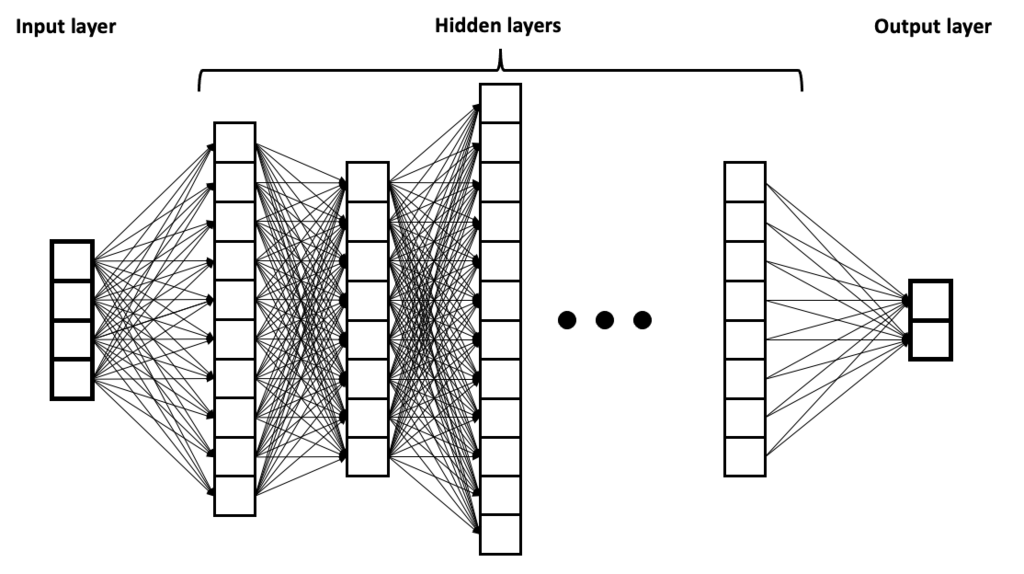
A typical network has at least three types of layers:
- Input Layer: This is the network's front door. It receives the raw data you want to process. For example, if you're analyzing a picture, each neuron in the input layer might correspond to the brightness of a single pixel.
- Hidden Layers: These are the layers between the input and output. There can be one or many hidden layers. This is where the network does its heavy lifting, identifying patterns and transforming the data in complex ways. The more hidden layers, the "deeper" the network.
- Output Layer: This layer produces the final result. If you're building a network to classify images of cats and dogs, the output layer might have two neurons, one for 'cat' and one for 'dog'.
How a Network Thinks
The process of information moving through a network is called forward propagation. It’s a one-way trip, starting at the input layer and ending at the output layer. There's no looping back.
Inside each neuron, a simple calculation happens. First, it multiplies every input by its corresponding weight. Then, it adds up all these weighted inputs and adds the bias. This gives a single number.
But the neuron doesn't just pass this number along. The sum () is then fed into an activation function. This function's job is to decide what the neuron's output should be based on that sum. It squashes the number into a more useful range, like between 0 and 1, or -1 and 1.
Activation functions introduce non-linearity to the network, which is just a fancy way of saying they allow the network to learn complex, curvy relationships in the data, not just straight lines.
A common example is the sigmoid function, which takes any number and squeezes it into an output between 0 and 1. It produces an S-shaped curve. A value of 0.5 might mean the neuron is uncertain, while a value close to 1 means it's highly activated or 'firing'.
This process repeats layer by layer. The outputs of one layer become the inputs for the next, until a final result is produced by the output layer. The weights and biases are the knobs the network tunes during training to get better at its task. By adjusting them, the network learns to make more accurate predictions.
What is the fundamental computational unit of a neural network, inspired by the human brain?
In the context of a single neuron, what is the role of the 'bias'?