Deep Learning Fundamentals
Introduction to Deep Learning
What Is Deep Learning?
Think about how a child learns to recognize a dog. You don't give them a list of rules like "if it has four legs, fur, and a wagging tail, it's a dog." Instead, you just point out dogs. Over time, after seeing many different dogs—big, small, fluffy, sleek—the child's brain automatically figures out the key features. They build an internal concept of "dog."
Deep learning works in a similar way. It's a specific type of machine learning that uses structures inspired by the human brain, called artificial neural networks. The "deep" part simply means these networks have many layers. Each layer learns to recognize something slightly more complex than the last, building knowledge from simple patterns to sophisticated concepts.
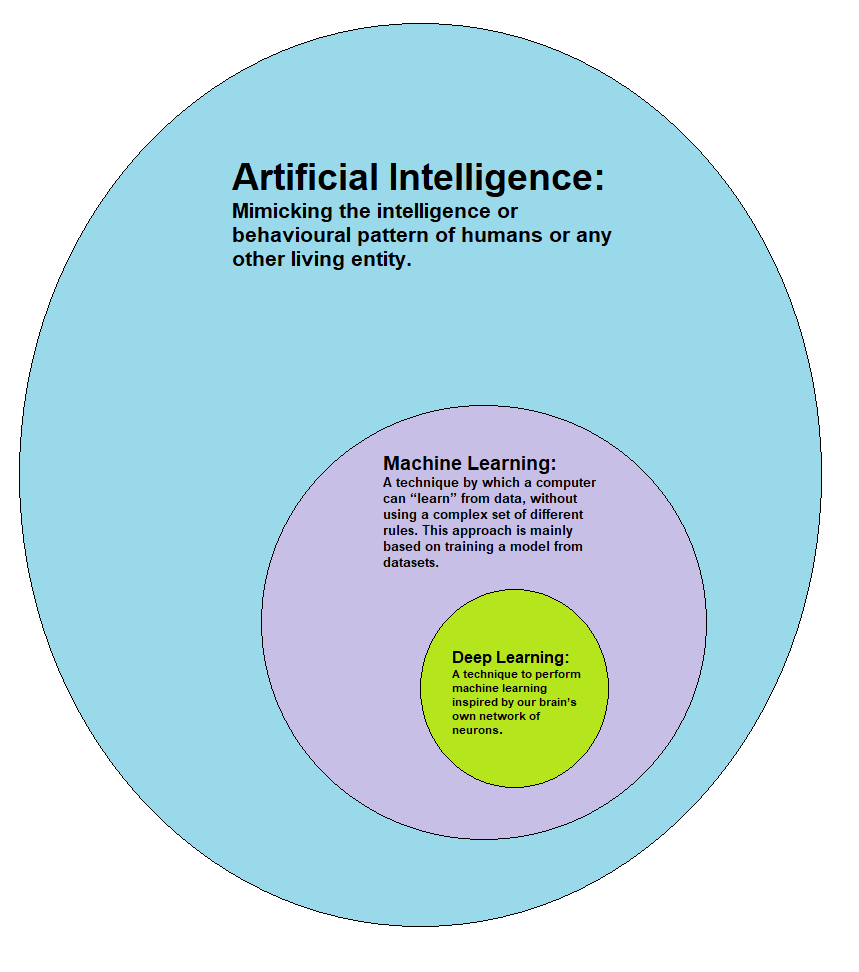
These multi-layered networks allow the machine to learn from huge amounts of data, like thousands of images or hours of audio, without being explicitly programmed for every detail. Just like the child learning to spot a dog, a deep learning model can learn to identify objects, understand language, or even compose music by processing vast numbers of examples.
Neural Network
noun
A computational model inspired by the structure and function of the human brain. It consists of interconnected nodes, or 'neurons,' organized in layers that process information and learn from data.
Machine Learning vs. Deep Learning
So, how is deep learning different from the traditional machine learning we've discussed? The biggest distinction lies in something called feature extraction.
In traditional machine learning, a data scientist has to do a lot of upfront work. They must manually identify and select the important features, or characteristics, in the data and feed them to the model. For example, to build a model that identifies cars in photos, a programmer would have to explicitly tell it to look for features like wheels, windows, and headlights.
Deep learning automates this process. You can feed the raw data—in this case, the pixels of the images—directly into a deep neural network. The network’s layers will learn the relevant features on their own, progressing from simple features like edges and colors in the first layers to more complex features like wheels and doors in deeper layers. This ability to self-learn from raw data is what makes deep learning so powerful.
| Feature | Traditional Machine Learning | Deep Learning |
|---|---|---|
| Feature Extraction | Requires manual, human-guided feature engineering. | Learns features automatically from data. |
| Data Amount | Performs well on smaller datasets. | Requires large datasets to perform well. |
| Hardware | Can run on standard CPUs. | Often requires powerful GPUs for efficiency. |
| Problem Solving | Breaks problems down into smaller parts. | Solves problems in an end-to-end manner. |
Why Go Deep?
The main advantage of deep learning is its performance on very large and complex datasets. While a traditional machine learning model might plateau in its performance as you give it more data, a deep learning model often continues to improve. This makes it perfect for the era of "big data."
It excels at handling unstructured data, like images, text, and audio, which make up the vast majority of data in the world. Traditional methods struggle to parse this kind of information effectively.
Deep learning models thrive on complexity and scale. The more data they see, the better they become at finding intricate patterns that humans might miss.
Deep Learning in the Wild
You probably interact with deep learning applications every day without realizing it. They are the engine behind many of the technologies we now take for granted.
Here are just a few examples:
-
Computer Vision: This is one of the most prominent fields. Deep learning powers facial recognition on your phone, helps self-driving cars identify pedestrians and other vehicles, and allows doctors to analyze medical scans like X-rays and MRIs with greater accuracy.
-
Natural Language Processing (NLP): When you use a translation service like Google Translate or talk to a chatbot, you're using deep learning. It helps machines understand the context and nuance of human language.
-
Speech Recognition: Virtual assistants like Siri, Alexa, and Google Assistant rely on deep learning to convert your spoken words into commands they can execute.
From recommending your next movie on Netflix to powering scientific research, deep learning is fundamentally changing how we solve complex problems.
Ready to check your understanding of these core concepts?
What is the primary difference between deep learning and traditional machine learning regarding 'feature extraction'?
The "deep" in deep learning refers to the large amount of data the model processes.