Deep Learning Fundamentals
Introduction to Deep Learning
What Is Deep Learning?
Deep learning is a specific method within the broader field of machine learning. Instead of being explicitly programmed, deep learning models learn from vast amounts of data. The key difference lies in how they learn. While traditional machine learning might rely on structured, labeled data and more direct guidance, deep learning uses complex, multi-layered structures called neural networks.
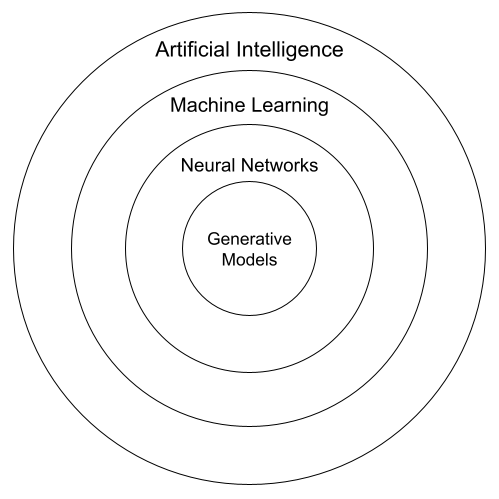
Think of it like a set of Russian nesting dolls. Artificial Intelligence is the biggest doll, encompassing all techniques that enable machines to mimic human intelligence. Machine learning is a smaller doll inside it, focusing on algorithms that learn from data. Deep learning is an even smaller doll inside machine learning, using deep neural networks to solve highly complex problems.
Inspired by the Brain
The structure that powers deep learning is the artificial neural network (ANN). As the name suggests, ANNs are loosely inspired by the biological neural networks in the human brain. They aren't literal copies, but they borrow the basic idea of interconnected nodes, or neurons.
A basic neural network is organized into layers:
- Input Layer: This is the network's front door. It receives the initial data, like the pixels of an image or the words in a sentence.
- Hidden Layers: These are the layers between the input and output. The “deep” in deep learning refers to having many hidden layers. Each layer processes the information from the previous one, looking for increasingly complex patterns.
- Output Layer: This is the final layer that produces the result, such as identifying an object in a photo or translating a sentence.
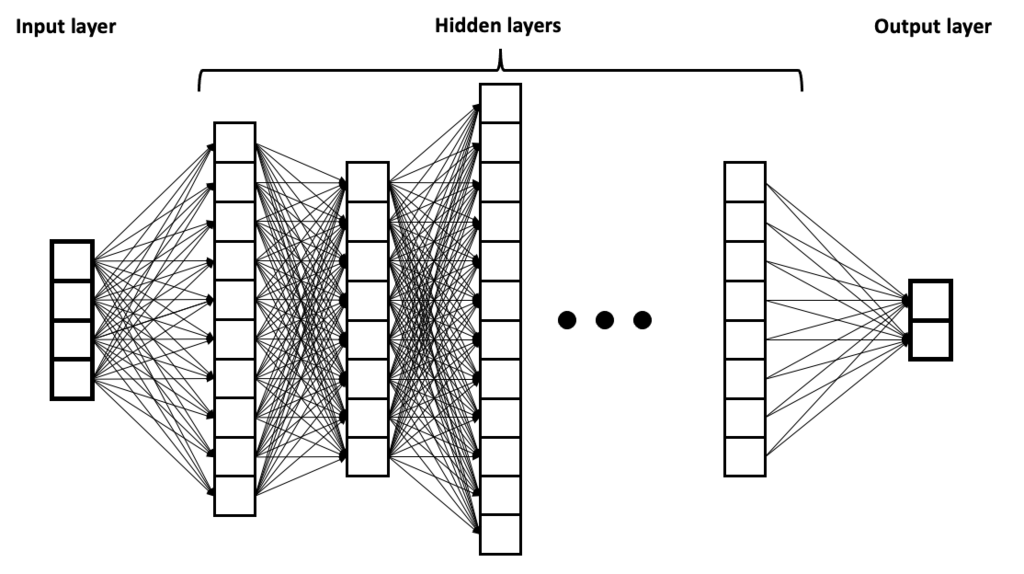
Each node in a layer receives inputs from nodes in the previous layer. It performs a simple calculation and then decides whether to pass a signal to the next layer. This decision is made by a component called an activation function.
Think of an activation function as a gatekeeper for each neuron. It looks at the incoming signal and decides if it's strong or important enough to open the gate and let it pass through to the next set of neurons.
This simple mechanism, repeated millions of times across many layers, allows the network to learn incredibly intricate patterns from data. Without activation functions, neural networks could only learn very simple, linear relationships.
What Can Deep Learning Do?
The ability to recognize complex patterns makes deep learning incredibly powerful for certain types of problems, especially those involving unstructured data like images, sounds, and text.
| Application Area | Example |
|---|---|
| Image Recognition | Identifying faces in photos, diagnosing diseases from medical scans, or enabling self-driving cars to see pedestrians. |
| Natural Language Processing (NLP) | Powering language translation apps, chatbots, and email spam filters. |
| Speech Recognition | Allowing voice assistants like Siri and Alexa to understand your commands. |
These tasks are difficult for traditional programming because the
rules are hard to define. How would you write a program to identify a cat? You'd have to account for every possible breed, color, angle, and lighting condition. Deep learning avoids this by learning the features of a cat directly from thousands of cat photos.
Which statement best describes the relationship between Artificial Intelligence (AI), Machine Learning (ML), and Deep Learning (DL)?
The term “deep” in deep learning refers to what characteristic of a neural network?