Deep Focus Mastery
Attention Mechanisms
Your Brain's Gatekeeper
Your brain is bombarded with information every second. Sights, sounds, smells, thoughts—it’s a constant flood. If you had to consciously process everything, you'd be overwhelmed instantly. So how do you focus on anything at all?
You have a gatekeeper. It's a network of neurons at the base of your brain called the Reticular Activating System, or RAS.
Reticular Activating System
noun
A network of nerve pathways in the brainstem connecting the spinal cord, cerebrum, and cerebellum, and mediating the overall level of consciousness.
Think of the RAS as a bouncer at the door of a club, which is your conscious mind. The bouncer decides what information gets in and what stays out. It's constantly scanning the environment and asking:
- Is this a threat?
- Is this new or unusual?
- Is this something I’ve been told is important?
This system is ancient. For our ancestors, it was a survival tool. A snapping twig in the woods (threat, novelty) would instantly grab their attention, thanks to the RAS. This automatic, stimulus-driven focus is called bottom-up attention.
Bottom-up attention is reactive. It's your brain's alarm system, pulling your focus toward things it deems urgent or important for survival.
In the modern world, this system gets hijacked. The ping of a notification, a flashing ad, or a breaking news alert are all treated like that snapping twig. Your RAS flags them as new and potentially important, pulling your focus away whether you want it to or not.
The CEO of Your Brain
If the RAS is the automatic alarm system, your Prefrontal Cortex (PFC) is the executive who decides what to do about the alarm. Located right behind your forehead, the PFC is the most evolved part of your brain. It's responsible for planning, reasoning, and consciously directing your focus.
This deliberate, goal-driven focus is called top-down attention. It's what you use when you decide to read a book, solve a math problem, or listen carefully to a friend. You are consciously telling your brain, "This is important right now. Pay attention to this and ignore other things."
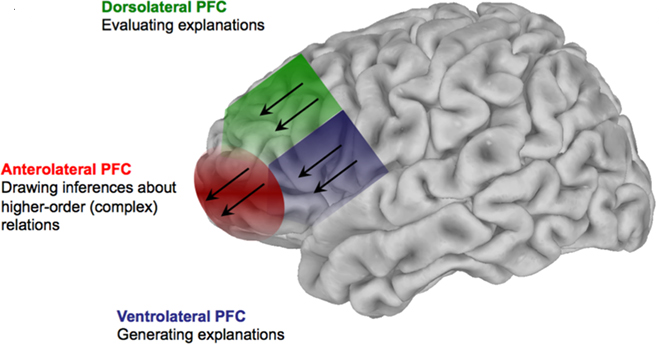
Deep focus happens when your PFC is in charge, successfully telling the RAS to ignore the constant stream of distractions. But this takes effort. Your PFC is like a muscle; it can get tired. When it's fatigued, the automatic, bottom-up system takes over more easily, and you find yourself getting distracted by every little thing.
The Cost of Switching
Every time you give in to a bottom-up distraction—even for a moment—you pay a price. Let's say you're writing an important report (a top-down task). You hear an email notification, and you quickly check it. It's just spam, so you immediately switch back to your report.
It seems harmless, but it's not. For the next several minutes, a part of your mind is still thinking about that email. Who was it from? Was it important? This lingering distraction is called attention residue.
Attention residue is the cognitive cost of task switching. When you switch tasks, your focus doesn't follow instantly. It leaves a 'residue' behind on the previous task, degrading your performance on the new one.
This residue makes it harder to concentrate, leading to shallower thinking, more mistakes, and less creativity. The more you switch, the more residue builds up, and the harder your PFC has to work to maintain focus. This is why a day filled with constant interruptions can leave you feeling exhausted, even if you didn't accomplish much.
Understanding these built-in mechanisms is the first step toward managing them. Your brain is wired for distraction, but it's also wired for deep, deliberate focus. The key is to create an environment where your PFC can do its job without constantly fighting the alarms triggered by your RAS.
What is the primary role of the Reticular Activating System (RAS) in the brain?
You are trying to solve a difficult math problem, deliberately ignoring the conversation happening nearby. This is an example of: