Deep Dive into Linked Lists and Pointer Algorithms
Memory Management Techniques
Where Nodes Live: Stack vs. Heap
When you declare a simple variable inside a function, like int x = 5;, the computer stores it in a neat, orderly place called the stack. The stack is fast and manages itself. When the function finishes, any variables it created are automatically wiped away. It’s efficient, but also rigid. The size of everything on the stack must be known when the program is compiled.
Linked lists need more flexibility. We don't know how many nodes we'll need ahead of time. For this, we use a different region of memory called the heap. The heap is a large, unstructured pool of memory available for a program to use as it runs. When you want to add a new node to your list, you dynamically request a small piece of the heap. This allocation is manual, giving you control over the memory's lifetime.
The stack is for data whose size and lifetime are known at compile time. The heap is for data whose size and lifetime are determined at runtime.
The Lifecycle of Dynamic Memory
Every node in a linked list follows a three-step lifecycle: allocation, usage, and deallocation. Getting this cycle right is fundamental to writing stable, low-level programs.
- Allocation: You explicitly ask the operating system for memory from the heap. In C, you'd use a function like
malloc(), specifying how many bytes you need. In C++, thenewoperator handles this. If the request is successful, the system gives you a pointer to the start of your new block of memory. - Usage: Your program uses this pointer to access the memory. You can store data in the node (like a number or a string) and set its
nextpointer to link it into your list. - Deallocation: This is the crucial part. The heap does not clean up after itself. When you're done with a node, you must manually return its memory to the system using
free()(formalloc) ordelete(fornew). If you don't, you create a memory leak—the memory remains allocated but is no longer accessible by your program.
Because the programmer controls memory allocation and deallocation, failing to free memory (memory leaks) or freeing memory incorrectly can lead to issues like memory leaks, undefined behavior, or segmentation faults.
Forgetting to deallocate memory might not crash your program immediately, especially if it's small. But in a long-running application like a web server or an operating system, even a tiny leak can accumulate over time, consuming all available memory and eventually causing a crash. This is why careful memory management is so important.
Fragmentation and the Cache
Because linked list nodes are allocated one by one, they can end up scattered all over the heap. An array, by contrast, always occupies a single, continuous block of memory. This fundamental difference has significant performance implications.
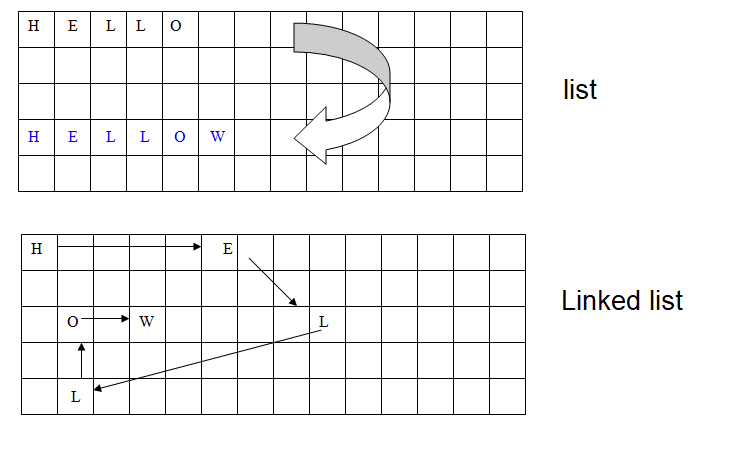
This scattering of nodes leads to memory fragmentation—a situation where the free memory on the heap is broken into many small, non-contiguous chunks. Even if you have enough total free memory, you might not be able to allocate a large, continuous block for another data structure, like a big array. It’s like having a parking lot full of single empty spots when you need to park a bus.
This also affects performance at the hardware level. Modern CPUs don't fetch data from main memory (RAM) one byte at a time. Instead, they pull in larger chunks called cache lines into a small, extremely fast memory buffer called the CPU caches. When you access an element in an array, the CPU often pulls in its neighbors along with it. This is called cache localitys. So, when you iterate through the array, the next few elements you need are likely already in the super-fast cache.
With a linked list, each time you follow a pointer to the next node, you might be jumping to a completely different part of memory. This often results in a cache miss, where the data you need isn't in the cache. The CPU has to pause and wait for the data to be fetched from the much slower main memory. This can make iterating through a linked list significantly slower than iterating through an array of the same size, even though both might have the same theoretical time complexity.
Where are simple variables, like int x = 5;, declared inside a function typically stored?
What is the primary reason linked list nodes are usually allocated on the heap?
Understanding these low-level details—how memory is allocated, organized, and accessed by hardware—is what separates building a simple data structure from engineering an efficient system.