Deep Dive into Large Language Models
Transformer Architecture
The Transformer Architecture
Large Language Models (LLMs) might seem like magic, but they're built on a clever design called the Transformer architecture. Before Transformers, models like Recurrent Neural Networks (RNNs) processed text one word at a time, like a person reading a sentence from left to right. This was slow and made it hard for the model to remember the beginning of a long sentence by the time it reached the end.
Transformers changed the game. Instead of reading sequentially, they process all words in a sentence at once. This parallel processing is not only faster but also much better at understanding the relationships between words, no matter how far apart they are. This is the key that unlocked the power of modern AI.
A Large Language Model uses a Transformer Model architecture that processes input through encoding and decoding stages to generate an output prediction.
The Encoder and Decoder
At its core, the Transformer has two main parts: an encoder and a decoder. Think of them as two specialists working together.
-
The Encoder: Its job is to read and understand the input text. It takes a sentence and creates a detailed numerical representation of it, capturing the meaning and context of every word. It's like a researcher reading a document and taking comprehensive notes.
-
The Decoder: Its job is to take the encoder's notes and generate the output. For a translation task, it would take the encoded English sentence and start writing the French translation, one word at a time. It looks at the encoder's understanding and what it has already written to decide the next best word.
This two-part structure allows the model to build a rich understanding of the source text before it even begins to generate a response.
Some models, like GPT, are decoder-only. They are designed specifically for text generation and don't have a distinct encoder part. Others, like BERT, are encoder-only and are used for tasks that require understanding text, like sentiment analysis.
The Secret Sauce: Self-Attention
The most important innovation of the Transformer is the self-attention mechanism. It allows the model to weigh the importance of different words in the input text as it processes a specific word.
Consider the sentence: "The robot picked up the ball because it was heavy." What does "it" refer to? A human knows "it" refers to the ball, not the robot. Self-attention gives the model a similar ability. When processing the word "it", the model can pay more attention to "ball" and less to "robot", correctly understanding the relationship.
This is done using three vectors for each word: a Query, a Key, and a Value.
- Query (Q): Represents the current word being processed. Think of it as a question: "I am the word 'it'. What other words in this sentence are most relevant to me?"
- Key (K): A label for all the words in the sentence. It's like a keyword on a file folder. The query vector is compared against all the key vectors to find the best match.
- Value (V): Contains the actual meaning of each word. Once the query finds the most relevant key (e.g., the key for "ball"), the model takes the corresponding value vector to get the rich contextual information from that word.
The model calculates a score to see how well each query matches each key. These scores are then used to create a weighted sum of all the value vectors, which becomes the new representation for the query word.
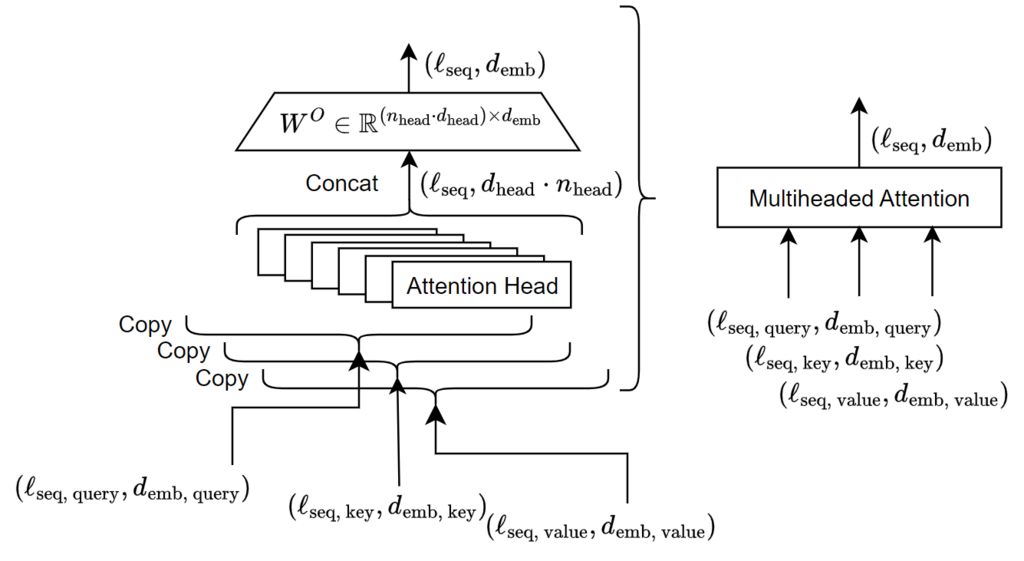
To make this process even more powerful, Transformers use Multi-Head Attention. Instead of calculating attention just once, it does it multiple times in parallel, each with different, learned linear projections of the original Q, K, and V vectors. Each "head" can learn to focus on different types of relationships, like grammatical structure or semantic meaning. The outputs from all heads are then combined to produce a final, comprehensive attention result.
Putting It All Together
A few other components are crucial for making the Transformer work.
Feedforward Neural Networks After the attention mechanism has done its work, the output is passed through a simple feedforward neural network. This happens independently for each word's representation. This step processes the information gathered by the attention layer and adds another layer of computational depth, allowing the model to learn more complex patterns.
Positional Encoding Because the Transformer processes all words at once, it has no inherent sense of word order. "The man bites the dog" and "The dog bites the man" would look the same to it. To fix this, we add a piece of information to each word's embedding called positional encoding.
This is a vector that gives the model a signal about the position of each word in the sequence. It's like adding a timestamp or a page number, so the model knows that a word is at the beginning, middle, or end of a sentence. The model can then learn to use this information to understand grammar and context that depend on word order.
By combining the encoder-decoder structure, multi-head self-attention, feedforward networks, and positional encodings, the Transformer creates a powerful and efficient architecture for understanding and generating language. Its ability to process text in parallel and capture long-range dependencies is what sets it apart from older models and powers today's most advanced LLMs.
Time to check your understanding.
What is the primary advantage of the Transformer architecture's parallel processing compared to the sequential processing of older models like RNNs?
In the self-attention mechanism, what is the role of the 'Query' (Q) vector?
These components form the foundation of how models like GPT and BERT process language so effectively.