Deconstructing the Stoic Opposition
Senatorial Dignitas
The Senatorial Conception of Libertas
In the context of the early Roman Empire, libertas was not a universal right but a specific, class-based privilege. For the senatorial elite, it meant freedom from the domination of a superior, the autonomy to engage in public life, and the preservation of their traditional role in governing the state. It was the freedom to speak one's mind in the Curia, to compete for magistracies, and to maintain one's standing without fear of arbitrary reprisal from an autocrat. This aristocratic libertas was fundamentally incompatible with the principate's centralizing logic, which steadily eroded the Senate's political functions and concentrated authority in the emperor, or Princeps.
Tacitus viewed the alternation of power between plebs and patres during the Republic against the backdrop of an unwritten, ‘living’ constitution consisting of mos (ancestral custom) and ius (justice or law, broadly understood).
The Julio-Claudian emperors, while often paying lip service to the Republic's traditions, systematically subverted the Senate's power. They controlled elections, dictated policy, and held the ultimate military authority. For a senator, this transformation wasn't just a political shift; it was a personal affront, a direct assault on the very foundation of their social and political identity which was rooted in the mos maiorum, the ancestral customs that had guided the Republic.
Dignitas as Political Capital
At the heart of the senatorial resistance was the concept of dignitas, a potent blend of personal honor, public reputation, and ancestral prestige. Dignitas was not a private virtue but a public commodity, earned through service to the state and demonstrated through political influence. For a Roman aristocrat, their dignitas was their most valuable asset. The rise of the Princeps created a zero-sum game: as the emperor's power grew, the Senate's capacity for meaningful political action—and thus its collective dignitas—inevitably shrank.
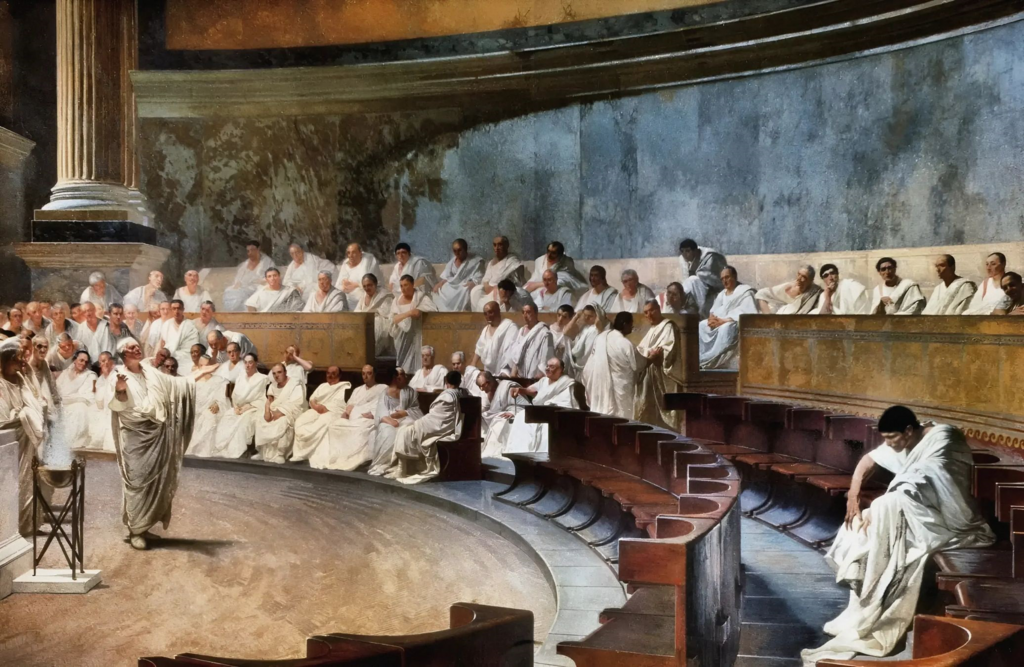
Every imperial encroachment, from controlling the treasury to conducting foreign policy unilaterally, was a wound to the Senate's honor. Emperors who failed to manage this dynamic, like Caligula or Nero, faced conspiracies and hostility not merely for their cruelty, but because they made the senators' impotence plain. They stripped away the illusion of shared governance, exposing the raw autocracy that lay beneath the carefully constructed facade of the restored Republic. This wasn't just about losing power; it was about public humiliation.
The Stoic Opposition
The so-called Stoic Opposition was less a coherent philosophical movement and more a political banner for disgruntled senators. Figures like Thrasea Paetus and Helvidius Priscus used the language of Stoicism—virtue, reason, and indifference to fate—to frame their traditionalist resistance in noble, philosophical terms. For them, true virtue was inseparable from the freedom to act upon one's principles in the political arena. A senator who could not speak freely or act with integrity was, in a Stoic sense, unable to live a virtuous life.
Stoicism provided a moral and intellectual framework for senators to conceptualize their opposition to imperial overreach, casting their defiance not as a grab for power, but as a stand for virtue itself.
This opposition, however, was also deeply intertwined with the economic interests of the senatorial class. These were not just men of principle; they were also the wealthiest landowners in the empire. Imperial centralization threatened their control over provinces, which were often a source of immense personal wealth. The emperor's expanding network of procurators and imperial freedmen encroached upon traditional senatorial domains of patronage and finance. Therefore, their stand for 'libertas' was also a defense of their economic privileges and the socio-economic order that had long favored them.
Ultimately, the struggle between the Senate and the Princeps was a conflict between two irreconcilable models of governance. The senators, particularly those who adopted a Stoic posture, clung to a Republican ideal where power was shared among a class of 'equals'. The emperors, by necessity, pursued a model of centralized authority essential for managing a vast and complex empire. The language of 'libertas' and 'dignitas' became the vocabulary of a losing battle, a nostalgic protest against the inevitable consolidation of power in one man's hands.