Deconstructing the Chrysippean System
Propositional Indemonstrables
The Indemonstrable Foundation
Chrysippus of Soli didn't just contribute to Stoic logic; he built its very engine. He formalized a system of propositional logic designed to be an unbreachable fortress against the relentless critiques of the Academic Skeptics. At the heart of this system were five 'indemonstrables' (ἀναπόδεικτοι λόγοι), elementary argument forms so self-evidently valid they required no proof. These were not mere intellectual exercises but the foundational schemas from which all other valid arguments could be derived through a set of transformation rules (θέματα).
Chrysippus was one of the first to organise propositional logic as an intellectual discipline.
The entire structure rested on the Stoic concept of the (λεκτόν), the incorporeal 'sayable' or proposition that is the actual bearer of truth or falsity. By focusing on the relationships between these abstract propositions, Chrysippus shifted logic from the analysis of terms to the analysis of complex statements, creating a powerful system of inference.
The Five Schemas
Chrysippus's genius was in identifying a complete set of basic inference patterns. These five schemas, using ordinal numbers for propositional variables, form the bedrock of his system. Any complex argument could be reduced to a chain of these indemonstrables. They represented a form of logical atomism, where these patterns were the indivisible units of valid inference.
| Indemonstrable | Structure | Modern Name |
|---|---|---|
| First | If the first, then the second. But the first. Therefore, the second. | Modus Ponens |
| Second | If the first, then the second. But not the second. Therefore, not the first. | Modus Tollens |
| Third | Not both the first and the second. But the first. Therefore, not the second. | Exclusive Disjunction |
| Fourth | Either the first or the second. But the first. Therefore, not the second. | Alternative Disjunction |
| Fifth | Either the first or the second. But not the second. Therefore, the first. | Disjunctive Syllogism |
Proposition vs. Term
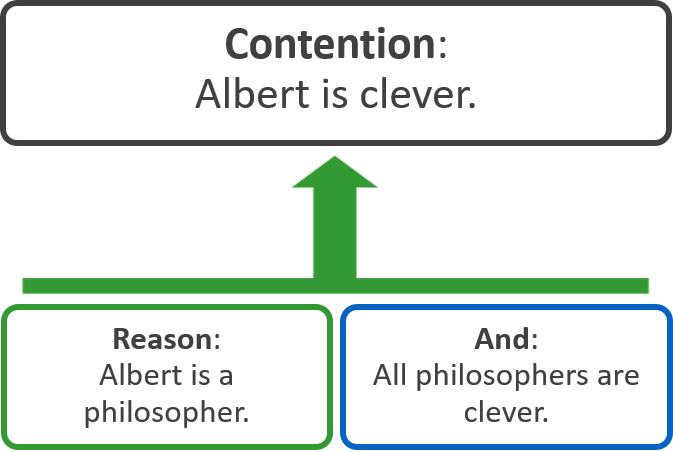
The fundamental divide between Chrysippean and Aristotelian logic lies in their basic unit of analysis. Aristotle's syllogistic is a term logic. It analyzes the relationships between categories or classes, as in "All men are mortal; Socrates is a man; therefore, Socrates is mortal." The validity rests on how the terms 'Socrates', 'man', and 'mortal' are distributed across the premises.
Chrysippus’s system, by contrast, is a propositional logic. It is unconcerned with the internal structure of the propositions themselves. The variables—'the first', 'the second'—stand for entire statements (lekta) which can be true or false. The validity of modus ponens holds whether the propositions are "If it is day, it is light" or "If a number is even, it is divisible by two." The logical connective ('if...then', 'or', 'and') is what matters. This represented a major leap in abstraction, creating a system that analyzed the syntax of argument itself.
From Syntax to Ontology
For the Stoics, logic was not a detached formal game; it was a map of the rational structure of the cosmos itself, which they identified with God or Zeus. The indemonstrables were more than just rules for correct reasoning; they mirrored the necessary connections within the causally determined universe. The logical necessity of "If p, then q; but p; therefore q" reflected the ontological necessity of cause and effect.
For Chrysippus the paradigmatically true conditional is one where the contradictory of the consequent conflicts with the antecedent.
This is how Chrysippus moved from linguistic syntax to ontological necessity. A valid logical argument wasn't just a coherent arrangement of words; it was a small-scale model of the universe's own rational unfolding. The rigor of his propositional logic was meant to provide an unshakable epistemic foundation—the kriterion of truth—that could withstand skeptical doubt. By establishing a system where complex truths could be reliably derived from self-evident logical atoms, he aimed to secure the entire Stoic philosophical architecture, from physics to ethics, on a bedrock of logical certainty.
What was the fundamental unit of analysis in Chrysippus's propositional logic?
Chrysippus developed his system of propositional logic primarily to create an unbreachable defense against the arguments of which philosophical school?