Deconstructing Roman Philosophical Adaptation
Roman Pragmatism vs Hellenistic Theoria
The Roman Filter
In the 1st-century BCE, the Roman elite did not simply import Greek philosophy; they filtered it. The Hellenistic pursuit of contemplative 'theoria'—knowledge as an end in itself—collided with the foundational Roman concept of 'mos maiorum', the ancestral customs that prioritized duty, tradition, and public life. For a Roman statesman, philosophy was never a detached intellectual exercise. It was a tool.
contemplation, theory
This instrumentalization was a core feature of the 'studia humanitatis' at Rome. Philosophical inquiry was valuable only when it served 'negotium', the business of public and private life. The Greek ideal of 'eudaimonia', or human flourishing achieved through contemplation, was reframed. For the Romans, it became a means to cultivate 'virtus' and 'gravitas'—the qualities of a leader, a man of action.
| Greek Ideal (Theoria) | Roman Adaptation (Negotium) |
|---|---|
| Pursuit of knowledge for its own sake | Knowledge as a tool for civic utility |
| Eudaimonia through contemplation | Virtus through practical application |
| Detached from political outcomes | Subordinate to the demands of the 'res publica' |
| The philosopher as an ideal | The statesman as an ideal |
The leading men of the Republic, figures like , engaged deeply with Stoic, Academic, and Peripatetic thought. Yet, their goal was not to become sages sequestered from the world. It was to become better orators, more effective senators, and more resilient commanders. Philosophy provided the language and intellectual framework to articulate and defend the very traditions of the Roman state. It was a whetstone for the mind, not a sanctuary for the soul.
Cicero subordinated philosophy to politics, so it should not surprise us to discover that his philosophy had a political purpose: the defense, and if possible the improvement, of the Roman Republic.
Utility over Truth
The tension is palpable. The Greek quest for 'physis' (natural order) often challenged 'nomos' (human convention). For the Romans, 'nomos'—specifically their 'mos maiorum'—was paramount. Any philosophical doctrine that radically questioned the foundations of the 'res publica' or promoted withdrawal from civic life, like certain interpretations of Epicureanism, was met with suspicion. The Athenian embassy of 155 BCE, featuring three prominent philosophers, famously showcased this clash. The Romans were intrigued by their rhetorical skill but wary of the moral relativism their arguments seemed to imply.
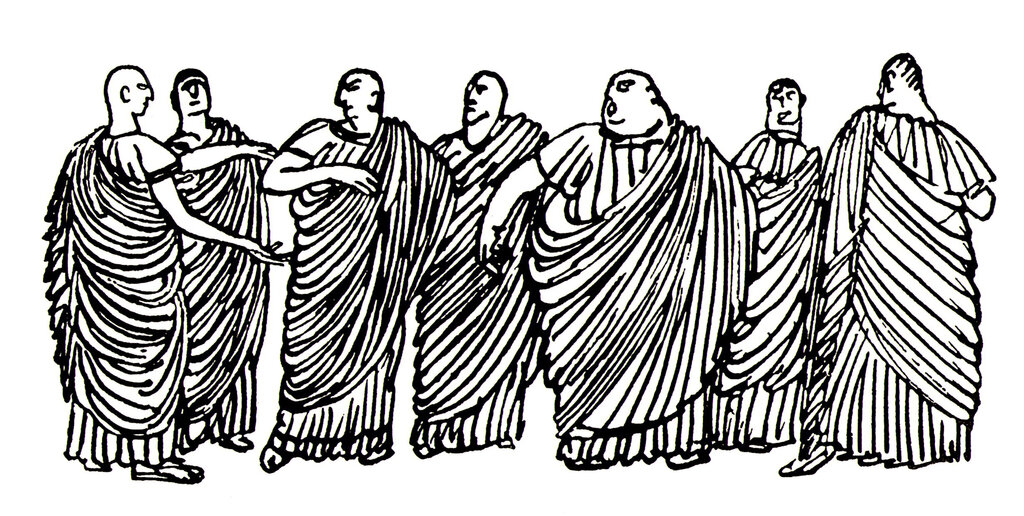
This selective adoption meant that aspects of Greek thought were amplified while others were discarded. The , rationality, and indifference to fortune resonated deeply with the Roman ideal of 'gravitas'. It provided a philosophical justification for the traditional Roman virtues of self-control and resilience in the face of political turmoil. The Stoic sage, in the Roman imagination, was not an ascetic hermit but a figure like Cato the Younger, whose philosophical convictions were demonstrated through unwavering political action.
Ultimately, the Roman engagement with Hellenistic philosophy was a pragmatic negotiation. The intellectual architecture was Greek, but the purpose was distinctly Roman. The pursuit of wisdom was tethered to the responsibilities of the citizen, ensuring that the 'vita contemplativa' always remained in service of the 'vita activa'.
Time to test your understanding of these dynamics.
What was the primary way the Roman elite approached Greek philosophy?
The Greek ideal of 'eudaimonia' (human flourishing through contemplation) was reframed by the Romans to mean a way to cultivate ________.