Deconstructing Roman Moral Historiography
Causal Models
Deconstructing the Moral Decline
The traditional narrative for the Roman Republic's fall is deceptively simple. For generations, historians following the Sallustian and Livian models pinpointed a specific moment of terminal decline: 146 BCE, the year Carthage was destroyed. The core of this argument is the concept of metus hostilis—the fear of a foreign enemy. This theory posits that the ever-present threat of Carthage compelled the Roman elite to maintain internal harmony (concordia) and traditional virtue (virtus). Once this external pressure vanished, so the story goes, avarice and ambition corrupted the state from within, setting the stage for the civil wars.
However, this moral-causal model is more of a literary construct than a historical reality. It serves as a powerful rhetorical tool, allowing authors like Sallust to diagnose the political decay of their own era by projecting its origins onto a mythologized past. Viewing 146 BCE as the definitive 'turning point' ignores the complex structural and economic pressures that truly drove the Republic's transformation.
Sallust’s Literary Diagnosis
Sallust’s Bellum Iugurthinum is a prime example of this technique. In his preface (praefatio), he explicitly states that the Republic functioned justly and with the greatest concord only as long as the fear of Carthage remained. He claims that after 146 BCE, the nobility began to abuse their power, and the people pushed back, leading to the strife that defined his own lifetime. This framing is deliberate. The war with Jugurtha, a corrupt North African king, becomes a case study for the very moral rot Sallust claims began decades earlier.
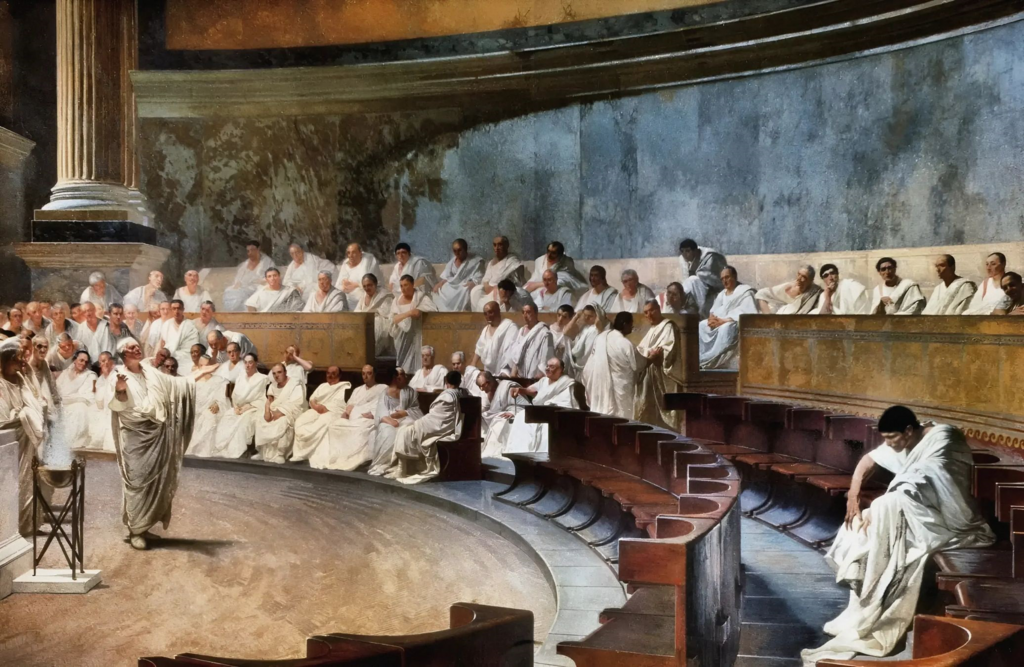
The irony in Sallust’s prose is palpable. He presents the metus hostilis thesis as a straightforward historical explanation, yet his narrative is filled with characters whose actions are driven by ambition and greed—qualities that were hardly absent before 146 BCE. His work is not an objective chronicle but a biased political commentary. He uses the fall of Carthage as a narrative device to create a clear 'before' and 'after,' allowing him to condemn the political chaos of the late Republic without directly attacking powerful contemporaries. He critiques the present by moralizing about the past.
Beyond the Moral-Causal Model
Critiquing the praefatio thesis requires moving beyond a simplistic moral framework. The decline of the Republic was not a sudden ethical collapse. It was a slow-burn process driven by profound structural changes. Imperial expansion brought immense wealth into Rome, but it was distributed unevenly, exacerbating class tensions. The professionalization of the army created legions more loyal to their generals than to the state, a direct consequence of prolonged overseas campaigns. These are not moral failures; they are the systemic consequences of an empire that outgrew its city-state political structure.
The 'metus hostilis' theory conveniently ignores the economic incentives and structural imperatives that underpinned Roman expansion long before and long after 146 BCE.
Sallust's narrative provided a satisfying, if inaccurate, explanation for the turmoil Romans were experiencing. It was easier to blame a loss of virtue than to confront the unsettling reality that the very mechanisms of imperial success were dismantling the Republic. The story of moral decay following Carthage's fall is a powerful myth, but treating it as a primary cause obscures the real, and far more complex, drivers of Rome's transformation from Republic to Empire.