Decoding the Human Essence
Classical Philosophical Foundations
The Soul's Blueprint
Are we born with a fixed nature, or are we blank slates shaped by experience? This question is at the heart of Western political and social thought. The ancient Greeks, particularly Plato, leaned heavily toward the idea of an innate human essence. He wasn't just talking about physical traits; he meant our psychological and moral makeup.
Plato proposed that the human soul is composed of three distinct parts, an idea known as the theory. He envisioned it as a chariot. One horse is the spirited, emotional part (Thymos), representing honor and courage. The other is the appetitive part (Epithymia), driving our base desires for food, drink, and sex. Holding the reins is the rational part (Logos), which seeks truth and knowledge. For Plato, a just and well-ordered person is one whose reason successfully guides the other two parts. This isn't a state we achieve; it's a reflection of our soul's inherent structure.
This framework is a cornerstone of essentialism, the philosophical view that objects, including people, have a set of attributes necessary to their identity and function. For Plato, our essence is this tripartite soul, and our purpose is to live according to its rational design. This isn't just a personal journey; it's a political one. In his work The Republic, Plato designs an ideal state where society is structured just like the soul, with philosopher-kings (reason), soldiers (spirit), and producers (appetite) each fulfilling their natural role.
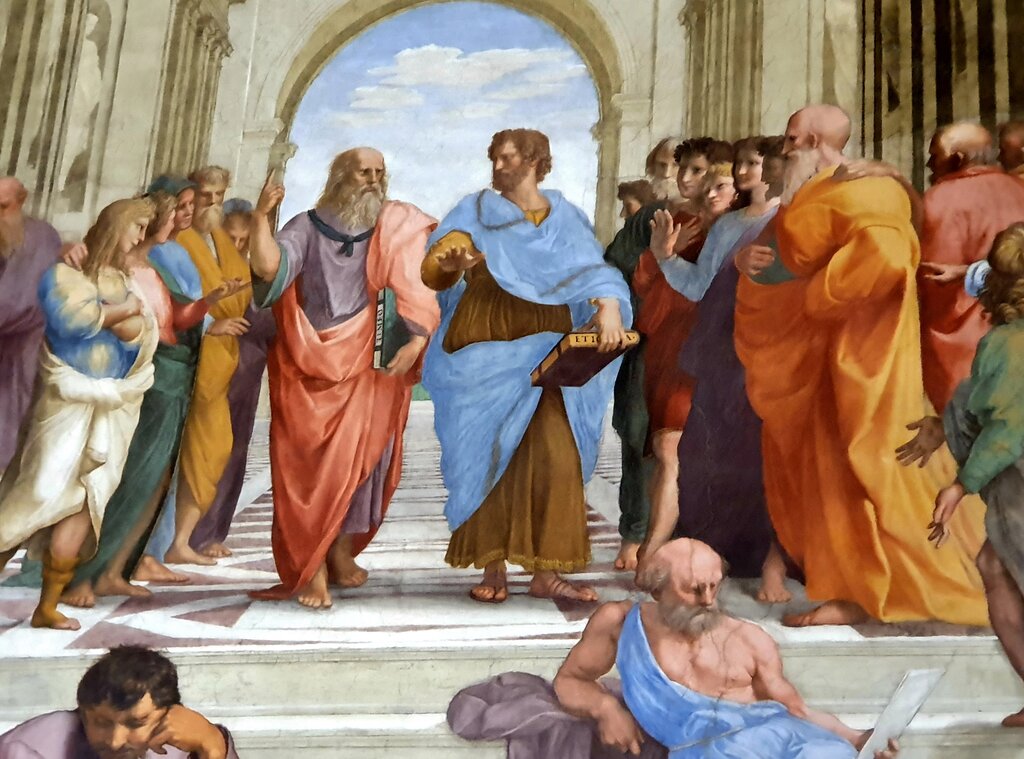
Aristotle, Plato’s student, agreed that humans have a fundamental nature but approached it from a different angle. He was a biologist at heart, obsessed with purpose. For him, everything has a telos—an ultimate end or goal. The telos of an acorn is to become an oak tree. The telos of a human, Aristotle argued, is to achieve eudaimonia, or a state of flourishing, by living a life of reason and virtue.
Crucially, Aristotle believed we couldn't achieve this flourishing alone. He famously declared that man is by nature a "political animal" (zoon politikon). Our essence isn't just rational; it's social. We are designed to live in a polis (city-state), because it's only through community, law, and debate that we can fully exercise our reason and achieve our telos. To live outside the polis was to be either a beast or a god, but not fully human.
The Social Contract
Fast forward two thousand years to the Enlightenment. The focus shifted from the soul's inner structure to the "state of nature"—a hypothetical condition before society and government. Philosophers used this thought experiment to deduce what human nature was really like, and therefore, what kind of government was legitimate. Two English and French thinkers, Thomas Hobbes and Jean-Jacques Rousseau, came to starkly different conclusions.
Hobbes, writing during the English Civil War, had a grim view. He argued that in a state of nature, humans are driven by a perpetual and restless desire for power. Without a common authority to keep them in check, life would be a "war of every man against every man." It would be, in his famous words, "solitary, poor, nasty, brutish, and short." For Hobbes, our fundamental nature is competitive and self-interested. We enter a social contract, giving up some freedoms to an absolute sovereign, not out of a natural desire for community, but out of fear of violent death.
A century later, Jean-Jacques Rousseau offered a romantic counter-narrative. He argued that Hobbes had mistakenly projected the vices of civilized man onto natural man. For Rousseau, the human in a state of nature was a "": solitary, yes, but also healthy, happy, and free. Natural man is motivated by self-preservation and pity, not greed or pride. It is society itself, particularly the invention of private property, that corrupts this innate goodness, leading to inequality, competition, and misery. Rousseau's social contract is an agreement to form a community that protects a collective "general will," aiming to restore the freedom we lost when we left the state of nature.
| Thinker | View of Human Nature | State of Nature | Reason for Social Contract |
|---|---|---|---|
| Thomas Hobbes | Selfish and competitive | "War of all against all" | To escape fear and death |
| Jean-Jacques Rousseau | Innately good and compassionate | Peaceful and solitary | To protect the general will |
This clash between Hobbes and Rousseau laid the groundwork for one of the most enduring debates in modern thought: nature versus nurture. Are our social behaviors, like aggression or cooperation, hardwired into our biology (nature)? Or are they products of our environment, upbringing, and social structures (nurture)?
The classical essentialism of Plato and Aristotle provides a foundation for the "nature" side of the argument. They saw our social and rational capacities as intrinsic to our being. The social contract theories, however, forced a deeper consideration of how society—nurture—shapes us. Whether society is a necessary cage to contain our brutal nature (Hobbes) or a corrupting force on our noble one (Rousseau), both thinkers agree that the environment we create drastically alters our behavior.
According to Plato, a just and well-ordered person is one whose soul is successfully governed by which of its three parts?
What did Aristotle mean by the term 'telos'?
These foundational ideas—from the structure of the soul to the state of nature—continue to influence everything from psychology and political science to our everyday assumptions about human potential.