Decoding Stellar Evolution with the HR Diagram
Stellar Properties
A Star's True Brightness
When you look up at the night sky, some stars appear brighter than others. This is called apparent brightness, and it's a combination of how much light a star actually produces and how far away it is. A dim star nearby can easily outshine a brilliant star that's much farther away.
To compare stars fairly, astronomers use a measure of intrinsic brightness called luminosity. It's the total amount of energy a star radiates every second. Think of it like a light bulb's wattage. A 100-watt bulb has a set brightness, but it will look dimmer the farther you move away from it. Luminosity tells us the bulb's actual power, not just how it looks from our specific vantage point.
Luminosity
noun
The total amount of electromagnetic energy—primarily light and heat—emitted per unit of time by a star or other celestial object.
Luminosity is a fundamental property that helps us understand a star's size, age, and mass. It gives us a standard way to talk about how powerful a star truly is, regardless of its distance from Earth.
Cosmic Thermometers
Just like a piece of metal glows red, then orange, and eventually white-hot as you heat it, a star's color reveals its surface temperature. The color of a star is one of the easiest things we can observe, and it tells us a remarkable amount about its physical state.
Cooler stars, with surface temperatures around 3,000 Kelvin (), glow with a reddish hue. Our own Sun, a medium-temperature star, has a surface temperature of about 5,800 and appears yellowish-white. The hottest stars can reach temperatures of 30,000 or more, shining with a brilliant blue-white light.
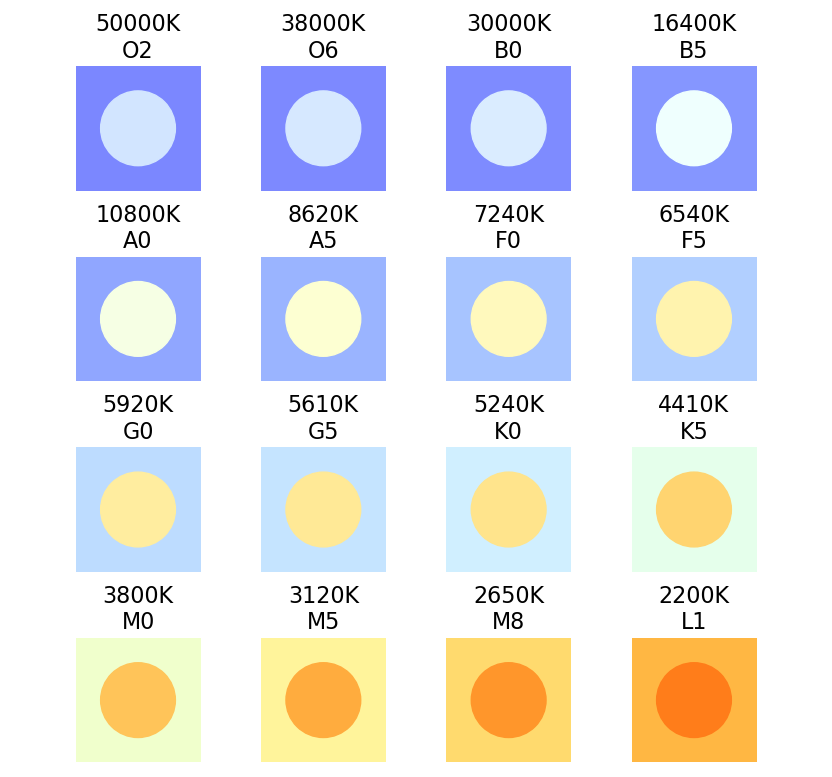
This relationship between color and temperature is a powerful tool. By simply analyzing the light from a distant star, we can get a good estimate of how hot its surface is.
A Stellar Alphabet
Astronomers take this a step further by analyzing a star's spectrum. When starlight passes through a prism, it splits into a rainbow of colors, but with dark lines interrupting it. These lines are absorption lines, created by chemical elements in the star's atmosphere absorbing specific wavelengths of light. The pattern of these lines is a unique fingerprint that depends almost entirely on the star's temperature.
This led to a classification system that sorts stars into spectral types. The main sequence of types, from hottest to coolest, is O, B, A, F, G, K, and M.
A popular mnemonic to remember the spectral classes is: Oh, Be A Fine Girl/Guy, Kiss Me!
Each letter represents a specific temperature range and a distinct spectral fingerprint. An 'O' star is incredibly hot and blue, showing spectral lines of ionized helium. A 'G' star, like our Sun, is yellow and shows strong lines from metals like calcium. An 'M' star is cool and red, with spectra dominated by molecules like titanium oxide.
| Spectral Type | Color | Temperature Range (K) |
|---|---|---|
| O | Blue | > 30,000 |
| B | Blue-White | 10,000 – 30,000 |
| A | White | 7,500 – 10,000 |
| F | Yellow-White | 6,000 – 7,500 |
| G | Yellow | 5,200 – 6,000 |
| K | Orange | 3,700 – 5,200 |
| M | Red | 2,400 – 3,700 |
So, a star's spectral type, color, and temperature are all deeply connected. By identifying one, astronomers can reliably infer the others. These properties—luminosity, temperature, and spectral class—are the cornerstones for understanding the nature and life of stars.
What is the term for a star's intrinsic brightness, independent of its distance from Earth?
A star's color is a direct indicator of its...