Decoding Scientific Literature
Scientific Method
The Scientific Method
Science is a process, not just a collection of facts. It's a structured way of exploring the world and building a reliable understanding of how it works. At the heart of this process is the scientific method, a systematic approach for asking questions and finding evidence-based answers.
At its essence, the scientific method is a systematic procedure that researchers use to explore observations, answer questions, and test hypotheses.
Think of it as a recipe for discovery. While the exact steps can vary depending on the field of study, the core logic remains the same. It guides researchers from a simple observation to a well-supported conclusion, ensuring that findings are based on evidence rather than opinion or guesswork. This process is what makes scientific knowledge so powerful and trustworthy.
The Core Steps
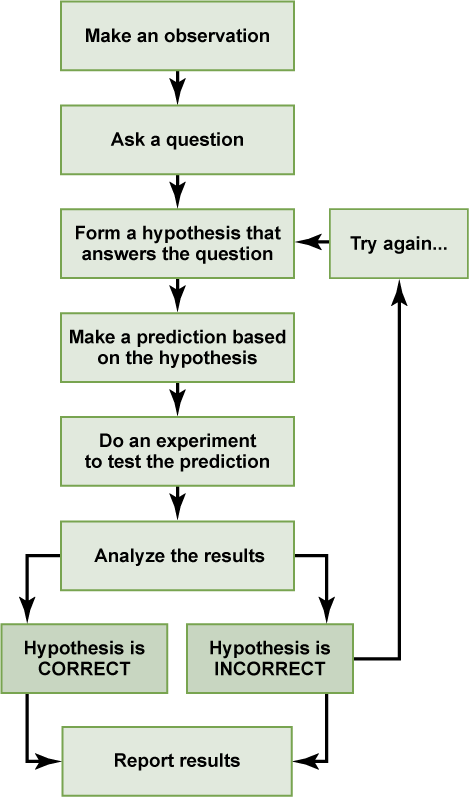
The journey of scientific discovery typically follows a path of distinct stages. It begins with curiosity and ends with a conclusion, with several crucial steps in between.
1. Observation
Everything starts with noticing something. An observation could be a specific event or a general pattern that sparks a question. For example, you might observe that your houseplants seem to grow taller and greener in one window compared to another. This leads to a natural question: Why?
2. Hypothesis
Next, you form a hypothesis, which is a potential answer to your question. A good hypothesis is more than just a guess; it's a testable statement. It makes a specific prediction that you can investigate. For our plant example, a testable hypothesis would be: "Houseplants grow better in the south-facing window because it gets more hours of direct sunlight."
Hypothesis
noun
A proposed explanation for a phenomenon, made as a starting point for further investigation.
3. Experimentation
This is the testing phase. You design and conduct an experiment to see if your hypothesis is supported by evidence. A key part of any experiment is controlling variables, which means you only change one thing at a time to see its effect. In our plant experiment, you would use two identical plants, place them in different windows (the variable you're testing), but keep everything else the same, like the type of pot, the soil, and the amount of water. You would then measure and record the plants' growth over a set period.
4. Conclusion
After the experiment, you analyze your data. Did the plant in the sunny window grow taller? If so, your results support the hypothesis. If not, the hypothesis might be incorrect, and you'd need to rethink your explanation. A conclusion summarizes what you learned and whether the evidence backs up your initial idea. It doesn't "prove" the hypothesis is absolutely true, but it provides evidence for or against it.
Built on Trust
The scientific method doesn't end with a single conclusion. Two critical concepts, reproducibility and peer review, ensure that scientific knowledge is robust and reliable.
Reproducibility means that other scientists should be able to perform the same experiment, following the original methods, and get similar results. If a finding can be reproduced, it builds confidence that the conclusion is valid and not just a fluke or the result of a mistake. This is why scientists publish their methods in great detail.
Peer review is a quality control system. Before a study is published in a scientific journal, it's sent to other experts in the same field. These reviewers, or peers, scrutinize the study's methods, data, and conclusions. They look for potential flaws in the experimental design, check the analysis, and assess whether the conclusions are justified by the evidence. This rigorous process helps filter out weak or poorly conducted research, maintaining a high standard for scientific literature.
By understanding this process, you can better evaluate scientific claims you encounter. Ask yourself: Was a testable hypothesis proposed? Was a controlled experiment conducted? Have the results been reviewed and reproduced by others? This critical mindset is the foundation of scientific literacy.
What is the primary purpose of the scientific method?
A scientist notices that birds at a certain feeder seem to eat more in the morning than in the afternoon. What is the most logical next step according to the scientific method?
The scientific method is a powerful tool for understanding the world, from the smallest atoms to the largest galaxies. It's a continuous cycle of questioning, testing, and refining our knowledge.