Decoding Nonsense Words
Introduction to Nonsensical Phrases
Grammar Without Meaning
Some sentences follow all the rules of grammar but make absolutely no sense. They are perfectly structured puzzles with no picture on the box. They show us that the rules of language and the meaning of words are two separate things.
Colorless green ideas sleep furiously.
This is a famous example from the linguist Noam Chomsky. Let’s break it down. An adjective (“colorless,” “green”) is followed by a noun (“ideas”), which is followed by a verb (“sleep”), which is followed by an adverb (“furiously”). The structure is flawless. You can diagram it just like any other sentence.
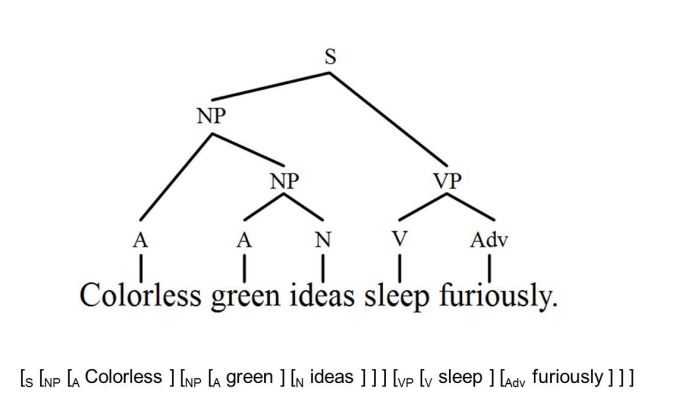
But the sentence is meaningless. Ideas can’t be green or colorless. They don’t sleep. And they certainly don’t do it furiously. This strange sentence reveals a fundamental split in how language works: the difference between syntax and semantics.
syntax
noun
The set of rules, principles, and processes that govern the structure of sentences in a given language. It's the grammar and word order.
semantics
noun
The branch of linguistics concerned with meaning. It deals with the interpretation of words, signs, and sentence structure.
Chomsky's point was that our brains process syntax separately from semantics. We can recognize that a sentence is grammatically correct even if it's pure nonsense. This idea challenged the belief that language is just a tool for communicating meaning; it's also a complex cognitive structure.
Nonsense in Literature
Linguists aren't the only ones who play with nonsensical phrases. Writers have long used them for humor, rhythm, and to create strange, imaginative worlds. Lewis Carroll was a master of this in his poem "Jabberwocky."
’Twas brillig, and the slithy toves Did gyre and gimble in the wabe: All mimsy were the borogoves, And the mome raths outgrabe.
Most of the key words here are made up. We don't know what a "tove" or a "borogove" is. But the sentence structure is familiar. We can tell that "slithy" is an adjective and "toves" is a plural noun. We know that "gyre and gimble" are verbs. Carroll uses proper syntax as an anchor, allowing the reader to navigate a world of semantic nonsense.
This kind of writing isn't just silly. It sparks our imagination and highlights the musicality of language. It reminds us that language can be a playground, not just a tool for conveying facts.
What is the primary point illustrated by Noam Chomsky's sentence, "Colorless green ideas sleep furiously"?
In linguistics, what does 'syntax' refer to?
Ultimately, nonsensical phrases show us the hidden architecture of language. They reveal that a sentence can be a well-built house with nobody living inside.