Decoding Biosignatures
Introduction to Biosignatures
The Search for Life's Fingerprints
When scientists search for life on other planets, they aren't looking for little green aliens. Instead, they hunt for evidence—subtle clues left behind by living things. These clues are called biosignatures.
biosignature
noun
Any object, substance, pattern, or process whose origin specifically requires a biological agent.
Think of it like cosmic forensics. A biosignature is like a fingerprint at a crime scene. It's a sign that life was, or still is, present. This is the foundation of astrobiology, the study of life in the universe. Without being able to travel to distant worlds, detecting these signatures in a planet's atmosphere or on its surface is our best method for finding life beyond Earth.
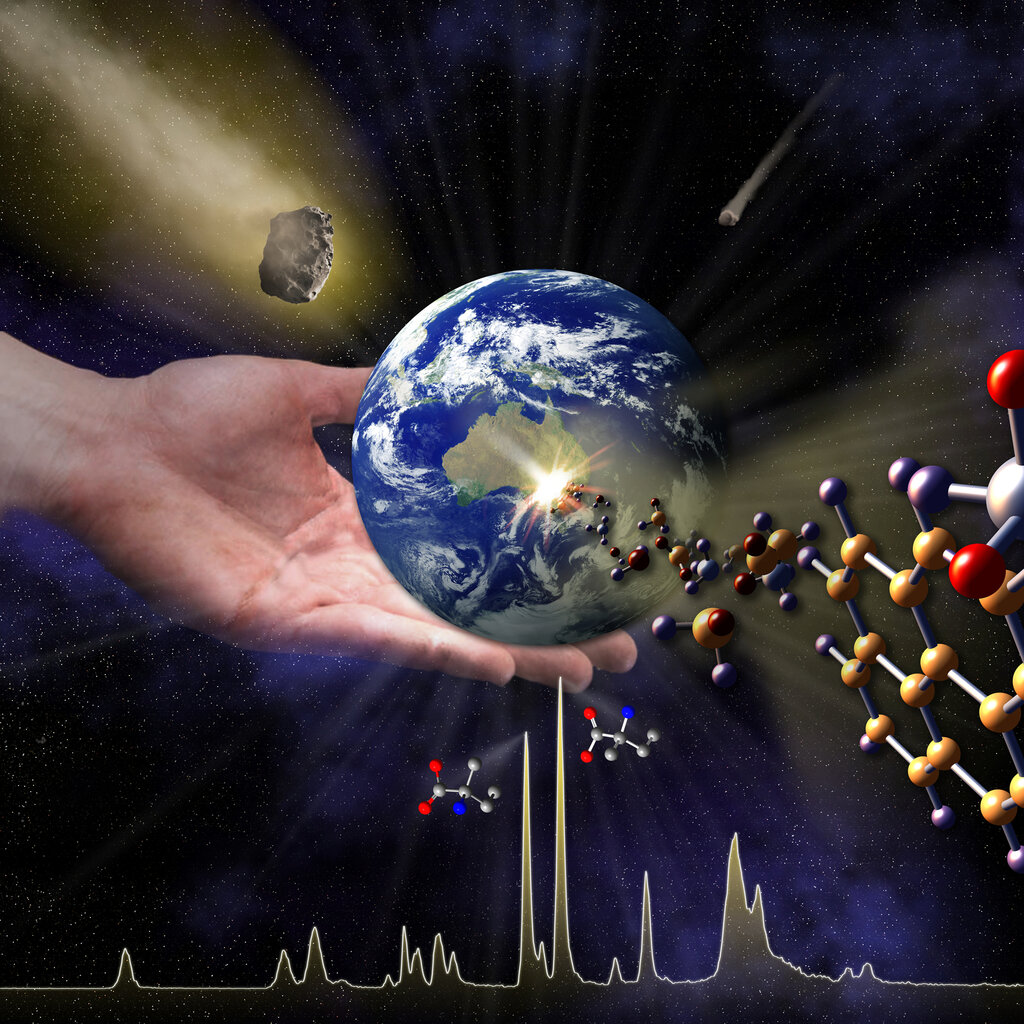
But finding a potential sign of life is just the first step. The real challenge is being sure.
A High Bar for Proof
Not all signs are created equal. For a biosignature to be considered reliable, it must meet strict criteria. Ideally, a biosignature is a feature that is difficult to create without biology. It should be something that non-living, or abiotic, processes are very unlikely to produce.
The context is also critical. A potential biosignature found in an environment where life is plausible (say, a planet with liquid water) is more convincing than one found in an obviously hostile setting. Scientists look for patterns or combinations of signals that, taken together, build a strong case for life.
An extraordinary claim like the discovery of alien life requires extraordinary evidence. A single, ambiguous clue is never enough.
The Problem of False Positives
The biggest hurdle in the search for life is the problem of cosmic impostors. Many chemical and geological processes can create substances that mimic biosignatures. These are known as false positives.
For example, methane gas is abundant in Earth's atmosphere, and a huge portion of it is produced by living organisms like microbes. Finding methane on another planet like Mars is exciting, but it's not definitive proof of life. Methane can also be produced by geological activity, such as the interaction of water and certain types of rock, which has nothing to do with biology.
This ambiguity means that scientists must be cautious. To confirm a biosignature, they need to rule out all possible non-biological explanations. This often involves looking for multiple, independent lines of evidence that all point toward a biological origin. It's a difficult, painstaking process of elimination that requires a deep understanding of a planet's total environment.
What is the primary definition of a biosignature in the context of astrobiology?
Why is finding methane in the atmosphere of Mars not considered definitive proof of life?
The search for biosignatures is a journey of careful, skeptical investigation. It's about building a case so strong that it withstands every attempt to knock it down.