Decoding Big Queries
Introduction to Big Data
What Is Big Data?
Think about all the data generated in a single day. Every social media post, every online purchase, every tap of a GPS-enabled map—it all creates a digital footprint. For a long time, we could manage this information with standard databases, like neatly organized filing cabinets. But the amount and complexity of data have exploded. The old filing cabinets are overflowing.
This is where the term "big data" comes in. It doesn't just mean "a lot of data." It describes datasets that are so large, fast-moving, and complex that traditional data processing tools can't handle them.
Big data refers to extremely large and complex sets of data that are difficult to manage and analyze using traditional data processing tools.
To really understand big data, we often talk about its main characteristics, known as the "Three V's": Volume, Velocity, and Variety.
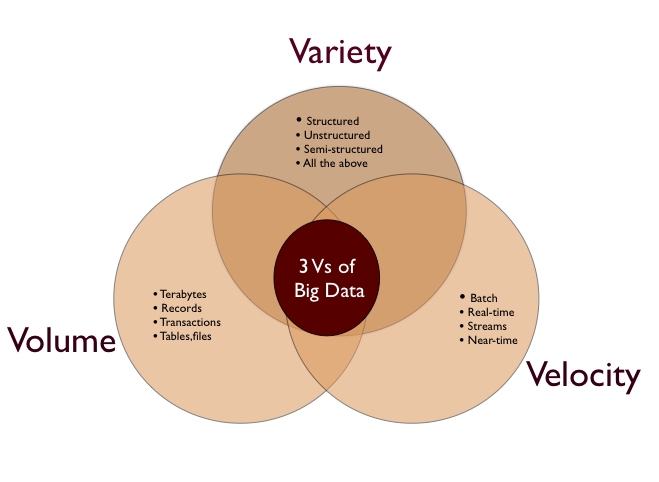
| Characteristic | Description | Example |
|---|---|---|
| Volume | The sheer amount of data. We're talking about terabytes, petabytes, and even exabytes. | The data from every flight taken in a single day, including sensor readings from the engines. |
| Velocity | The speed at which data is generated and must be processed. | Real-time stock market trades or the constant stream of updates from a social media feed. |
| Variety | The different forms data can take. | This includes structured data (like a sales spreadsheet), unstructured data (like emails, videos, and photos), and semi-structured data (like JSON files from a web app). |
The Challenges of Bigness
Dealing with big data isn't straightforward. Each of the three V's presents a unique hurdle.
Storing It: The sheer volume of data makes storage a major issue. Traditional databases aren't built to scale to the petabyte level efficiently or affordably. It's like trying to fit the entire ocean into a swimming pool.
Processing It: Analyzing this data quickly is another challenge. With data arriving at incredible speeds (velocity), businesses need to process it in near real-time to make timely decisions. A standard computer trying to sift through this much information would take far too long to produce useful insights.
Managing It: The variety of data makes it messy. How do you analyze an email, a satellite image, and a database log all at once? The data is often unstructured and comes from many different sources, which can lead to inconsistencies and quality issues. It requires new methods to clean, organize, and make sense of it all.
Why Bother with Big Data?
If big data is so challenging, why do companies invest so much in it? Because hidden within that massive, complex information are incredibly valuable insights. By analyzing big data, organizations can uncover patterns, trends, and associations that were previously invisible. This leads to smarter business moves, more efficient operations, and a better understanding of customers.
Here are a few examples of its impact:
Healthcare: Public health officials can track the spread of a disease in real-time by analyzing social media posts and search engine queries about symptoms.
Retail: An online store can analyze a customer's browsing history, past purchases, and even mouse movements to provide personalized product recommendations.
Finance: Banks can detect fraudulent credit card transactions within milliseconds by analyzing spending patterns against a massive dataset of historical transactions.
Entertainment: Streaming services analyze viewing data from millions of users to decide which new TV shows or movies to fund.
The goal is to transform raw data into real understanding. By tackling the challenges of volume, velocity, and variety, we can answer questions we didn't even know to ask.
Ready to check your understanding?
What is the primary characteristic that defines a dataset as "big data"?
A global logistics company tracks millions of packages in real-time using GPS sensors that update every second. Which of the 'Three V's' is most prominent in this scenario?