Decision Trees Demystified
Introduction to Machine Learning
What Is Machine Learning?
Machine learning gives computers the ability to learn from data without being explicitly programmed. Instead of writing step-by-step instructions for every possible scenario, we create algorithms that allow a computer to find patterns and make decisions on its own.
Think about how you learned to recognize a cat. You weren't given a list of rules like "if it has pointy ears, fur, and whiskers, it's a cat." Instead, you saw many different cats and eventually learned to identify them. Machine learning works in a similar way, by showing a computer thousands or millions of examples.
Machine Learning
noun
A field of artificial intelligence that uses statistical techniques to give computer systems the ability to "learn" from data, without being explicitly programmed.
There are three main ways a machine can learn: with a teacher (supervised), on its own (unsupervised), or through trial and error (reinforcement).
Supervised Learning
Supervised learning is like studying with flashcards. Each card has a question and a correct answer. The goal is to learn the mapping between the two so you can eventually answer new questions correctly.
In machine learning, this means we feed the algorithm labeled data—data that already has the correct output. The algorithm learns the relationship between the inputs and the outputs. After training, it can predict the output for new, unseen inputs.
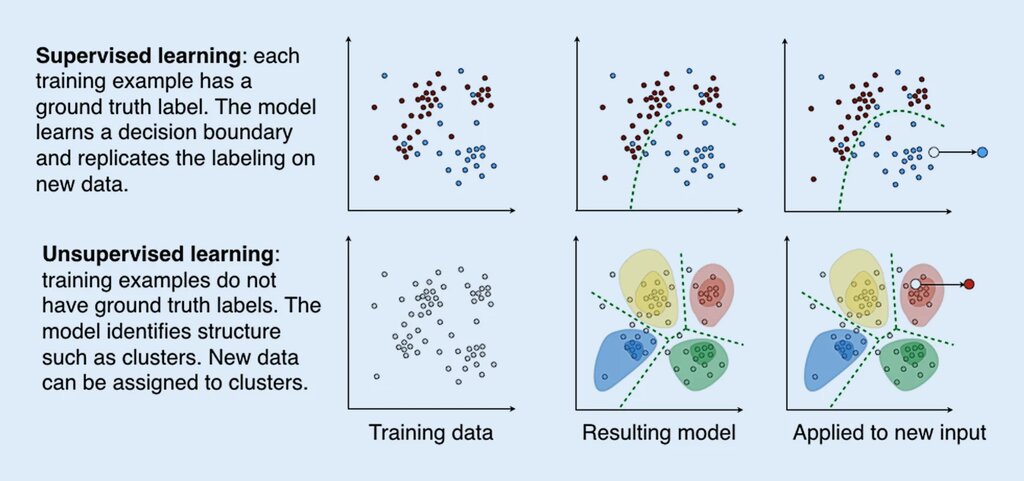
Applications of Supervised Learning:
- Spam Detection: Emails are labeled as "spam" or "not spam." The model learns to classify new emails.
- Image Recognition: Images are labeled with what they contain, like "cat" or "dog." The model learns to identify objects in new pictures.
- Price Prediction: Housing data is labeled with sale prices. The model learns to predict the price of a house based on its features (size, location, etc.).
Unsupervised Learning
Unsupervised learning is the opposite. It works with unlabeled data. There's no answer key. The algorithm's task is to explore the data and find interesting patterns or structures on its own.
Imagine being given a box of assorted fruits and being asked to sort them. You might group them by color, shape, or size. You're creating categories without being told what they are. That's the core idea of unsupervised learning.
Applications of Unsupervised Learning:
- Customer Segmentation: Grouping customers with similar purchasing habits for targeted marketing.
- Anomaly Detection: Identifying unusual credit card transactions that could indicate fraud.
- Topic Modeling: Finding the main topics in a collection of news articles.
Reinforcement Learning
Reinforcement learning is about learning through trial and error. An algorithm, called an agent, interacts with an environment. It performs actions and receives feedback in the form of rewards or penalties. The agent's goal is to learn a strategy, or policy, that maximizes its total reward over time.
Think of training a dog to sit. When the dog sits, you give it a treat (a reward). When it doesn't, it gets nothing (no reward). Over time, the dog learns that sitting leads to treats. The agent in reinforcement learning does the same, figuring out which actions lead to the best outcomes.
Applications of Reinforcement Learning:
- Game Playing: Teaching an AI to play games like Chess or Go by rewarding it for winning moves.
- Robotics: Training a robot to walk or pick up objects by rewarding successful attempts.
- Self-Driving Cars: Helping a car learn to make optimal driving decisions, like staying in a lane or braking at the right time.
These three learning types form the foundation of machine learning, each suited for different kinds of problems.
Now, let's check your understanding of these fundamental concepts.
What is the core idea behind machine learning?
You are given a large collection of customer reviews and asked to group them into a few distinct topics, but you don't know what the topics are beforehand. Which type of machine learning would be most suitable for this task?