Decimal Arithmetic Mastery
Understanding Decimals
Beyond Whole Numbers
We use whole numbers like 1, 5, and 20 every day. But what about the numbers in between? Decimals are a way to write numbers that aren't whole. They use a decimal point to separate the whole number part from the fractional part.
Think of 💲7.50. The '7' is the whole dollar amount, and the '.50' is the part of a dollar.
The numbers to the left of the decimal point are the whole numbers you're already familiar with: ones, tens, hundreds, and so on. The numbers to the right represent parts of a whole.
Place Value Matters
Just like with whole numbers, the position of a digit in a decimal changes its value. As you move to the right of the decimal point, each place value is 10 times smaller than the one before it.
| ... | Hundreds | Tens | Ones | . | Tenths | Hundredths | Thousandths | ... |
|---|---|---|---|---|---|---|---|---|
| ... | 100 | 10 | 1 | . | 1/10 | 1/100 | 1/1000 | ... |
| ... | 100 | 10 | 1 | . | 0.1 | 0.01 | 0.001 | ... |
Let's break down the number 24.375:
- 2 is in the tens place (20)
- 4 is in the ones place (4)
- 3 is in the tenths place (3/10 or 0.3)
- 7 is in the hundredths place (7/100 or 0.07)
- 5 is in the thousandths place (5/1000 or 0.005)
You can think of it as an expanding sum of its parts.
When converting decimals to fractions, how do we know to say hundredths? tenths? or thousandths? This is where understanding place values come in.
Fractions in Disguise
Every decimal can be written as a fraction. In fact, that's what they are: a special kind of fraction where the denominator is a power of 10 (like 10, 100, 1000, and so on). The word "decimal" comes from the Latin word for ten, decem.
The easiest way to convert a fraction to a decimal is to remember that the fraction bar simply means "divide."
decimal
noun
A number expressed in the scale of tens. Commonly refers to a number containing a decimal point.
To convert a fraction to a decimal, just divide the numerator (the top number) by the denominator (the bottom number). Let's try it with 1/4.
Sometimes the division is simple, and sometimes it's more complex, but the process is always the same. What about 3/8?
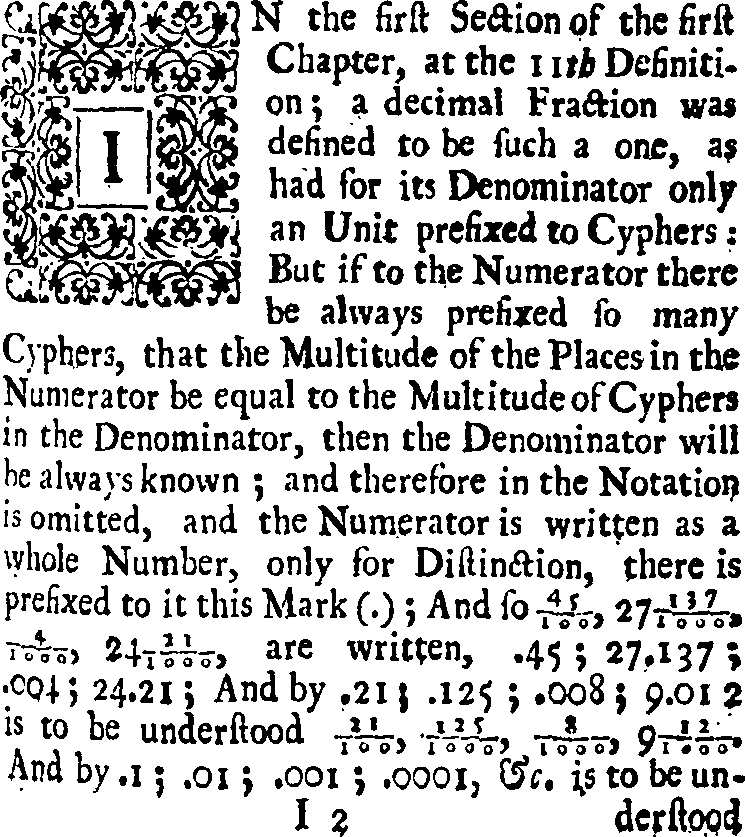
You can see this relationship in historical texts about math and commerce, where fractions and decimals were used for complex calculations.
Comparing Decimals
Which is bigger, 0.7 or 0.52? It might be tempting to say 0.52 because 52 is bigger than 7. But that's not how it works. When comparing decimals, you need to compare them place by place, starting from the left.
Here’s a reliable way to do it:
- Line them up. Write the numbers with their decimal points aligned vertically.
- Add zeros. Add zeros to the end of the shorter decimal so both numbers have the same length. This doesn't change their value. 0.7 is the same as 0.70.
- Compare. Now, just compare the numbers as if the decimal points weren't there. Which is bigger, 70 or 52?
| Number | With Zeros | Comparison |
|---|---|---|
| 0.7 | 0.70 | 70 > 52 |
| 0.52 | 0.52 | So, 0.7 > 0.52 |
Let's try a trickier one: compare 0.125 and 0.13.
First, line them up and add a zero to 0.13.
0.125
0.130
Now, compare 125 and 130. Since 130 is greater than 125, we know that 0.13 is greater than 0.125.
The key is to always start comparing from the leftmost digit. If they are the same, move one place to the right and compare again. Keep going until you find a difference.
Time to check your understanding of these new concepts.
In the number 14.825, what does the digit 2 represent?
To convert a fraction to a decimal, you divide the denominator by the numerator.
Understanding how decimals work is the first step toward mastering more complex math. They are a fundamental tool for everything from handling money to making precise measurements.