Debunking the Middle Stoic Synthesis
Middle Stoic Context
From Dogma to Dialogue
The intellectual world of the 2nd century BCE was a crucible for Stoicism. The Old Stoa, meticulously systematized by Chrysippus, had established a formidable, internally consistent philosophical edifice. Its psychology was strictly monistic: the soul was a unified, rational faculty, the hēgemonikon. Passions were not separate forces but simply errors in judgment—a failure of reason itself. This framework, while powerful, presented a rigid picture of human experience and was increasingly challenged from the outside.
The most significant pressure came from the New Academy, particularly from its leader, Carneades of Cyrene. His formidable skeptical arguments targeted the very foundation of Stoic epistemology: the katalēptikē phantasia, or apprehensive impression, which the Stoics claimed was a guarantor of truth. Carneades argued that no impression could be proven to be infallibly true, introducing a probabilistic standard for belief (pithanon) that threatened the Stoics' dogmatic certainty. This philosophical assault demanded a response, creating the fertile ground for Middle Stoicism.
The philosophers returned in 155 in the persons of the Academic Carneades, the Peripatetic Critolaus, and the Stoic Diogenes, who aroused the interest of the young Romans, and the indignation of the aged Cato, by the sophistry of the arguments with which they defended the seizure of Oropus by Athens (Plut. Cato, i 22).
This pivotal embassy to Rome showcased the intellectual dynamism of the era. The Stoic response was not one of retrenchment but of adaptation and synthesis, a project spearheaded by Panaetius of Rhodes.
Panaetius and the Platonizing Turn
Panaetius (c. 185–109 BCE) marks the formal shift to the Middle Stoa. Residing for a time in Rome as part of the influential Scipionic Circle, he was exposed to the practical demands of Roman statesmanship. This environment fostered a move away from the idealized Stoic sage and toward the ethical challenges faced by ordinary, imperfect individuals striving for virtue. His work On Duties (which heavily influenced Cicero's De Officiis) exemplifies this practical turn.
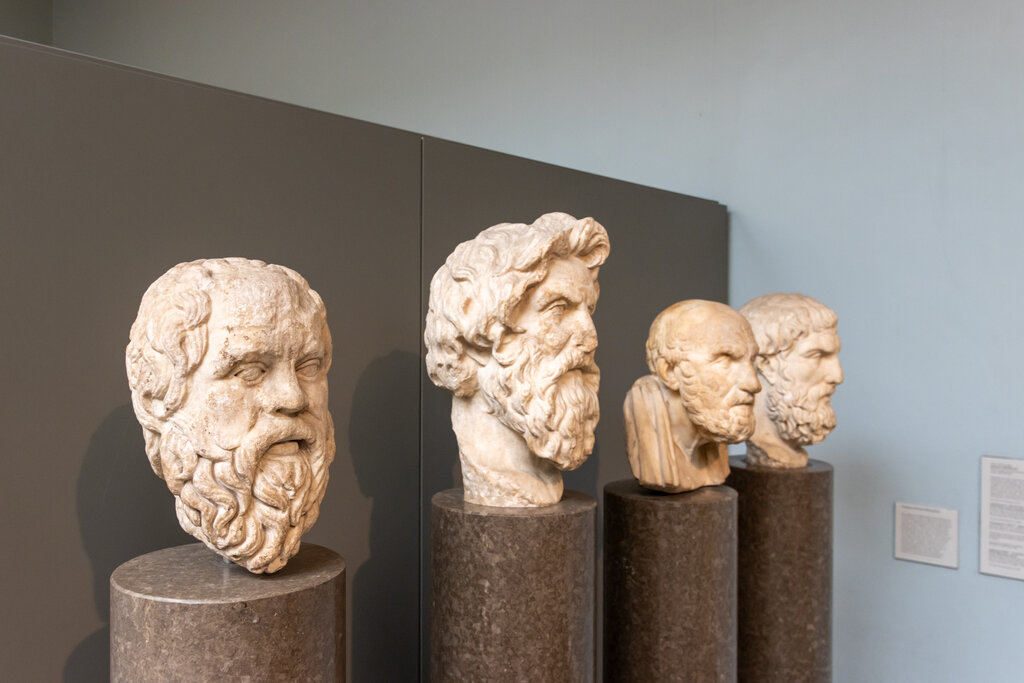
Philosophically, Panaetius initiated a significant 'Platonizing' trend. He modified the strict monistic psychology of the Old Stoa, suggesting a more pluralistic model of the soul that was closer to Plato's tripartite theory. By allowing for non-rational impulses or instincts (hormai) that were not simply cognitive errors, his system offered a more nuanced account of human motivation. This made Stoic ethics more accessible and psychologically plausible, even if it sacrificed some of the early Stoa's theoretical purity. He also abandoned the controversial doctrine of ekpyrosis, the periodic conflagration of the universe, further distancing his thought from the more dogmatic elements of his predecessors.
This eclectic approach, incorporating ideas from Plato and Aristotle, was not a surrender to Roman ideology but an internal evolution. It was a strategic adaptation designed to make Stoicism more resilient to Academic skepticism and more relevant to the complexities of lived experience.
His student, Posidonius (c. 135–51 BCE), continued and expanded upon this project. If Panaetius was the diplomat, Posidonius was the polymath. His interests were vast, spanning astronomy, geography, ethnography, and history. He conducted empirical research, studying the tides in relation to the moon and attempting to measure the Earth's circumference. This scientific curiosity was not separate from his philosophy; it was an expression of it. For Posidonius, understanding the cosmos (physis) was integral to living a rational life in accordance with it. His work reinforced the idea that philosophy must engage with the observable world in all its detail, moving Stoicism further from abstract logic and closer to empirical science.
The common narrative of Stoicism being simply 'Romanized' is therefore an oversimplification. Middle Stoicism's evolution was an internal philosophical development, a sophisticated response to external intellectual pressures and new empirical data. The engagement with Rome provided a new context and set of priorities, but the philosophical modifications were driven by Greek thinkers solving Greek problems, albeit on an increasingly cosmopolitan stage. This period set the stage for the final phase of Stoicism, but its innovations were foundational and shaped the entire subsequent trajectory of the school.