Debunking the Flat Earth Theory
Flat Earth Model
A World on a Disc
Before we sent satellites into orbit, how did people picture the Earth? For many ancient cultures, the answer was simple: it was flat. This wasn't a wild guess. From a human perspective on the ground, the world looks and feels flat. The ground extends outwards to a horizon that appears as a straight line. This everyday experience formed the basis of the earliest cosmologies.
Ancient civilizations, from the Egyptians in their Nile valley to the Mesopotamians between their two rivers, conceptualized a flat Earth. It was often imagined as a disc floating in a vast ocean. Early Greek thinkers, too, initially worked with this model. It was a practical and intuitive way to understand the world based on direct observation.
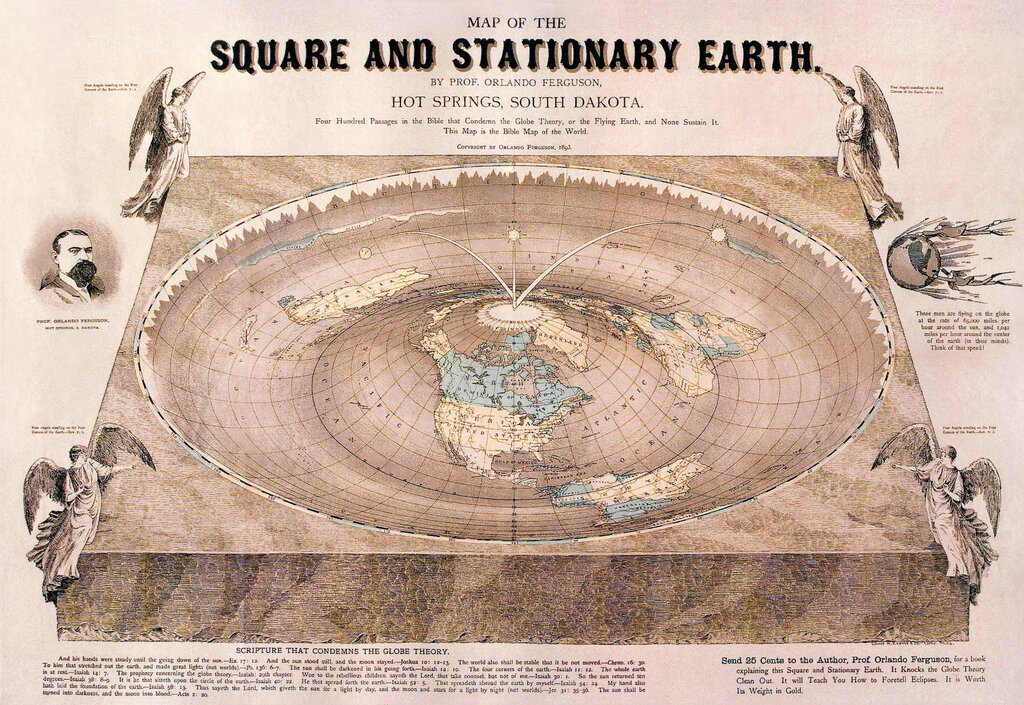
While the knowledge of a spherical Earth has been established for over two millennia, the old idea of a flat world never completely vanished. In recent years, it has found new life online.
The Modern Model
Modern Flat Earth theories are more detailed than their ancient counterparts. Most proponents envision the Earth not as a square, but as a massive disc. In this model, the Arctic is the magnetic center of the disc, and what we know as Antarctica isn't a continent at all. Instead, it's a colossal ice wall that encircles the disc, holding in the oceans.
What about the sky? Many models include a physical dome, often called the firmament, that encloses the world. The stars are said to be fixed to this dome, while the sun and moon are smaller bodies that circle high above the Earth, illuminating different parts of the disc as they move, which explains day and night cycles.
And gravity? The common explanation is that the disc of the Earth is not stationary but is constantly accelerating upwards at a rate of 9.8 m/s². This creates the downward force that we perceive as gravity.
A Modern Resurgence
The internet and social media have allowed these ideas to spread rapidly. Online forums, video-sharing platforms, and social networks provide spaces for believers to connect, share information, and develop their theories. This digital ecosystem has allowed a niche belief to gain a surprising amount of visibility.
The movement is often characterized by a deep skepticism of conventional science and government institutions, particularly space agencies like NASA. Proponents argue that evidence of a spherical Earth, such as satellite photos, is part of a large-scale conspiracy.
Today’s rejuvenated flat-Earth philosophy, as promoted by rappers and YouTube videos, is not simply a recrudescence of pre-scientific ignorance.
To better understand the differences between this model and the scientific consensus, let's review the core tenets of the Flat Earth model.
According to the text, why did many ancient cultures believe the Earth was flat?
In the modern Flat Earth model, what is described as being at the center of the disc?
Understanding the framework of the Flat Earth model is the first step in comparing it to the globally accepted model of a spherical Earth.