Debunking Plotinian Neoplatonism in Rome
Rome's School Fragmented
The Myth of Plotinus's Roman Academy
The traditional image of Plotinus presiding over a formal Platonic academy in Rome is a compelling one, but it's largely a fiction. This narrative, crafted primarily by his student Porphyry, obscures the reality of Plotinus's circle. It was not an institution with a curriculum and hierarchy, but an informal gathering of intellectuals meeting in a private home. These discussions took place against the tumultuous backdrop of the Third Century Crisis, a period of profound political and military instability that makes the existence of a stable, long-term philosophical school highly improbable.
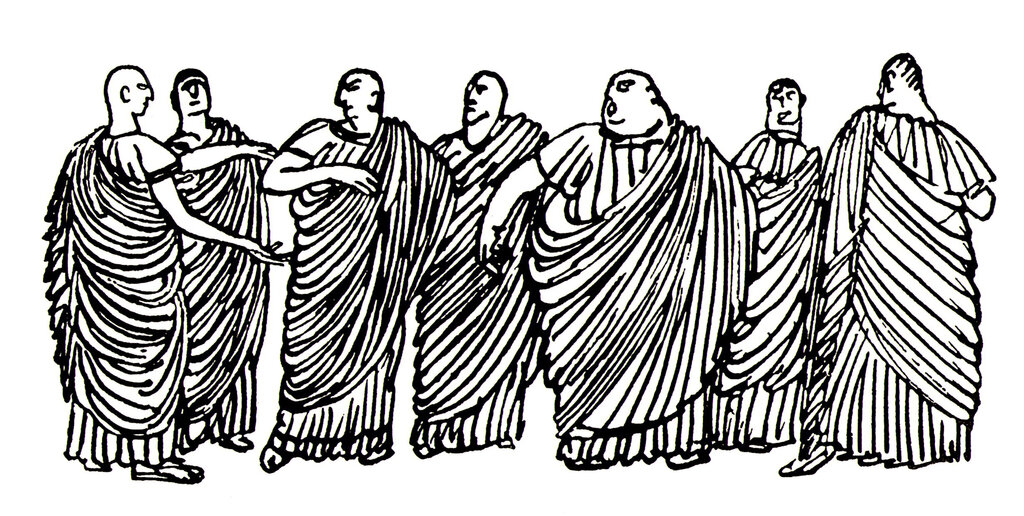
Plotinus arrived in Rome around 244 CE, having survived the disastrous Persian expedition of Emperor Gordian III. His circle wasn't a public gymnasium or a state-sanctioned schola. Instead, it was a loose-knit group that included senators, doctors, and other philosophers who convened to discuss Platonic texts. The dynamic was ad hoc, driven by the questions and interests of those present rather than a systematic program of study. This informality is crucial. It was a salon, not a university.
Porphyry's Hagiographic Agenda
Our primary source for Plotinus's life and work is Porphyry's Vita Plotini (Life of Plotinus), which serves as the introduction to his edition of Plotinus's writings, the Enneads. Porphyry’s account is not disinterested history; it's a carefully constructed hagiography. His goal was to present his master as a semi-divine sage, the ultimate heir to Plato, and to establish a clear lineage for the philosophical tradition he was inheriting. By structuring the Enneads and framing Plotinus's life as that of a formal 'school' leader, Porphyry retroactively imposed an order and institutional legitimacy that likely never existed.
Porphyry often develops his own unique interpretations and arguments under the guise of a commentary on Plotinus.
This editorializing is evident in his organization of Plotinus’s unsystematic essays into six books of nine treatises each, a numerologically significant arrangement. It is also visible in his anecdotes. Porphyry emphasizes Plotinus’s influence over powerful Romans and his role as a spiritual guide, portraying him as the head of a cohesive movement. This serves to elevate both Plotinus's stature and, by extension, Porphyry's own as his chosen successor and editor.
Debunking Platonopolis
A key piece of evidence Porphyry uses to bolster the image of an institutionalized school is the story of Platonopolis ('City of Plato'). According to the Vita, Plotinus petitioned Emperor Gallienus to re-found a ruined settlement in Campania as an ideal city governed by Plato's laws. The project supposedly failed due to the interference of jealous courtiers. However, this story strains credulity. The very idea of establishing an independent city-state during the reign of Gallienus, an emperor struggling to hold the empire together, is politically naive at best. There is no corroborating evidence for this project from any other source.
It's more likely that the Platonopolis story is a literary device. It serves to illustrate Plotinus's ambition and philosophical commitment, paralleling Plato's own attempts to advise the rulers of Syracuse. Whether it was a genuine, albeit doomed, proposal or a complete fabrication by Porphyry, its inclusion in the Vita reinforces the hagiographic narrative. It paints Plotinus as a figure of world-historical importance, capable of influencing emperors and attempting to bring philosophy into political reality, thus cementing his legacy.
Recognizing the informal, ad hoc nature of Plotinus's circle is essential. It requires reading Porphyry's Vita Plotini not as a factual biography but as a polemical and constructive text. The 'school' of Plotinus was not a building or an institution, but a shifting group of individuals drawn to a charismatic thinker amidst a period of profound crisis. The stability of the academy was a retrospective invention.
Let's test your understanding of these distinctions.
What was the actual nature of Plotinus's philosophical circle in Rome?
True or False: Porphyry's Vita Plotini should be read as a straightforward and objective biography of his teacher.
The distinction between the historical reality of Plotinus's circle and its later portrayal is a critical one for understanding the development of Neoplatonism. It reveals how philosophical legacies are not just inherited but actively constructed.