Debunking Plotinian Henosis and Porphyrian Hagiography
Porphyry's Hagiographic Lens
The Making of a Divine Man
Porphyry’s “Life of Plotinus” is less a biography and more a carefully constructed piece of rhetorical hagiography. It aims not just to record Plotinus's life but to elevate him into the paradigm of the '', or divine man. This archetype, prevalent in late antiquity, portrayed certain philosophers and holy men as intermediaries with the divine, possessing near-supernatural insight and virtue. Porphyry's authorial hand is evident throughout, shaping the narrative to present his master as the ultimate exemplar of the philosophical life, culminating in a transcendent union with the One.
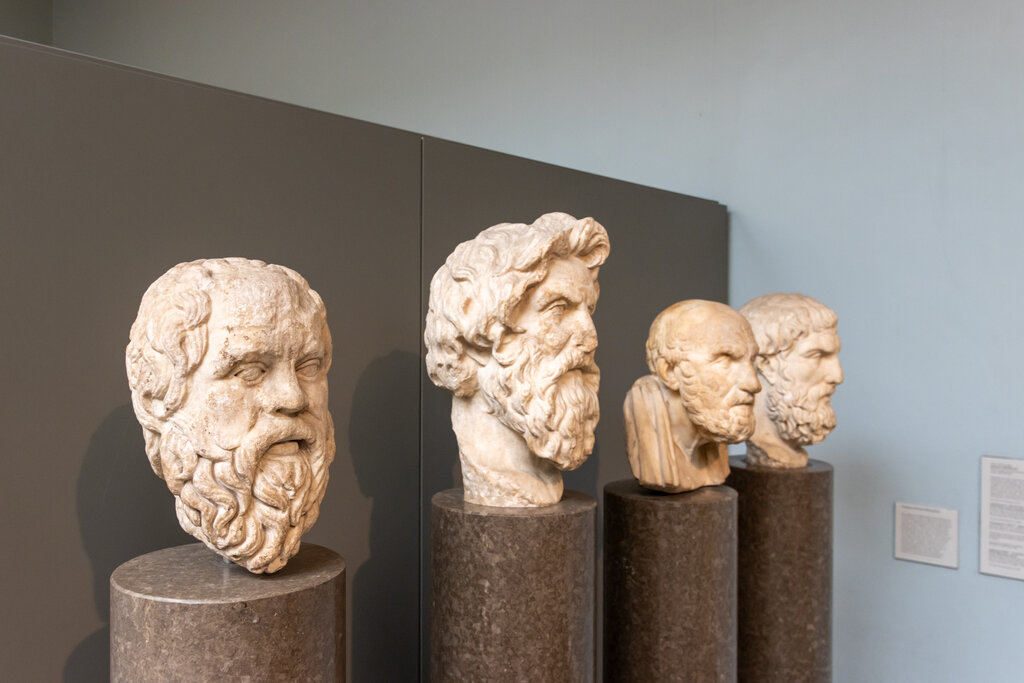
The most striking example of this is Porphyry’s claim that Plotinus achieved henosis, or union with the One, four times. This assertion externalizes what, in the Enneads, is an internal, dialectical process. For Plotinus, the ascent to the One is the culmination of rigorous intellectual and spiritual discipline—a stripping away of multiplicity to reach the source of Being. Porphyry, however, presents these unions as discrete, almost miraculous events, framing them as external validation of Plotinus's sanctity.
Porphyry transforms the philosophical process of the Enneads into a series of quantifiable spiritual achievements in the Vita.
This editorializing creates a fundamental tension. The Plotinus of the Enneads is a philosopher guiding the soul through argument and contemplation. The Plotinus of the Vita Plotini is a saint who has already reached the destination. This hagiographic lens can obscure the purely philosophical content of Plotinus's work, encouraging readers to see it as mystical revelation rather than reasoned metaphysics. Porphyry's editorial agency is not just biographical; it's interpretive, directing future generations on how to read his master.
Porphyry's Editorial Agenda
Porphyry’s role was not passive. As the editor of the Enneads, he made significant structural decisions that shaped the reception of Plotinus's thought. The most famous is his arrangement of Plotinus’s treatises into six groups of nine, creating the “Enneads” (from the Greek for nine). This organization is not chronological. Instead, Porphyry ordered the works thematically to create a curriculum, guiding the reader from ethics to physics and finally to metaphysics.
In general, Porphyry’s arrangement has been repeatedly criticized in the past as utterly artificial and arbitrary, echoing more the editor’s views than those of Plotinus.
This ordering imposes a specific pedagogical structure. It suggests a linear path to enlightenment, with the Vita serving as its capstone—proof that the journey is possible. There are notable philological discrepancies between the Vita and the treatises themselves. For instance, Porphyry emphasizes oracles and divine interventions, elements that are largely absent from Plotinus’s own dialectical and abstract writings. The focus on Plotinus's struggles with rivals like Numenius of Apamea also serves a rhetorical purpose, positioning Plotinus as the true heir to Plato against competing interpretations.
| Element | The Enneads (Plotinus) | The Vita Plotini (Porphyry) |
|---|---|---|
| Path to the One | Internal, dialectical, philosophical ascent | Externalized, discrete, miraculous events |
| View of Plotinus | A guide; a philosopher engaging in argument | A destination; a perfected sage or 'divine man' |
| Key Focus | Metaphysical reasoning and contemplation | Biographical anecdotes, oracles, and rivalries |
| Literary Mode | Philosophical treatise | Hagiography |
Porphyry’s editorial choices were not merely for clarity; they were polemical. By framing Plotinus's life and work in this way, he was engaging in the fierce philosophical and religious debates of the 3rd century CE. He presents Neoplatonism not just as a valid philosophy, but as the supreme spiritual path, embodied by its perfected founder.
Reconciling the Two Plotinuses
How, then, should we approach Plotinus? The key is to recognize the different aims of the Vita and the Enneads. The Vita Plotini is an introduction, a spiritual frontispiece designed to inspire awe and devotion. It is Porphyry’s argument for why one should read Plotinus. The Enneads are the argument itself. They demand rigorous intellectual engagement, not passive reverence.
Understanding Porphyry's hagiographic lens is crucial for any serious study of Plotinus. It allows us to separate the historical man from the constructed icon and to engage directly with the philosophical system presented in the Enneads on its own terms. We can appreciate the Vita as a masterpiece of late antique rhetoric while focusing our philosophical inquiry on the treatises it was designed to promote.
What was Porphyry's primary objective in writing the “Life of Plotinus”?
According to the text, the tension between the “Vita Plotini” and the “Enneads” is that the “Vita” presents Plotinus as a saint who has already reached his destination, while the “Enneads” present him as a philosopher guiding the soul through argument.