Debunking Ciceronian Natural Law
Stoic-Civic Tension
The Stoic-Civic Impasse
In De Legibus, Cicero attempts a monumental task: to ground the Roman res publica in the Stoic doctrine of providentia. The work, however, is less a cohesive philosophical synthesis and more an exercise in constitutional crisis management. It reveals the irreconcilable friction between the universalism of the Stoic cosmopolis and the pragmatic, often exclusionary, nature of Roman law. Cicero's adaptation of the Stoic concept of nomos as a universal law of reason founders when confronted with the realities of the ius civile.
The core of the problem lies in the clash between Stoic oikeiosis—the idea of a natural affinity extending to all humanity—and the foundational pillars of Roman society. How can a universal brotherhood of man coexist with the institution of dominium over slaves, or the absolute authority of the paterfamilias under patria potestas? The Stoic view posits a shared rationality among all humans, making chattel slavery a philosophical contradiction. Cicero sidesteps this, grafting the language of universal reason onto a legal system that is inherently hierarchical and particularist.
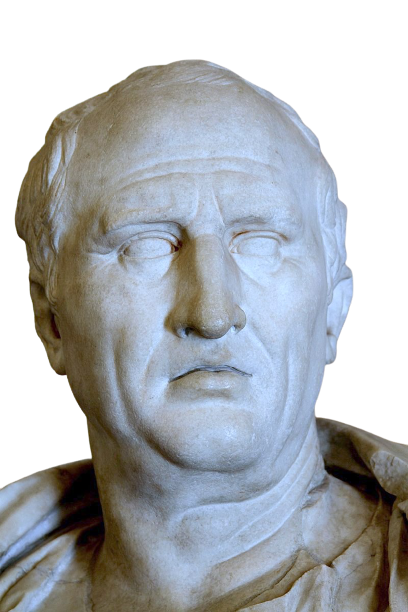
Cicero insisted that civil law must shape itself in accordance with the natural law of divine reason.
Ratio vs. Mos Maiorum
Cicero attempts to bridge this gap by borrowing from the Stoic philosopher and his conception of nomos as the king of all things, divine and human. For Cicero, this becomes Lex Vera—True Law—an eternal and unchanging principle of right reason. He presents this as the ultimate source of legal authority, superior to any written statute. Yet, this appeal to a transcendent ratio is fundamentally at odds with the Roman reverence for mos maiorum, the ancestral customs that formed the bedrock of their legal and social order. Roman law was pragmatic, evolving through precedent and the rulings of praetors, not deduced from abstract philosophical principles.
The Lex Vera thus becomes a rhetorical tool rather than a viable legal instrument. It serves to legitimize the authority of the senatorial class, presenting their governance not as a matter of political expediency but as an expression of natural justice. By framing the ideal statesman as one who understands and applies this True Law, Cicero elevates his own political faction. The fictionality of Lex Vera as a practical legal code is its most telling feature; it is an ideal grafted onto a system it cannot reform from within.
A Constitution in Crisis
Ultimately, De Legibus is a document of its time: the Late Roman Republic, an era of intense political instability and constitutional breakdown. Cicero's philosophical project is an attempt to find a stable foundation for a state that was tearing itself apart. He turns to Stoicism for its prestige and its language of order, reason, and duty. However, the deep incompatibility between the Stoic universal 'ought' and the Roman particularist 'is' makes the synthesis untenable. The work's failure to create a cohesive system is, paradoxically, its greatest success for historians. It lays bare the profound ideological tensions of a republic on the brink, caught between its traditional identity and the universalist philosophies of the Hellenistic world it had come to dominate.
What is the central philosophical conflict that Cicero grapples with in De Legibus, according to the provided text?
Cicero's concept of Lex Vera (True Law) was primarily a rhetorical tool used to...