Debunking Ciceronian Moral Psychology
Eclecticism as Distortion
Rhetorical Appropriation vs. Philosophical Fidelity
Cicero’s role is often cast as a dutiful curator, translating Greek philosophy for a Roman audience. This view, however, overlooks the radical nature of his project in works like the Tusculan Disputations. Far from being a passive conduit, Cicero actively manipulates Hellenistic doctrines. His eclecticism is not a mere synthesis but a strategic appropriation, where the rhetorical needs of the argument supersede any commitment to philosophical fidelity.
He leverages his New Academic skepticism not to find truth, but to justify picking and choosing from incompatible systems. Stoic and Peripatetic dogmas are treated as a menu of options, stripped of their ontological foundations and redeployed to serve a particular persuasive goal. This is especially evident in his treatment of the passions and the nature of the good life. The core tenets of his sources are often preserved in name only, their substance hollowed out and repurposed.
For Cicero to really use philosophy effectively, he needed to make it accessible to a Roman audience.
The result is a philosophical bricolage. Cicero isn't building a coherent system; he's constructing an argument. He borrows the Stoic concept of virtue as the sole good, but he often softens its harshness with Peripatetic appeals to the value of external goods. This creates a version of eudaimonism that is rhetorically potent but philosophically inconsistent with its source materials. The goal is not intellectual coherence but therapeutic and political effect.
The Deconstructive Power of 'Probabile'
The key to Cicero’s method is the New Academic concept of the 'probabile', or the 'plausible'. For a true skeptic like Arcesilaus or Carneades, this was a guide for action in the absence of certainty. For Cicero, it becomes a license for intellectual cherry-picking. If no doctrine can be known with certainty, then all doctrines are available for rhetorical use so long as they appear plausible to his intended audience.
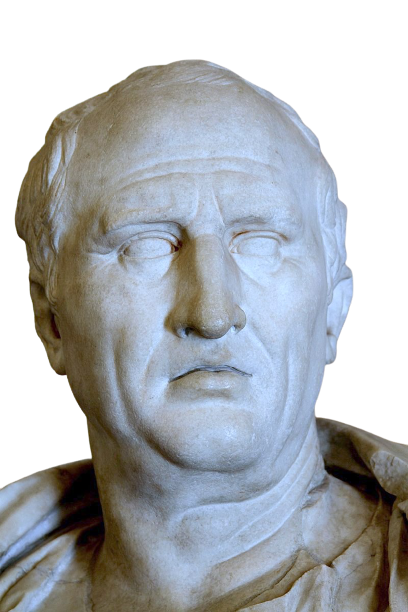
This transforms the probabile from an epistemological tool into a deconstructive one. Cicero can present a Stoic argument against grief in one section and then pivot to a more emotionally accommodating Peripatetic view in another, all under the guise of exploring what is 'probable'. He isn't testing these ideas against each other to approach a truth; he is deploying them as discrete, situational tools. The Tusculan Disputations thus becomes less a dialogue seeking wisdom and more a masterclass in using philosophical language for persuasive ends, detached from the systems that gave that language meaning.
Metaphysical Exile
The context of the Tusculan Disputations is crucial. Written in 45 BCE after the death of his daughter Tullia and during Caesar's dictatorship, the work is a form of political displacement. With the Roman Republic effectively dead and his own political career in ruins, Cicero turns to philosophy not just for personal solace but to carve out a new space for influence. This is the essence of his 'Metaphysical Exile'. Unable to act in the Forum, he relocates his activity to the realm of ideas.
The '' genre, a traditional form of philosophical consolation for grief, becomes a political act. By framing the pursuit of a tranquil mind as the highest good, Cicero implicitly critiques the chaotic and tyrannical political reality of his time. He is not merely coping with personal loss; he is articulating a vision of Roman identity grounded in philosophical virtue rather than public office. The syncretism of his approach is a product of this displacement. He needs a philosophy that is practical, adaptable, and resonant for a Roman elite cut off from their traditional sources of power and meaning.
The 1st century BCE was rife with this syncretic impulse, but Cicero's version is unique. While others, like Panaetius, sought to genuinely bridge Stoicism with Platonism, Cicero’s project feels less about synthesis and more about utility. His eclecticism is a feature of his exile, a necessary tool for a man of action who suddenly finds himself confined to the world of words. He distorts not out of ignorance, but out of necessity, creating a philosophy that can do something in a world where traditional action is impossible.
Having reviewed how Cicero's method can be seen as a form of distortion, let's test your understanding of these nuances.
According to the text, the traditional view of Cicero as a 'dutiful curator' of Greek philosophy is misleading because it overlooks his...
How did Cicero use the New Academic concept of the 'probabile' (the plausible)?
Cicero’s work stands as a testament to the idea that philosophy could be a form of political action. By examining his method, we see not a flawed philosopher, but a masterful rhetorician who bent abstract doctrines to the urgent needs of his historical moment. His eclecticism wasn't a bug; it was the entire point.