dbt Core and Snowflake Data Transformation
Introduction to dbt and Snowflake
The Modern Data Duo
In today's world, companies collect vast amounts of data. But raw data is often messy, inconsistent, and hard to use. To get valuable insights, you need to clean, organize, and reshape it. This process is called data transformation.
Two tools have become central to this process: dbt and Snowflake. They work together to make data transformation efficient and reliable.
Think of Snowflake as a massive, intelligent warehouse for your data. It's a cloud-based platform, meaning you don't need to manage physical servers. It's designed to store enormous amounts of data and allow you to access it very quickly. Its key innovation is separating the storage of data from the computing power used to analyze it. This makes it flexible and cost-effective.
dbt (data build tool) is the set of instructions for what to do with the data inside that warehouse. It doesn't store any data itself. Instead, it helps you manage all the SQL code needed to transform your raw data into clean, trustworthy datasets ready for analysis.
dbt (data build tool) lets data analysts, data scientists, and data engineers easily transform data in their warehouses while using the same practices that software engineers use to build applications.
In short: Snowflake holds the data, and dbt manages the logic to transform it.
A New Way of Working
Traditionally, data was transformed before being loaded into a warehouse. This was called ETL (Extract, Transform, Load). The process was often slow and rigid.
The combination of dbt and Snowflake popularizes a newer approach: ELT (Extract, Load, Transform). Raw data is extracted from its source and loaded directly into Snowflake. The powerful, scalable engine of Snowflake is then used to run the transformations, which are managed by dbt. This is much faster and more flexible.
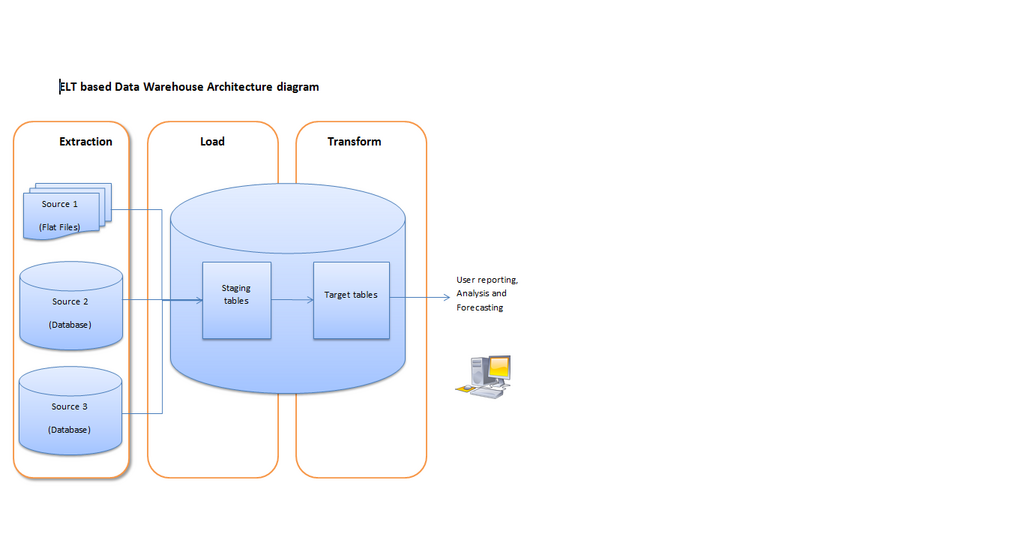
Imagine a restaurant kitchen. In the old ETL model, ingredients were chopped, mixed, and partially cooked in different small kitchens before being brought to the main one. It was inefficient.
In the new ELT model, all raw ingredients (data) are delivered directly to a large, state-of-the-art kitchen (Snowflake). The chefs (data analysts using dbt) then have everything they need in one place to prepare the final dishes (analytics-ready tables).
Key Capabilities
So why is this combination so powerful? It comes down to what each tool does best.
What makes Snowflake special?
Its architecture is the main advantage. By separating storage and compute, multiple teams can run complex queries at the same time without slowing each other down. If you have a massive transformation job, you can instantly scale up your computing power, and then scale it back down when you're done so you only pay for what you use.
Snowflake's scalability means you can go from analyzing a tiny dataset to a massive one without changing your setup. The warehouse grows with your needs.
What makes dbt special?
dbt brings the best practices of software engineering to data analytics. Instead of writing isolated, messy SQL scripts, you can build modular, reusable data models.
Key features include:
- Version Control: You can track changes to your code using tools like Git, making it easy to collaborate and roll back mistakes.
- Testing: You can write tests to ensure your data is accurate and reliable. For example, you can automatically check that a customer ID column never contains null values.
- Documentation: dbt automatically generates documentation about your data models and shows the lineage, or how your data flows from raw sources to final tables.
With dbt, you can stop wondering if your data is correct and start proving it with automated tests.
When you put them together, you get a modern, scalable, and reliable system. Snowflake provides the raw power, and dbt provides the organization, testing, and workflow to harness that power effectively.
In the context of a modern data stack, what are the primary roles of Snowflake and dbt?
How does the ELT (Extract, Load, Transform) paradigm, popularized by tools like Snowflake and dbt, differ from the traditional ETL (Extract, Transform, Load) approach?
Now that you understand the roles of dbt and Snowflake, you're ready to see how they connect and work in practice.