Day Trading Pattern Analysis Mastery
Introduction to Day Trading
What is Day Trading?
Day trading is the practice of buying and selling financial assets within a single trading day. The goal is to profit from small price movements. Unlike investors who might hold stocks for years, day traders close all their positions before the market closes. This means no holding onto stocks, currencies, or commodities overnight.
The core rule is simple: get in and get out on the same day. This strategy avoids the risks and volatility that can happen when the market is closed.
This approach is fundamentally different from other popular styles of interacting with the market. Each style has its own time horizon and level of involvement.
| Trading Style | Time Horizon | Goal |
|---|---|---|
| Day Trading | Minutes to hours | Profit from small, intraday price moves. |
| Swing Trading | Days to weeks | Capture larger price swings or 'swings' in the market trend. |
| Position Trading | Months to years | Capitalize on long-term trends, similar to investing. |
The Market's Players
The financial markets are a vast ecosystem with different participants, each playing a distinct role. As a day trader, you're primarily a retail trader, but you're trading alongside giants.
Retail Traders: These are individuals like you, trading their own money. They access the market through brokerage firms.
Institutional Investors: These are the big players—hedge funds, mutual funds, and pension funds. They manage huge pools of money and their large trades can move markets.
Market Makers: These are firms or individuals that provide liquidity to the market. They are always ready to buy and sell a particular asset, ensuring that there's a counterparty for trades. They profit from the spread, which is the small difference between their buying and selling price.
Placing Your Orders
To trade, you need to communicate your intentions to the market. You do this through orders. There are three basic types you'll use constantly.
| Order Type | What It Does | When to Use It |
|---|---|---|
| Market Order | Buys or sells immediately at the best available current price. | When speed is your top priority and you're willing to accept the current market price. |
| Limit Order | Buys or sells at a specific price or better. A buy limit order executes only at the limit price or lower; a sell limit order executes only at the limit price or higher. | When price is more important than speed. It gives you control over the execution price, but your order might not be filled if the price doesn't reach your limit. |
| Stop Order | Becomes a market order once a specific price (the stop price) is reached. It's often used to limit losses or lock in profits. | For risk management. A stop-loss order can automatically sell your position if the price drops to a certain level, preventing further losses. |
The effectiveness of these orders depends heavily on market liquidity.
Liquidity
noun
The degree to which an asset can be quickly bought or sold in the market at a price reflecting its current value. In simple terms, it's a measure of how many buyers and sellers are present and whether transactions can happen easily.
For day traders, liquidity is everything. A liquid market means you can get in and out of a trade quickly without your own order significantly affecting the price. In an illiquid, or "thin," market, a large order can cause a sudden price spike or drop because there aren't enough participants on the other side to absorb the trade smoothly.
Staying in the Game
Successful trading isn't just about picking the right stocks or timing the market perfectly. It's about survival. The two pillars of survival are risk management and emotional discipline.
Risk management separates casual traders from consistent traders.
Your trading capital is your lifeblood. Protecting it is your primary job. Many traders follow a simple rule: never risk more than 1% of your account on a single trade. This means if you have a $30,000 account, the most you should be willing to lose on any one position is $300. This strategy ensures that a string of losses won't wipe out your account, allowing you to stay in the game long enough to find winning trades.
Just as important is managing your emotions. The two biggest enemies of a trader are fear and greed. Greed can tempt you to stay in a winning trade too long, only to watch your profits evaporate. Fear can cause you to exit a good trade too early or avoid taking a trade altogether. A solid trading plan, with predefined entry points, exit points (for profits), and stop-loss levels, is your best defense against emotional decision-making.
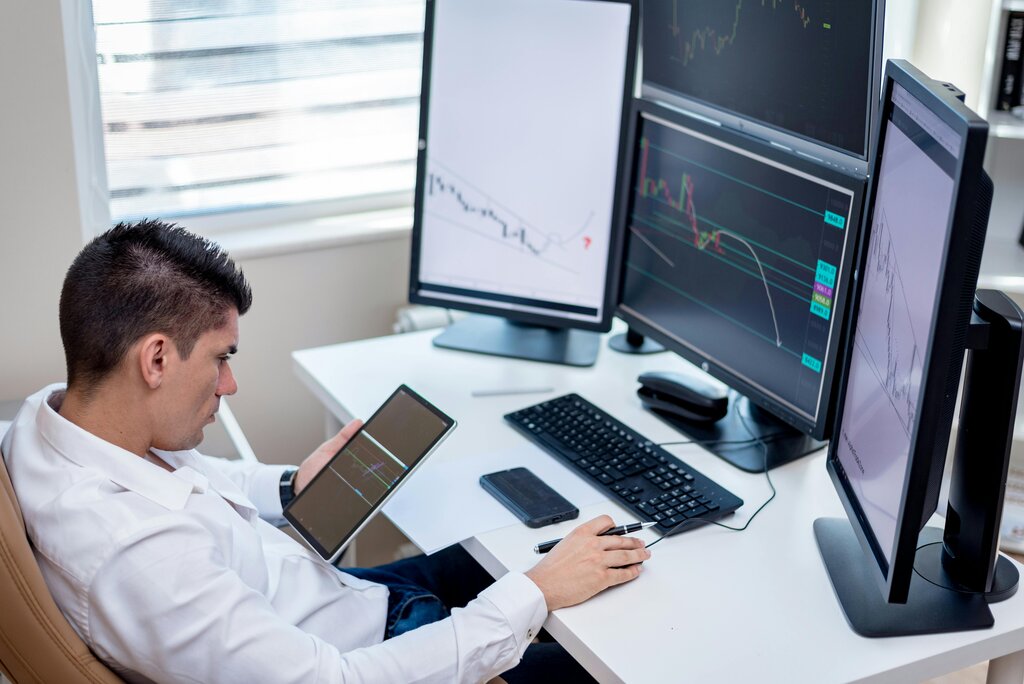
Discipline is the bridge between your strategy and your results. It's about following your rules, even when it's uncomfortable. Every successful trader knows that consistency in execution, not the occasional big win, is the key to long-term success.
Ready to check your understanding? Let's review what you've learned.
What is the defining characteristic of day trading?
In the context of financial markets, what is the primary role of a market maker?
Understanding these fundamentals is the first step. It's not about complex strategies yet, but about building a solid foundation of how the market works and how to protect yourself while you navigate it.