Database Design for System Architecture
Data Modeling
Structuring Your Data
Before you can build an application, you need a plan for your data. Where will it live? How will different pieces of information relate to each other? This planning stage is called data modeling. Think of it as creating a blueprint for a house before you start hammering nails. A good blueprint ensures everything has a logical place and the house is sturdy and efficient. A good data model does the same for your database.
Blueprint for Data: ER Diagrams
One of the most common tools for creating this blueprint is the Entity-Relationship (ER) diagram. It's a visual way to see how your data is structured. ER diagrams have three main components: entities, attributes, and relationships.
Entity
noun
A person, place, object, event, or concept about which data is stored. In an ER diagram, an entity is usually represented by a rectangle.
Entities have properties that describe them, which are called attributes.
Attribute
noun
A property or characteristic of an entity. For a 'Student' entity, attributes might include 'StudentID', 'FirstName', and 'Major'.
Finally, relationships show how entities are connected. For instance, a Student entity enrolls in a Course entity. These connections are crucial because they show how the different parts of your data work together. We often describe these relationships by their cardinality, like one-to-one, one-to-many, or many-to-many.
For example, one customer can have many orders (a one-to-many relationship). An order can contain many products, and a product can be in many different orders (a many-to-many relationship).
Keeping Data Tidy: Normalization
Once you have a basic blueprint, the next step is to organize it efficiently. Normalization is the process of structuring your database to reduce data redundancy and improve data integrity. In simpler terms, it's about making sure you don't store the same piece of information in multiple places and that related data is stored together logically.
Imagine a spreadsheet for tracking orders where you enter the customer's name, address, and the product name and price for every single item they buy. If a customer changes their address, you'd have to find and update every single row they appear in. If you miss one, your data becomes inconsistent. This is what normalization helps prevent.
Normalization is a technique used to design databases in a way that minimizes redundancy and dependency.
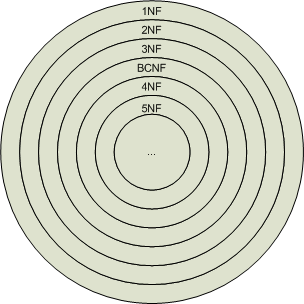
Normalization involves a series of guidelines called normal forms. While there are several, the first three are the most important for most applications:
- First Normal Form (1NF): Ensures that each column in a table holds a single, atomic value, and each row is unique. You can't have a list of items in a single cell.
- Second Normal Form (2NF): Builds on 1NF. It requires that all non-key attributes are fully dependent on the entire primary key. This is mainly relevant for tables with composite keys (keys made of multiple columns).
- Third Normal Form (3NF): Builds on 2NF. It requires that all attributes depend only on the primary key, not on other non-key attributes. For example, if you store a product's price in an order table, that violates 3NF because the price depends on the product, not the order itself. It should be in the
Productstable.
Following these rules helps keep your data clean, consistent, and easy to manage.
When to Break the Rules: Denormalization
Normalization is great for data integrity, but it can sometimes make data retrieval slower. To get a complete picture of an order, you might have to join data from the Orders table, the Customers table, and the Products table. Joining many tables can be computationally expensive, especially with large amounts of data.
This is where denormalization comes in. Denormalization is the strategic process of adding redundant data back into your database to improve read performance. It's a trade-off: you sacrifice some storage efficiency and data integrity for faster queries.
For example, you might decide to store the customer's name directly in the
Orderstable, even though it's already in theCustomerstable. This avoids a join, making it faster to display a list of orders with customer names.
Denormalization is a careful balancing act. You should only do it when there's a clear performance bottleneck that can't be solved in other ways. It's often used in systems that handle a high volume of reads, like data warehouses used for analytics.
Choosing the Right Container
The final piece of our blueprint is choosing the right data types and sizes for each attribute. When you define a column in a table, you have to specify what kind of data it will hold—a number, text, a date, etc. This choice has a real impact on performance and storage.
For example, if you need to store a person's age, using an integer type that can hold numbers up to 2 billion is wasteful. A smaller integer type that can only hold numbers up to 255 would be far more efficient, using less disk space and memory.
Similarly, if a column for a product code will never be more than 10 characters long, defining it as a text field that can hold 500 characters is inefficient. Being precise with data types and sizes ensures your database is as lean and fast as possible.
| Data Type | Common Use | Why It Matters |
|---|---|---|
INTEGER | Whole numbers (e.g., ID, age, quantity) | Using the smallest integer type that fits the data saves space. |
VARCHAR(n) | Variable-length text (e.g., name, email) | Setting n appropriately prevents wasted space. |
BOOLEAN | True/False values | Very efficient for storing binary states (e.g., is_active). |
TIMESTAMP | Date and time values | Essential for tracking when events occur, like order placement. |
Thoughtful data modeling is a foundational step in building any robust system. By creating clear ER diagrams, applying normalization principles, using denormalization wisely, and selecting appropriate data types, you set your application up for success.
What is the primary purpose of data modeling?
In an Entity-Relationship (ER) diagram, what are the properties that describe an entity called?