Data Warehousing for Power BI
Data Warehousing Basics
What's a Data Warehouse?
Think of a data warehouse as a company's central library for all its historical data. It doesn't just store information; it collects and organizes it from many different sources—like sales systems, marketing platforms, and customer support logs. The goal is to create a single, reliable source of truth.
Unlike the databases that run day-to-day operations, a data warehouse is built specifically for analysis and reporting. It's designed to answer big-picture questions that help guide business strategy. Instead of just tracking a single sale, it helps you see sales trends over the last five years, across different regions, and for various product lines.
The main purpose of a data warehouse is to consolidate data from multiple sources to make it easy to access and analyze for business intelligence.
Warehouse vs. Day-to-Day Database
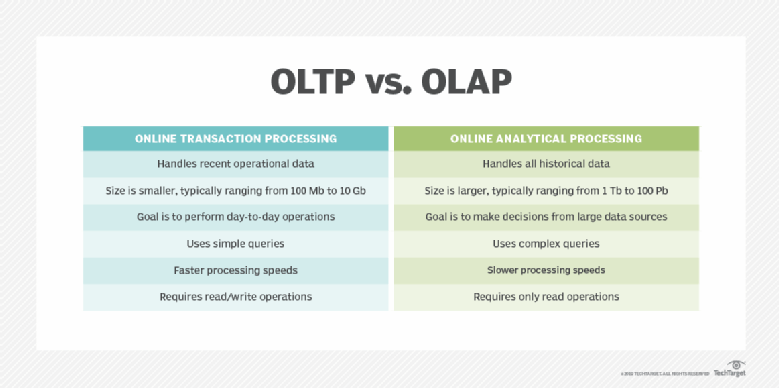
It's easy to confuse a data warehouse with a regular database, also known as an Online Transaction Processing (OLTP) system. After all, they both store data. But their jobs are completely different. An operational database is like a cashier at a grocery store, processing one transaction at a time, quickly and efficiently. A data warehouse is like the store manager analyzing years of sales reports to decide what to stock next month.
This fundamental difference in purpose leads to very different designs.
| Feature | Operational Database (OLTP) | Data Warehouse (OLAP) |
|---|---|---|
| Primary Goal | Run daily business operations | Support business decisions |
| Data | Current, real-time | Historical, aggregated |
| Focus | Fast data entry & updates | Fast data retrieval & analysis |
| Queries | Simple, transactional (e.g., 'Find customer X') | Complex, analytical (e.g., 'Compare Q3 sales by region over 5 years') |
| Users | Front-line workers, customers | Data analysts, managers, executives |
In short, one is built for speed and current accuracy in operations, while the other is built for depth and historical context in analysis.
The Blueprint of a Warehouse
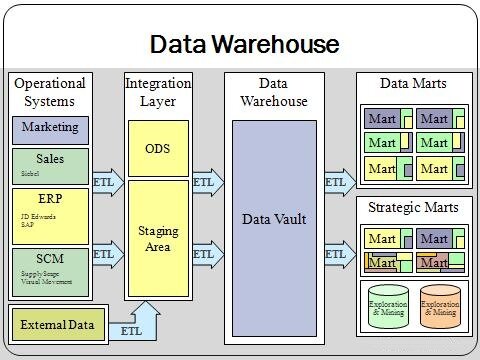
A data warehouse isn't just one giant database. It's a system with several key components working together. Data flows through a distinct process before it's ready for analysts.
-
Data Sources: This is where everything begins. Data comes from various internal systems (like CRM, ERP, sales databases) and sometimes external sources (like market trend data).
-
Staging Area: Before data enters the warehouse, it's temporarily held in a staging area. Here, it gets cleaned, transformed, and standardized. This crucial step ensures data from different sources is consistent. For example, 'USA', 'U.S.A.', and 'United States' might all be standardized to 'USA'.
-
Central Repository: This is the core of the warehouse. It's a large database where the clean, integrated, historical data is stored permanently. The data here is structured to make querying and analysis fast and efficient.
-
Data Marts: Sometimes, the central repository is so massive that it's helpful to create smaller, more focused mini-warehouses called data marts. A marketing team might have its own data mart with just marketing and sales data, while the finance team has one with financial data. This makes it easier for specific departments to find what they need without searching the entire warehouse.
Why It's Worth the Effort
Building and maintaining a data warehouse is a significant undertaking, but the benefits for business intelligence (BI) are huge.
First, it provides a single source of truth. When everyone in a company uses the same validated data, decisions are more consistent and reliable. There are no more arguments about whose spreadsheet is correct.
Second, it drastically improves query performance. Asking complex questions of an operational database can slow it down to a crawl, impacting daily business. Warehouses are built for these heavy-duty queries, delivering answers quickly.
Finally, a warehouse unlocks historical insights. By storing data over many years, businesses can analyze long-term trends, understand seasonality, and make predictions with much greater confidence. This historical perspective is something that operational databases, which often only keep current data, simply can't provide.
Ready to check your understanding of these core concepts?
What is the primary purpose of a data warehouse?
A key benefit of a data warehouse is that it provides a 'single source of truth' for an organization.
By consolidating and structuring information for analysis, data warehouses provide the solid foundation needed for effective business intelligence and data-driven decision-making.