Data Structures and Algorithms Fundamentals
Introduction to Data Structures
Organizing Information
Imagine trying to find a specific book in a library where all the books are just thrown into one giant pile. It would be a nightmare. Libraries work because they have a system: books are organized by genre, then alphabetically by author. This system makes finding what you need fast and predictable.
In the world of computing, data structures are the systems we use to organize data. They are formats for storing and managing information so we can access and modify it efficiently. Just like a library has different sections for different types of books, programming has different data structures for different kinds of tasks.
Choosing the right data structure is like choosing the right tool for a job. You wouldn't use a hammer to saw a piece of wood. Similarly, you wouldn't use a data structure designed for a simple list to manage a complex network.
Data structures are formats for the organization, management, and storage of data that enable efficient access and modification.
A Tour of Common Structures
There are many types of data structures, but most fall into two main categories: linear and non-linear. Linear structures arrange data in a sequence, like a list. Non-linear structures arrange data in a more complex, multi-level way.
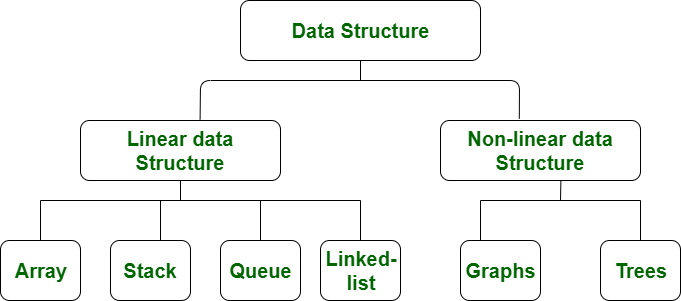
Let's look at some of the most common ones you'll encounter.
Arrays are the simplest data structure. Think of an array as a numbered list of items, like a row of mailboxes. Each item has a specific position, or index, so you can go directly to it if you know its number. This makes accessing elements very fast.
Linked Lists are sequences of items, but unlike arrays, the items aren't stored in contiguous memory locations. Instead, each item in the list contains a pointer to the next item, forming a chain. This structure makes it easy to add or remove items from the middle of the list without shifting everything else around.
Stacks follow a simple rule: Last-In, First-Out (LIFO). Imagine a stack of plates. You add a new plate to the top, and when you need one, you take the top one off. You can't take a plate from the bottom without removing all the ones on top first.
Queues are the opposite. They follow a First-In, First-Out (FIFO) rule, just like a line at the grocery store. The first person to get in line is the first person to be served.
Trees are non-linear structures that represent hierarchical relationships. Think of a family tree or the folder structure on your computer. There's a single root (the main folder), which branches out into other nodes (subfolders), which can branch out even further.
Graphs are used to model networks. They consist of a set of nodes (or vertices) and the connections (or edges) between them. A social network, where people are nodes and friendships are edges, is a perfect example of a graph.
Data Structures in the Wild
You interact with data structures every day, even if you don't realize it.
That playlist you made for your workout? It could be a linked list, making it easy to add a new song in the middle or reorder your tracks.
The "Back" button in your web browser uses a stack. Each time you visit a new page, it's added to the top of the stack. When you click "Back," the browser pops the most recent page off the top, taking you to the previous one.
When you send a document to a printer along with other people in your office, you're joining a queue. The printer handles jobs in the order they were received.
Social networks like LinkedIn or Facebook are giant graphs. They map out who is connected to whom, allowing the platform to suggest new friends or connections.
The file system on your computer is a tree. You have a root directory (like C: or /), with folders inside folders, creating a clear hierarchy.
| Data Structure | Real-World Example |
|---|---|
| Array | A list of contacts on your phone |
| Linked List | An "undo" feature in a text editor |
| Stack | The browser history's "back" button |
| Queue | A line of customers waiting for service |
| Tree | A company's organizational chart |
| Graph | Google Maps suggesting routes |
Understanding these fundamental building blocks is the first step toward writing powerful, efficient, and scalable software.
Ready to check your understanding? Let's see what you've learned.
Which data structure operates on a Last-In, First-Out (LIFO) principle?
A file system on a computer, with a root directory containing folders that in turn contain other folders, is a classic example of which data structure?
Now that you've seen the basic types of data structures, you're ready to explore how they're actually built and used to solve specific problems.