Data Structures and Algorithms Essentials
Introduction to Data Structures
What Are Data Structures?
At its core, a data structure is just a way to organize and store data in a computer so it can be used efficiently. Think about organizing books in a library. You could just throw them all in a big pile, but finding a specific book would be a nightmare. Instead, libraries use systems like the Dewey Decimal System to arrange books by subject. This makes finding what you need much faster.
Data structures do the same thing for information in your software. The way you structure your data directly impacts how quickly your program can access it, add to it, or delete from it. Choosing the right data structure for a task can be the difference between an application that feels fast and responsive and one that feels slow and clunky.
Data structures are the organizational systems for information inside a computer program.
The Basic Building Blocks
There are many different types of data structures, each with its own strengths and weaknesses. Let's look at a few of the most fundamental ones that appear in almost every piece of software.
Arrays
The simplest data structure is the array. An array is a collection of items stored in a numbered sequence, like a row of mailboxes or an egg carton. Each slot, or element, holds a single item, and you can access any item directly if you know its position number, called an index.
Arrays are incredibly fast for looking up data. If you need the fifth item in a list, you can jump directly to the fifth slot. Their main drawback is that their size is often fixed. If you create an array with 10 slots, you can't easily add an 11th item later. You'd have to create a brand new, bigger array and copy everything over.
Arrays are great for storing a fixed number of items that you'll need to look up quickly by their position.
A common use for an array is storing the days of the week. You know there will always be seven of them, and you might want to quickly access the third day (Wednesday) using its index.
Linked Lists
What if you don't know how many items you need to store, or you need to add and remove items frequently? This is where a linked list shines. A linked list is a chain of items where each item, called a node, contains a piece of data and a pointer to the next node in the chain.
Imagine a scavenger hunt. Each clue holds a piece of the treasure and tells you where to find the next clue. You can easily add a new clue anywhere in the middle by just changing the directions on the clue before it. This makes linked lists very flexible. The downside is that you can't jump directly to the fifth item. You have to start at the beginning and follow the chain, one node at a time.
A great example of a linked list is a music playlist. You can easily add, remove, and reorder songs without having to rebuild the entire list every time.
Stacks and Queues
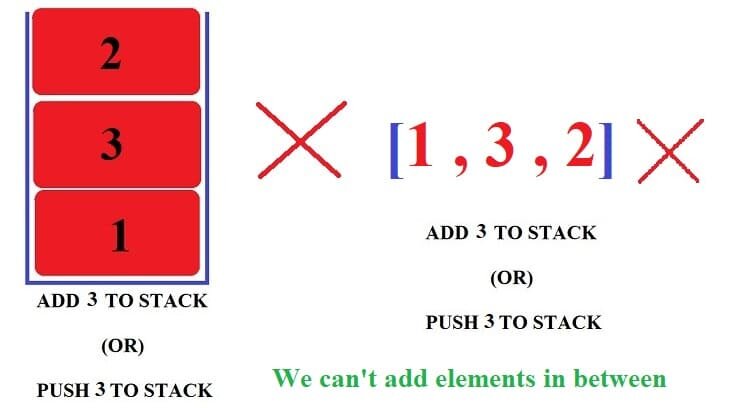
Stacks and queues are data structures defined by how you access their data. They don't let you access any item you want; instead, they enforce a specific order for adding and removing items.
Stack
noun
A data structure that follows a Last-In, First-Out (LIFO) principle. The last item added is the first one to be removed.
Think of a stack of plates. You put a new plate on top, and when you need a plate, you take one from the top. You can't easily grab one from the bottom of the stack. This "Last-In, First-Out" (LIFO) behavior is useful in many situations. Your web browser's "Back" button is a perfect example. Each time you visit a new page, it's added to the top of a stack. When you click "Back," the last page you visited is taken off the top, and you go there.
Queue
noun
A data structure that follows a First-In, First-Out (FIFO) principle. The first item added is the first one to be removed.
A queue works just like a line at a grocery store. The first person to get in line is the first person to be served. This is called "First-In, First-Out" (FIFO). Queues are ideal for managing tasks that need to be done in the order they were received, like print jobs sent to a printer or messages in a chat application.
Choosing the right data structure is a fundamental skill in programming. By understanding how these basic building blocks work, you can write code that is not only correct but also efficient and scalable.