Data Mining Mastery and Practical Applications
Professional Mining Life Cycles
From Data to Decisions
Having raw data is like having a pile of bricks. You can't build a house by just staring at them; you need a blueprint. In data analytics, that blueprint is a structured process. Without one, projects often drift, miss their goals, or solve the wrong problem entirely.
The most widely used framework is the Cross-Industry Standard Process for Data Mining, or CRISP-DM. It provides a reliable roadmap for turning data into valuable insights. It’s a cyclical process, not a linear one, meaning you’ll often revisit earlier steps as you learn more. The framework consists of six phases: Business Understanding, Data Understanding, Data Preparation, Modelling, Evaluation, and Deployment.
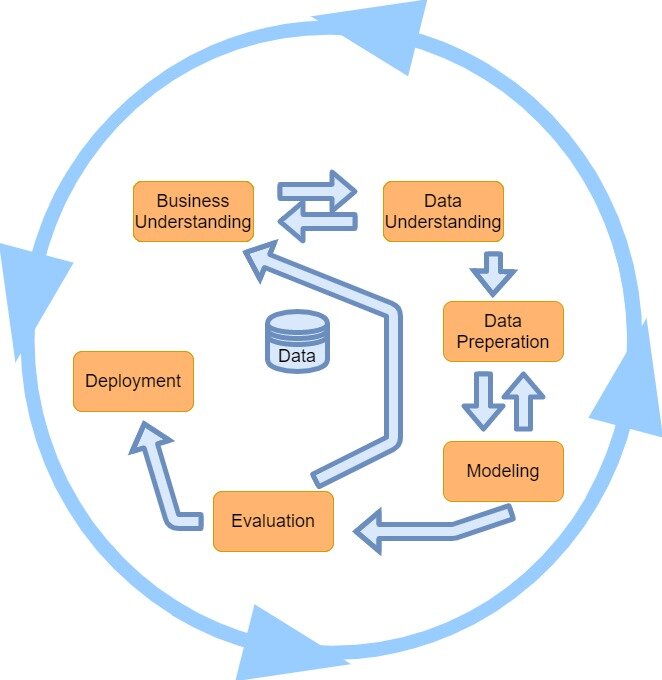
We'll focus on the first two phases here. Getting them right is the single most important factor in a successful project.
Starting with Why
Every data project begins with the Business Understanding phase. The goal here is to translate a business problem into a specific data mining task. It’s easy to get this wrong. A stakeholder might say, “We need to reduce customer churn.” That’s a valid business goal, but it's not a data mining objective.
A data analyst's job is to reframe that. A good data mining objective would be: “Build a classification model that predicts which customers are most likely to churn in the next 30 days, with an accuracy of at least 85%.” This is specific, measurable, and directly tied to the business goal.
Clearly distinguishing between business success and technical success is crucial. Business success is reducing churn by 10%. Technical success is building a model that meets the agreed-upon performance metrics. The latter should always serve the former.
This phase involves talking to people, not just looking at data. You need to understand the context. What factors are believed to cause churn? What has been tried before? What would a successful outcome look like for the business? Answering these questions sets the direction for the entire project.
Know Your Materials
Once you have a clear objective, you move to the Data Understanding phase. This is where you conduct an initial data audit. It’s your first real look at the raw materials you have to work with. The main goal is to identify potential problems early, before you invest significant time and resources.
This involves a few key activities:
- Data Collection: Gathering the initial data from various sources.
- Data Description: Documenting the datasets, including the number of records, fields, and their meanings.
- Data Exploration: Using basic statistical and visualisation tools to get a feel for the data. You might calculate summary statistics (mean, median, mode) or create simple charts to spot patterns and outliers.
- Data Quality Verification: This is a critical step. You're looking for issues that could derail your project.
| Quality Issue | Example | Potential Impact |
|---|---|---|
| Missing Values | A customer record has no 'last purchase date'. | Skews time-based analysis; may need to be removed or estimated. |
| Incorrect Data | A customer's age is listed as 150. | Invalidates statistical calculations; requires cleaning. |
| Inconsistent Formats | Dates are stored as 'DD/MM/YYYY' in one table and 'MM-DD-YY' in another. | Prevents joining tables; requires standardisation. |
| Ambiguous Fields | A column is named 'status' with values 0, 1, 2 without a data dictionary. | The data is unusable without clarification. |
The findings from this phase determine the project's feasibility. Do you have enough high-quality data to achieve the objective? If not, you may need to acquire more data or, crucially, revisit the Business Understanding phase to adjust the project's scope. It's better to realise this now than after months of work.
Plan and Iterate
The first two phases are not just about understanding; they are about planning. The output is a project plan that details the steps, required resources (people, software, time), and a clear definition of success. It also includes an assessment of risks and contingencies. What if the data quality is worse than expected? What if a key stakeholder leaves?
Most importantly, this process is iterative. The insights from Data Understanding often force you to refine your Business Understanding. This feedback loop is a core strength of CRISP-DM, preventing you from proceeding with flawed assumptions.
By investing heavily in these initial phases, you establish a solid foundation. You ensure that your technical work is aligned with real organisational needs and that you are set up for a successful outcome, not just a technically interesting one.
With a clear goal and a good grasp of your data, you're ready to move on to the next phases: Data Preparation and Modelling.
What is the primary goal of the Business Understanding phase in the CRISP-DM framework?
A manager asks you to "improve customer engagement." According to the principles of the Business Understanding phase, what is the most appropriate first step for a data analyst?