Data-Driven Presentations
Understanding Macroeconomic Indicators
Checking the Economy's Pulse
Just like a doctor checks a patient's vital signs, economists use key numbers to check the health of an economy. These are called macroeconomic indicators. They tell us whether things are growing, shrinking, or holding steady. Let's look at the four most important ones: GDP, unemployment, inflation, and interest rates.
Gross Domestic Product (GDP)
Think of Gross Domestic Product, or GDP, as a country's total economic report card. It measures the total value of all the goods and services produced within a country over a specific period, usually a quarter or a year. If a country produces more cars, more software, and more coffee than it did last year, its GDP goes up. This is called economic growth.
A rising GDP generally means the economy is healthy. Companies are hiring, people have more money to spend, and the country's overall standard of living is improving. A falling GDP suggests the opposite: the economy is contracting, which can lead to job losses and financial hardship.
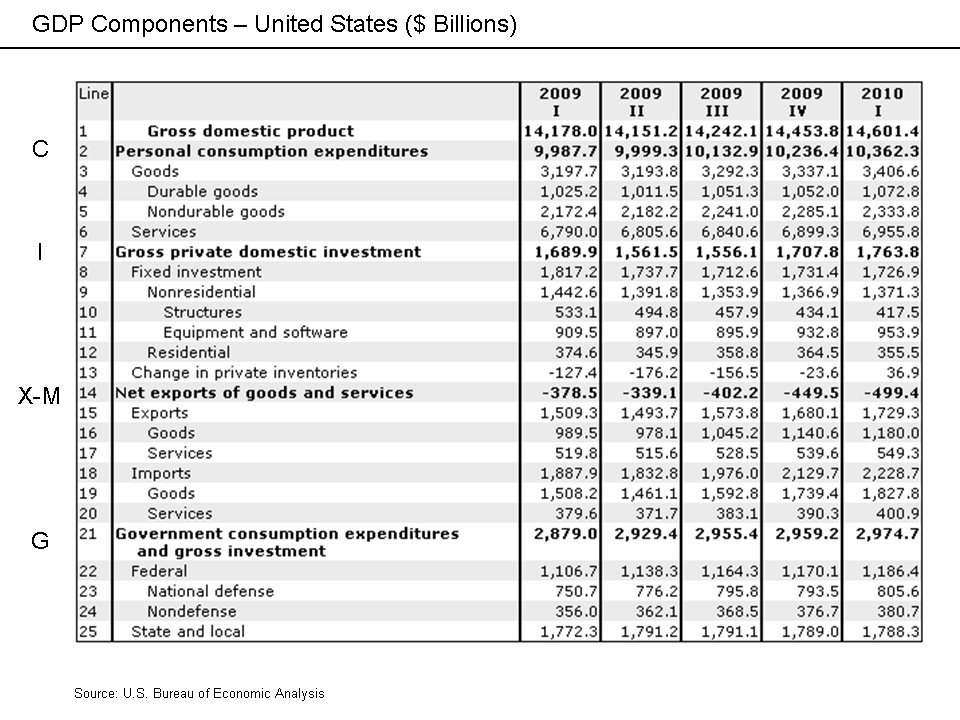
The Gross Domestic Product (GDP) is one the primary indicators used to gauge the health of a country’s economy.
GDP is calculated with a simple formula that adds up spending in four key areas:
Here's what each letter means:
- C is for Consumption: This is spending by households on things like groceries, rent, and movie tickets.
- I is for Investment: This includes business spending on new equipment and buildings, as well as people buying new homes.
- G is for Government Spending: This covers government spending on things like roads, defense, and schools.
- X - M is for Net Exports: This is the value of a country's exports (goods sold to other countries) minus the value of its imports (goods bought from other countries).
The Unemployment Rate
The unemployment rate is another critical vital sign. It measures the percentage of the labor force that is jobless but actively looking for work. It doesn't include people who aren't looking for a job, like retirees or students.
unemployment
noun
The state of being jobless but actively searching for work and available to take a job.
A low unemployment rate is usually a good sign. It means most people who want a job can find one, which boosts spending and helps the economy grow. However, if unemployment gets too low, it can sometimes lead to a shortage of workers, which can push wages and prices up.
A high unemployment rate is a sign of trouble. It means people are losing jobs, have less money to spend, and may struggle to pay their bills. This can slow down the entire economy.
The Inflation Rate
Inflation is the rate at which the overall level of prices for goods and services is rising, and as a result, the purchasing power of currency is falling. In simple terms, your money buys less than it used to.
If inflation is 3%, it means that, on average, something that cost you 💲100 a year ago would cost you 💲103 today.
A small amount of inflation (around 2%) is generally considered healthy for an economy. It encourages people to spend and invest rather than hoard cash, which keeps economic activity humming.
High inflation, however, can be dangerous. It erodes people's savings and can make it difficult for businesses to plan for the future. If prices rise too quickly, it can create economic instability. The opposite of inflation is deflation, a decrease in general price levels, which can be even more damaging as it discourages spending and can lead to a recession.
Interest Rates
An interest rate is the cost of borrowing money, expressed as a percentage of the loan amount. When you put money in a savings account, the bank pays you interest. When you take out a loan, you pay the bank interest.
The most important interest rates are often set by a country's central bank (like the Federal Reserve in the United States). These rates influence all other interest rates in the economy, from mortgages to credit cards to business loans.
Central banks use interest rates as a tool to manage the economy. Think of it like a gas pedal and a brake:
- To fight inflation (the brake): If the economy is growing too fast and prices are rising, the central bank might raise interest rates. This makes borrowing more expensive, which cools down spending and helps bring inflation under control.
- To stimulate growth (the gas): If the economy is slow and unemployment is high, the central bank might lower interest rates. This makes borrowing cheaper, which encourages businesses to invest and consumers to spend, helping the economy grow.
Continuously analyze economic indicators like GDP, employment, and interest rates to anticipate market fluctuations and adjust strategies accordingly.
These four indicators are interconnected. A change in one often causes a change in another. By watching them together, economists and policymakers can get a clear picture of what's happening in the economy and make informed decisions.
Let's check your understanding of these core concepts.
What does Gross Domestic Product (GDP) primarily measure?
Which of the following individuals would be officially counted as 'unemployed'?
Understanding these indicators is the first step to analyzing the economic world around you.