Dante and the Architecture of the Afterlife
Divine Comedy Foundations
A Journey in Three Parts
Dante Alighieri's masterpiece, the Divine Comedy, is not a single story but a trilogy. It's an epic poem divided into three distinct parts, or cantiche: Inferno (Hell), Purgatorio (Purgatory), and Paradiso (Paradise). Each section chronicles a stage of a soul's journey toward God, but the entire epic begins in the most terrifying place imaginable: Hell.
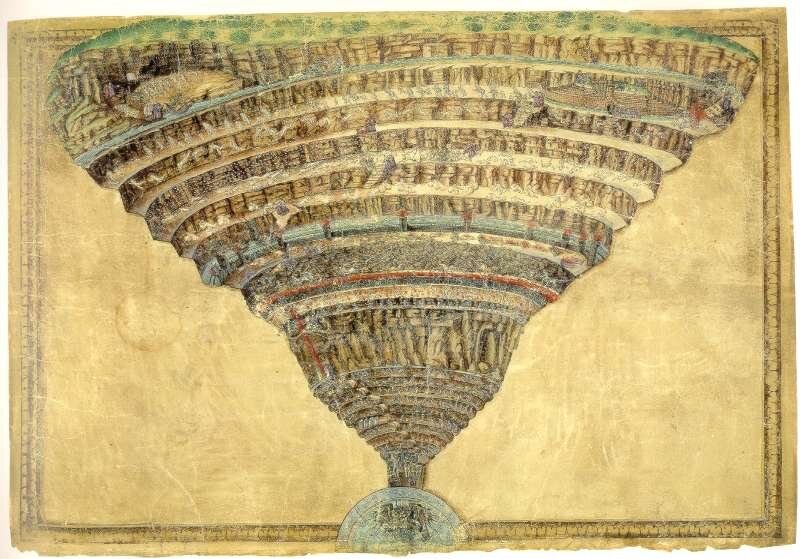
The poem's protagonist is Dante himself, presented as a pilgrim who has lost his way. The story begins on the night before Good Friday in the year 1300, when Dante, at age 35, finds himself in a dark and frightening forest.
The Divine Comedy is a long poem recounting the author’s journey among the damned in hell, guided by the Roman poet Virgil.
The Dark Wood
The journey starts in a selva oscura, a dark wood. This isn't just a literal forest; it's a powerful allegory for a life lived in sin and spiritual confusion. Dante has strayed from the righteous path, and the woods represent his moral and existential crisis. He is lost, afraid, and unable to find his way back to the light.
dark wood
As he tries to climb a sunlit mountain, symbolizing a path to salvation, his way is blocked by three menacing beasts. Each animal represents a different type of sin that prevents humans from reaching God.
- The Leopard: Symbolizes lust and fraud. It is nimble and beautiful, representing sins that are tempting and deceptive.
- The Lion: Represents pride and violence. Its roaring presence is an embodiment of ambition and unchecked arrogance.
- The She-Wolf: The most terrifying of the three, she represents avarice and incontinence—a boundless, insatiable greed that consumes everything.
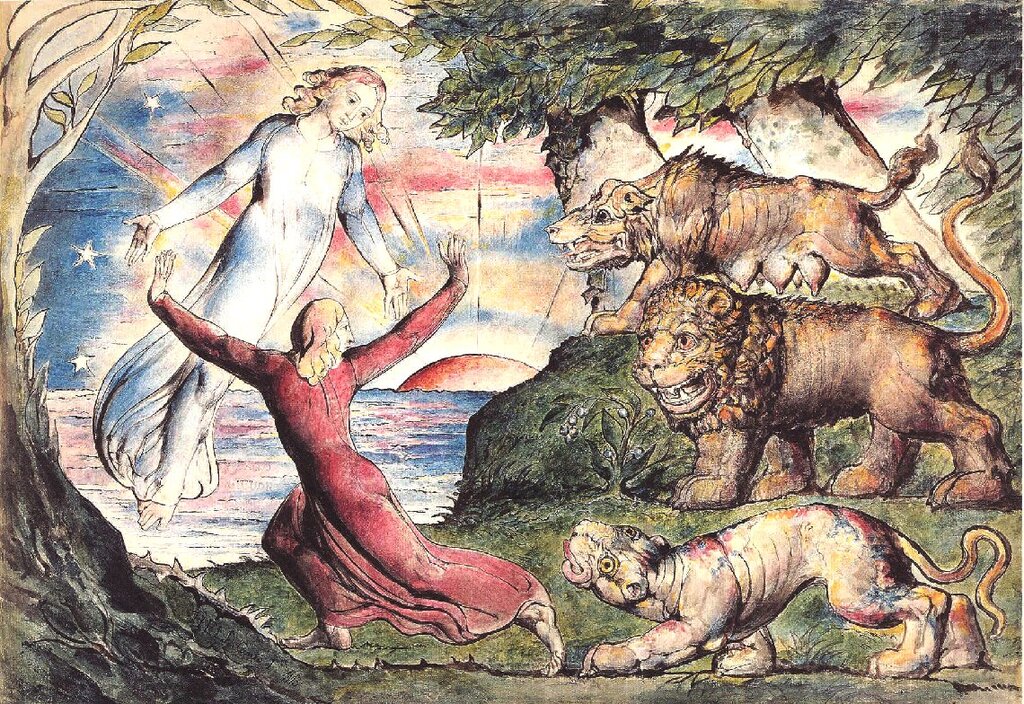
Trapped and despairing, Dante is about to be driven back into the woods when a figure appears. It is the ghost of the Roman poet Virgil, author of the epic Aeneid. Virgil has been sent by Beatrice, Dante's deceased love, to guide him on a different path to salvation—one that leads directly through Hell.
Reason, Exile, and Allegory
Virgil is more than just a guide; he is the personification of human reason. As a pagan who lived before Christ, he represents the pinnacle of human wisdom and virtue achievable without divine grace. He can lead Dante through the logical consequences of sin in Hell and the process of purification in Purgatory, but he cannot enter Paradise. Reason alone can understand sin, but it takes faith to reach God.
Virgil's presence establishes a key theme: the Divine Comedy bridges the classical epic tradition of poets like Homer and Virgil with a distinctly Christian worldview.
The poem is also deeply personal. Dante wrote much of it while in exile from his home city of Florence, a victim of bitter political feuds. This sense of personal injustice and loss fuels the narrative. Throughout Inferno, he places many of his real-life political enemies in the various circles of Hell, using the poem as a vehicle for both divine justice and personal retribution.
Allegory
noun
A story, poem, or picture that can be interpreted to reveal a hidden meaning, typically a moral or political one.
By casting himself as the protagonist and Virgil as his guide, Dante transformed the classical epic—a story of heroes and gods—into a Christian allegory about the soul's journey. It's a tale where mythological figures coexist with Catholic saints, and ancient punishments are re-imagined as the logical outcomes of specific sins. This synthesis of classical and Christian thought was revolutionary, setting the stage for the rest of his monumental journey.
Now, let's test your understanding of these foundational concepts.
The Divine Comedy is divided into three parts, or cantiche. What is the correct order of these parts, following Dante's journey?
At the beginning of the poem, Dante is lost in a selva oscura (dark wood). What does this setting allegorically represent?
With these foundations in place, you are ready to follow Dante and Virgil as they pass through the gates of Hell.