Cybersecurity Fundamentals
Network Security Basics
The Blueprint of Connection
Every network, from the one in your home to the global internet, has a structure. Think of it like the layout of a city. Some cities have a simple grid system, while others have winding roads and cul-de-sacs. The way a network is arranged is called its topology.
This layout dictates how data flows between devices. There are several common designs, each with its own strengths and weaknesses. A bus topology, for instance, is like a single main street where all the houses (devices) are connected. A star topology is more like a suburb with a central roundabout connecting all the streets. Data has to pass through the center to get anywhere.
Understanding a network’s architecture is the first step in securing it. If you don't know the layout of the city, you can't effectively place police officers to keep it safe.
The Language of Networks
For devices on a network to understand each other, they need a common language. In networking, these languages are called protocols. They are sets of rules that govern how data is formatted, transmitted, and received.
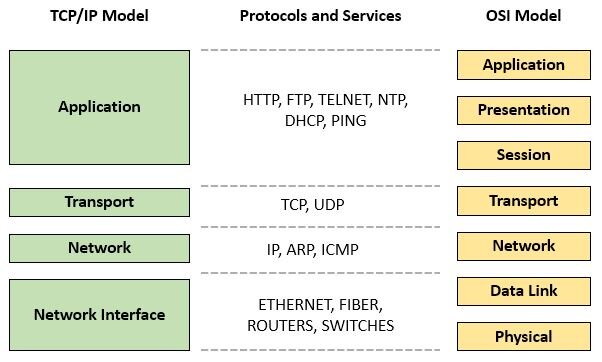
The most fundamental protocol suite is TCP/IP (Transmission Control Protocol/Internet Protocol). Think of it as the postal service for the internet. IP is responsible for addressing the envelopes so they get to the right computer, while TCP makes sure all the pieces of the letter arrive in the correct order and without any pages missing. They form the backbone of most internet communication.
On top of TCP/IP, we use other protocols for specific tasks. When you browse a website, your computer is using HTTP (Hypertext Transfer Protocol) to request the webpage from a server. When you upload photos to a cloud service, you might be using FTP (File Transfer Protocol), which is designed specifically for moving files.
| Protocol | Full Name | Primary Use |
|---|---|---|
| TCP/IP | Transmission Control/Internet Protocol | Core communication for the internet |
| HTTP | Hypertext Transfer Protocol | Loading websites in a browser |
| FTP | File Transfer Protocol | Uploading and downloading files |
Guarding the Gates
So why do we care about network layouts and languages? Because protecting a network means managing who has access and ensuring data stays safe as it travels. This brings us to the core principles of network security. These principles are often called the CIA Triad.
Confidentiality: Keeping data secret. Only authorized users should be able to see the information.
Integrity: Keeping data accurate. The information shouldn't be altered in transit by someone who shouldn't be touching it.
Availability: Ensuring data is accessible. Authorized users should be able to get to the data when they need it.
Every security measure, from passwords to firewalls, is designed to support one or more of these principles. When you use a password to log into your email, that's enforcing confidentiality. When a bank ensures that your account balance doesn't randomly change, that's maintaining integrity. And when a website is protected from attacks that would take it offline, that's preserving availability.
By understanding the architecture and protocols of a network, security professionals can identify weak spots and implement controls to uphold these principles. This is the fundamental role of network security: to protect the flow of data and keep digital resources safe, accurate, and ready for use.
Time to check your understanding.
What is network topology?
In the analogy comparing TCP/IP to a postal service, what is the role of IP (Internet Protocol)?
Knowing these basics provides a strong foundation for understanding the more complex challenges of cybersecurity.